answer.
Ask question
Login Signup
Ask question
All categories
  • English
  • Mathematics
  • Social Studies
  • Business
  • History
  • Health
  • Geography
  • Biology
  • Physics
  • Chemistry
  • Computers and Technology
  • Arts
  • World Languages
  • Spanish
  • French
  • German
  • Advanced Placement (AP)
  • SAT
  • Medicine
  • Law
  • Engineering
padilas [110]
2 years ago
3

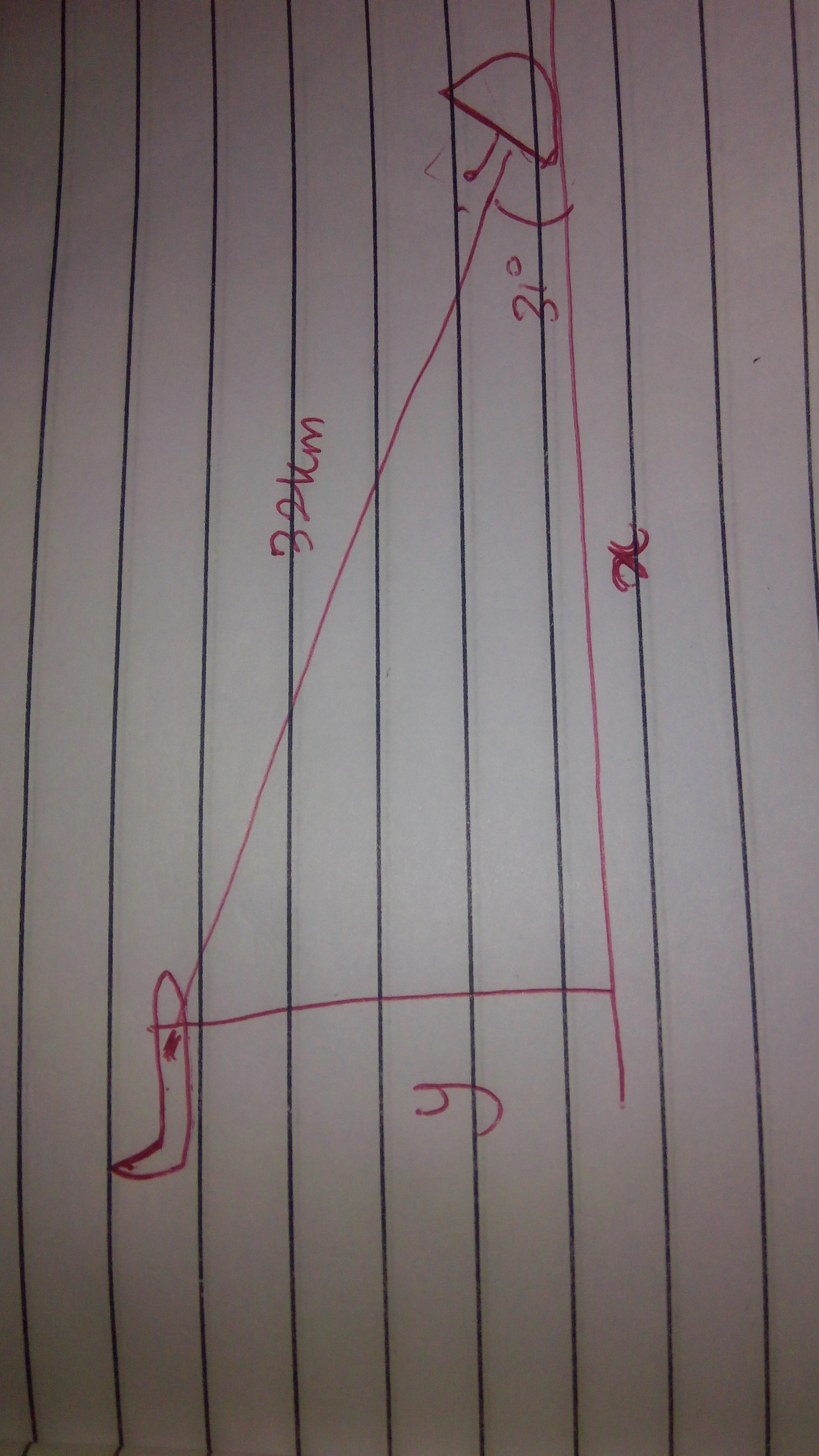
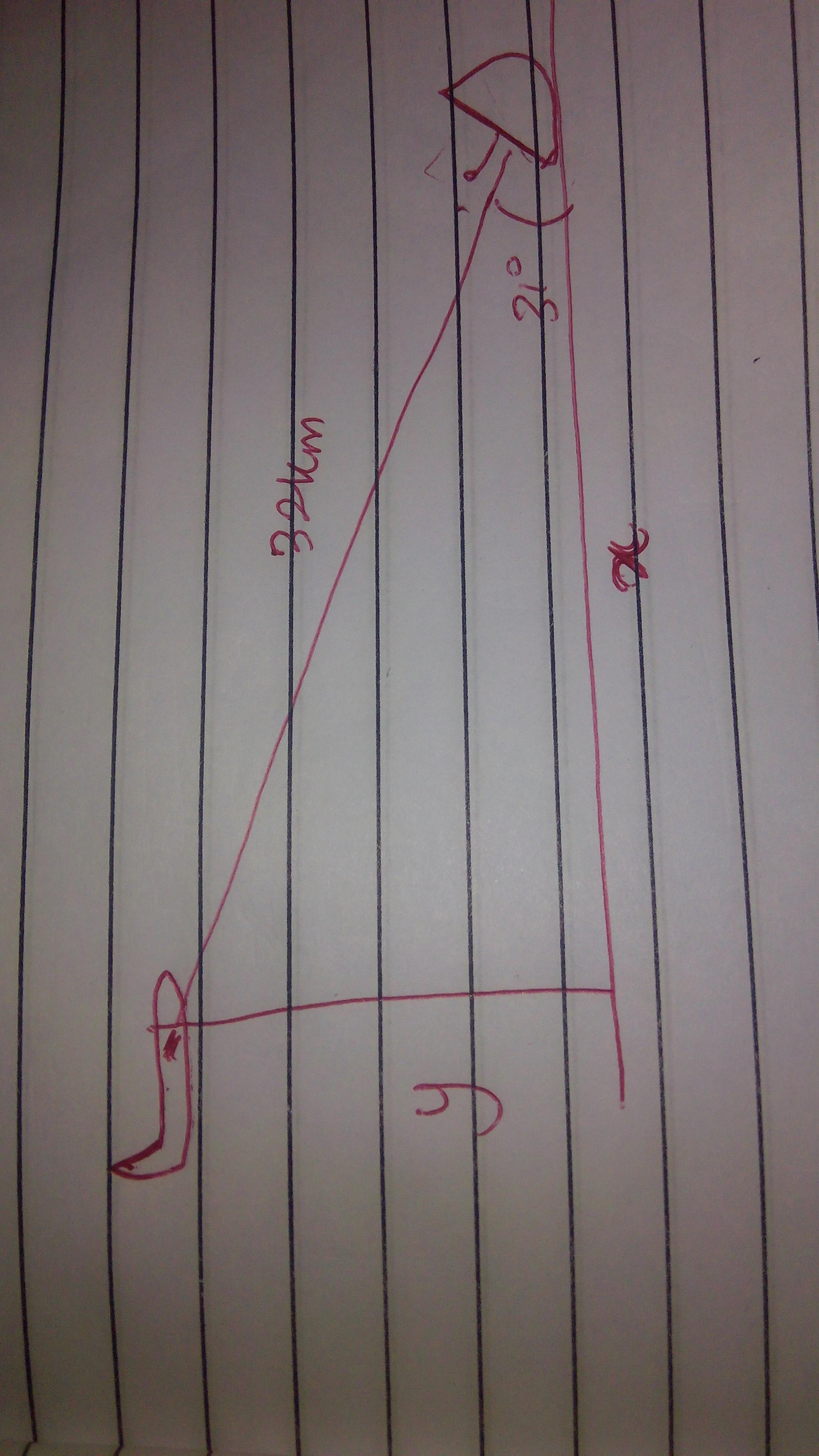
A plane flies towards a ground-based radar dish. Radar locates the plane at a distance D = 32 km from the dish, at an angle θ =

31° above horizontal.Part (a) What is the jet's horizontal distance, DH in meters, from the radar dish? DH 11114.5 DH = 1 1 110 V Correct! 33% Part (b) What is the jet's vertical distance, Dv in meters, above the radar dish?

Physics
1 answer:
jek_recluse [69]2 years ago
4 0

Answer:

A) Horizontal distance, DH= 27430 m

B) Vertical distance, DV= 16480 m

Explanation:

A) Horizontal distance, DH:

From the diagram, using SOHCAHTOA:

cosθ = adj/hyp

cos(31) = x/32

=> x = 32 * cos(31)

x = 27.43 km = 27430 m

Therefore, DH = 27430 m

B) VERTICAL DISTANCE, DV:

Using SOHCAHTOA:

sinθ = opp/hyp

sin(31) = x/32

= 32 * sin(31)

y = 16.48 km = 16480 m

Therefore, DV = 16480 m

You might be interested in
As the drawing illustrates, a siren can be made by blowing a jet of air through 20 equally spaced holes in a rotating disk. The
Aneli [31]

Answer:

ω = 630.2663 = 630[rad/s]

Explanation:

Solution:

- We can tackle this question by simple direct proportion relation between angular speed for the disk to rotate a cycle that constitutes 20 holes. We will use direct relation with number of holes per cycle to compute the revolution per seconds i.e frequency of speed f.

                                  1rev(20 hole) -> 20(cycle)/rev  

                                        2006.2(cycle) -> f ?  

                              f = 2006.2/20 = 100.31rev at second  

- The relation between angular frequency and angular speed is given by:

                                 ω = 2πf

                                 ω = 2*3.14*100.31

                                 ω = 630.2663 = 630[rad/s]

4 0
2 years ago
A cart is driven by a large propeller or fan, which can accelerate or decelerate the cart. The cart starts out at the position x
mash [69]

Answer:

The acceleration of the cart is 1.0 m\s^2 in the negative direction.

Explanation:

Using the equation of motion:

Vf^2 = Vi^2 + 2*a*x

2*a*x = Vf^2 - Vi^2

a = (Vf^2 - Vi^2)/ 2*x

Where Vf is the final velocity of the cart, Vi is the initial velocity of the cart, a the acceleration of the cart and x the displacement of the cart.

Let x = Xf -Xi

Where Xf is the final position of the cart and Xi the initial position of the cart.

x = 12.5 - 0

x = 12.5

The cart comes to a stop before changing direction

Vf = 0 m/s

a = (0^2 - 5^2)/ 2*12.5

a = - 1 m/s^2

The cart is decelerating

Therefore the acceleration of the cart is 1.0 m\s^2 in the negative direction.

5 0
2 years ago
A charged wire of negligible thickness has length 2L units and has a linear charge density λ. Consider the electric field E-vect
Stels [109]

Answer:

E=2K\lambda d\dfrac{L }{d^2\sqrt{L^2+d^2}}

Explanation:

Given that

Length= 2L

Linear charge density=λ

Distance= d

K=1/(4πε)

The electric field at point P

E=2K\int_{0}^{L}\dfrac{\lambda }{r^2}dx\ sin\theta

sin\theta =\dfrac{d}{\sqrt{d^2+x^2}}

r^2=d^2+x^2

So

E=2K\lambda d\int_{0}^{L}\dfrac{dx }{(x^2+d^2)^{\frac{3}{2}}}

Now by integrating above equation

E=2K\lambda d\dfrac{L }{d^2\sqrt{L^2+d^2}}

4 0
2 years ago
A tube with a cap on one end, but open at the other end, produces a standing wave whose fundamental frequency is 130.8 Hz. The s
Angelina_Jolie [31]

Answer:

A. 261.6 hz.

B. 0.656 m.

Explanation:

A.

When yhe tube is open at one end and closed at the other,

F1 = V/4*L

Where,

F1 = fundamental frequency

V = velocity

L = length of the tube

When the tube is open at both ends,

F'1 = V/2*L

Where

F'1 = the new fundamental frequency

Therefore,

V/2*L x V/4*L

F'1 = 2 * F1

= 2 * 130.8

= 261.6 hz.

B.

F1 = V/4*L

Or

F'1 = V/2*L

Given:

V = 343 m/s

F1 = 130.8

L = 343/(4 * 130.8)

= 0.656 m.

8 0
2 years ago
A disk is free to rotate about an axis perpendicular to the disk through its center. If the disk starts from rest and accelerate
garri49 [273]

Answer:

(C) 16 radians

Explanation:

The angular displacement is given by the following equation:

\Delta \theta=\omega_i t+\frac{1}{2}\alpha t^2

Here

\Delta \theta Is the angular displacement of the body at the indicated time (t).

\omega_i Is the angular velocity of the body at the initial moment.

\alpha Is the angular acceleration of the body.

The disk starts from rest, so \omega_i=0

Replacing the given values:

\Delta \theta=\frac{1}{2}(2\frac{radians}{s^2})(4s)^2\\\Delta \theta=16 radians

3 0
2 years ago
Other questions:
  • Janelle wants to buy some strings of decorative lights for her home. She is trying to decide between two strings of lights that
    11·2 answers
  • It takes 3 minutes to make toast in a 1500 watt toaster. Calculate how much work is done by the toaster.
    5·2 answers
  • A 5.00 kilogram mass is traveling at 100 meters per second. Determine the speed of the mass after an impulse of 30 Newton * seco
    12·2 answers
  • Describe the energy transformations that occur from the time a skydiver jumps out of a plane until landing on the ground.
    13·2 answers
  • What's the diameter of a dish antenna that will receive 10−20W of power from Voyager at this time? Assume that the radio transmi
    14·1 answer
  • A solar heated house loses about 5.4 × 10⁷ cal through its outer surfaces on a typical 24-h winter day.
    13·1 answer
  • Finally, you are ready to answer the main question. Cheetahs, the fastest of the great cats, can reach 50.0 miles/hourmiles/hour
    8·1 answer
  • At its lowest setting a centrifuge rotates with an angular speed of ω1 = 250 rad/s. When it is switched to the next higher setti
    11·1 answer
  • What is the net force acting on the buggy?<br> N<br> The net force is pointing to the...
    15·2 answers
  • Nuclear waste disposal is one of the largest issues with nuclear power. Cesium-137 is one of the high level waste products in an
    7·1 answer
Add answer
Login
Not registered? Fast signup
Signup
Login Signup
Ask question!