answer.
Ask question
Login Signup
Ask question
All categories
  • English
  • Mathematics
  • Social Studies
  • Business
  • History
  • Health
  • Geography
  • Biology
  • Physics
  • Chemistry
  • Computers and Technology
  • Arts
  • World Languages
  • Spanish
  • French
  • German
  • Advanced Placement (AP)
  • SAT
  • Medicine
  • Law
  • Engineering
bulgar [2K]
2 years ago
7

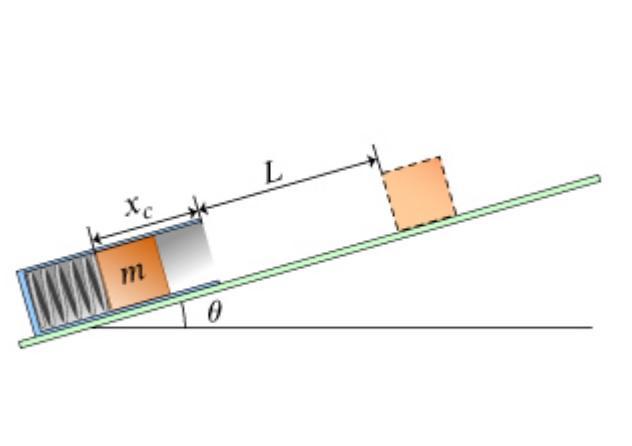
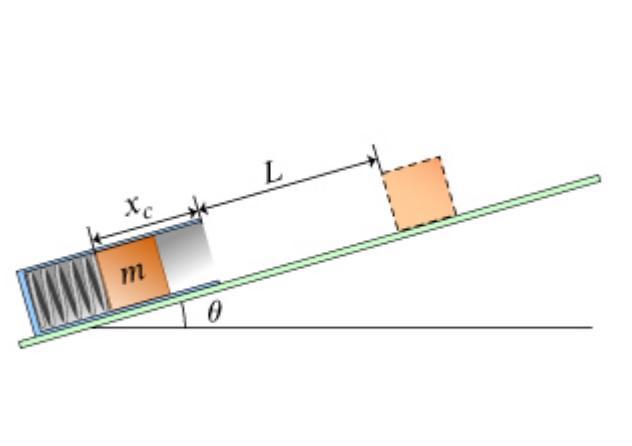
Find L, the distance traveled along the incline by the block after it exits the gun. Ignore friction when the block is inside th

e gun. Also, assume that the uncompressed spring is just at the top of the gun (i.e., the block moves a distance xc while inside of the gun). Use g for the magnitude of acceleration due to gravity. Express the distance L in terms of xc, k, m, g, μ, and θ.

Physics
1 answer:
LenaWriter [7]2 years ago
8 0

Answer:

L = [0.5*k*(Xc)^2 - m*g*Xc*sin(θ)] / [m*g*μ*cos(θ) + m*g* sin(θ)]

Explanation:

To understand this problem we must analyze well the description of this problem, that is why we went to google, to look for a clearer description of this as well as the question.

In the attached image we find, a graphical description of the problem, very important to be able to perform an analysis.

On the Internet was founded the widest description and the same for the question.

<u>Full description:</u>

A block of mass m is placed in a smooth-bored spring gun at the bottom of the incline so that it compresses the spring by an  amount Xc. The spring has spring constant k. The incline makes an angle θ with the horizontal and the coefficient of kinetic

friction between the block and the incline is μ. The block is released, exits the muzzle of the gun, and slides up an incline a  total distance L.

<u>Question</u>

Find L, the distance traveled along the incline by the block after it exits the gun. Ignore friction when the block is inside  the gun. Also, assume that the uncompressed spring is just at the top of the gun (i.e., the block moves a distance Xc while  inside of the gun). Use g for the magnitude of acceleration due to gravity.

Now we begin to analyze the problem with the data they give us, so we can find the distance L in terms of Xc, k, m, g, μ, and θ.

We will use the theorem of work and energy conservation, which tells us that the initial mechanical energy plus the work done on the body must be equal to the final mechanical energy.

Therefore:

E_{1}+W_{1-2}=E_{2}

where

E1 = initial energy [J]

W1-2 = trabajo realizado [J]

E2 = final energy [J]

We will use as a reference point of potential energy, at the moment the mass m is compressed before leaving the gun, ie at this point the potential energy is zero.

E_{1}=E_{pot}+E_{kin}+E_{elas}\\E_{1}=0+0+E_{elas}

We notice that the kinetic energy at first is equal to zero because there is no movement.

Therefore:

E_{1}=E_{elas}\\E_{1}=\frac{1}{2} *k*x_{c}^{2}

In order to find the work done by friction we must perform a scheme of the block moving on the inclined plane, with the forces acting in the direction of orientation of the plane. In another attached image we can see this diagram.

We know that the friction force is equal to the product of normal force by the coefficient of friction.

f = N * μ

where:

f = friction force [N]

N = normal force [N]

μ = friction coefficient

We then perform a sum of forces equal to zero on the Y axis, since there is no movement on the Y axis.

-m*g*cos(θ) + N = 0

N = m*g*cos(θ)

Therefore:

f = m*g*cos(θ)*μ

Here we must understand that the friction force is doing work in the opposite direction to the movement, therefore the work is negative.

W1-2 = - L*m*g*μ*cos(θ)

Energy at the end, we can easily deduce to interpret the block when it reaches the maximum position, has traveled the distances L & Xc in the inclined plane, at this point, its speed is zero, therefore there is no kinetic energy and no interaction of the spring, therefore its elastic energy is zero. The only energy that exists is the potential, and we must find the height in function of the rectangle triangle that forms.

E2 = m*g* (Xc + L)*sin(θ)

Now we organize the terms:

0.5*k*(Xc)^2 - L*m*g*μ*cos(θ) = m*g* (Xc + L)*sin(θ)

Clearing the variable L, we have:

0.5*k*(Xc)^2 - L*m*g*μ*cos(θ) = m*g*Xc*sin(θ)+ m*g*L*sin(θ)

0.5*k*(Xc)^2 - m*g*Xc*sin(θ) =  L*m*g*μ*cos(θ) + m*g*L*sin(θ)

L = [0.5*k*(Xc)^2 - m*g*Xc*sin(θ)] / [m*g*μ*cos(θ) + m*g* sin(θ)]
You might be interested in
Mr. Smith is designing a race where velocity will be measured. Which course would allow velocity to accurately get a winner?
liraira [26]
I’m not completely sure but most likely is is the 10 mile bike ride, I hope I can help! (:
6 0
2 years ago
Read 2 more answers
A force f = bx 3 acts in the x direction, where the value of b is 3.7 n/m3. how much work is done by this force in moving an obj
Elodia [21]
The answer would be 21.6 but rounded up it would be 22J.
8 0
2 years ago
You are using a lightweight rope to pull a sled along level ground. The sled weighs 485 N, the coefficient of kinetic friction b
Bogdan [553]

Answer:

N=459.01N

Explanation:

According to Newton's first law:

N+F_y-W=0

The component of the force on the y-axis can be obtained through the Pythagorean Theorem. This is because the components are the cathetus of a right triangle and its hypotenuse is the magnitude of the force:

sin12^\circ=\frac{F_y}{F}\\F_y=Fsin12^\circ

Replacing and solving for N:

N=W-Fsin12^\circ\\N=485N-(125N)sin12^\circ\\N=459.01N

5 0
2 years ago
The constant pressure molar heat capacity, C_{p,m}C p,m ​ , of nitrogen gas, N_2N 2 ​ , is 29.125\text{ J K}^{-1}\text{ mol}^{-1
antoniya [11.8K]

Answer:

Explanation:

Constant pressure molar heat capacity Cp = 29.125 J /K.mol

If Cv be constant volume molar heat capacity

Cp - Cv = R

Cv = Cp - R

= 29.125 - 8.314 J

= 20.811 J

change in internal energy = n x Cv x Δ T

n is number of moles , Cv is molar heat capacity at constant volume ,  Δ T is change in temperature

Putting the values

= 20 x 20.811 x 15

= 6243.3 J.

3 0
2 years ago
Two resistors of 5.0 and 9.0 ohm are connected in parallel. A 4.0 ohm resistor is then connected in series with the parallel com
rewona [7]

Answer:

I1 = 0.772 A

Explanation:

<u>Given</u>: R1 = 5.0 ohm, R2 = 9.0 ohm, R3 = 4.0 ohm, V = 6.0 Volts

<u>To find</u>:  current I = ? A

<u>Solution: </u>

Ohm's law  V= I R

⇒   I = V / R

In order to find R (total) we first find R (p) fro parallel combination. so

1 / R (p) = 1 / R1  + 1/ R2          ∴(P) stand for parallel

R (p) = R1R2 / ( R1 + R2)

R (p) = (5.0 × 9.0) / (5.0 + 9.0)

R (p) = 3.214 ohm

Now R (total) = R (p) + R3     (as R3 is connected in series)

R (total) = 3.214 ohm + 4.0 Ohm

R (total) = 7.214 ohm

now I (total) = 7.214 ohm / 6.0 Volts

I (total) = 1.202 A

This the total current supplied by 6 volts battery.

as voltage drop across R (p) = V = R (p) × I (total)

V (p) = 3.214 ohm × 1.202 A  = 3.864 volts

Now current through 5 ohms resister  is I1 = V (P) / R1

I1 = 3.864 volts / 5 ohm

I1 = 0.772 A

3 0
2 years ago
Other questions:
  • After watching a video about submarines, Jamil wants to learn more about the ocean. which question could be answered through sci
    9·1 answer
  • Rana writes a summary about a mass on a spring in simple harmonic motion as it moves upward from the equilibrium position toward
    9·2 answers
  • A 60.0 kg object is moving east at 8.00 m/s, and then slows down to 4.00 m/s. How much work was done?
    8·2 answers
  • A child is riding a bike at a speed of 6m/s with a total kinetic energy of 1224J. If the mass of the child is 30kg, what is the
    8·1 answer
  • Tom has built a large slingshot, but it is not working quite right. He thinks he can model the slingshot like an ideal spring wi
    15·1 answer
  • On a horizontal, linear track lies a cart that has a fan attached to it. The mass of the cart plus fan is 364 g. The cart is pos
    15·2 answers
  • A uniformly dense solid disk with a mass of 4 kg and a radius of 2 m is free to rotate around an axis that passes through the ce
    6·2 answers
  • The figure above represents a stick of uniform density that is attached to a pivot at the right end and has equally spaced marks
    13·1 answer
  • What tangential speed, v, must the bob have so that it moves in a horizontal circle with the string always making an angle θ fro
    8·1 answer
  • Athlete mesert defar runs at 10m/s. how long will it take her to go 1 minute ​
    5·1 answer
Add answer
Login
Not registered? Fast signup
Signup
Login Signup
Ask question!