answer.
Ask question
Login Signup
Ask question
All categories
  • English
  • Mathematics
  • Social Studies
  • Business
  • History
  • Health
  • Geography
  • Biology
  • Physics
  • Chemistry
  • Computers and Technology
  • Arts
  • World Languages
  • Spanish
  • French
  • German
  • Advanced Placement (AP)
  • SAT
  • Medicine
  • Law
  • Engineering
RideAnS [48]
2 years ago
3

The student dissolves the entire impure sample of CuSO4(s) in enough distilled water to make 100.ML of solution. Then the studen

t measures the absorbance of the solution and observes that it is 0.30 . Determine the concentration of CuSO4(aq) in the solution.

Chemistry
1 answer:
valkas [14]2 years ago
3 0

Answer:

Here's what I get  

Explanation:

I assume you prepared a calibration curve — a plot of the absorbance vs the concentrations of known solutions.

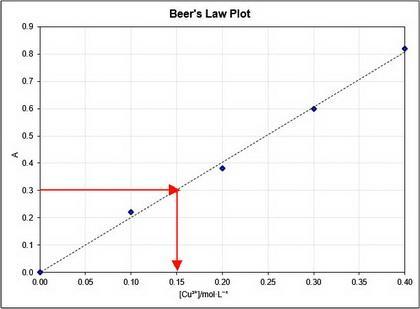
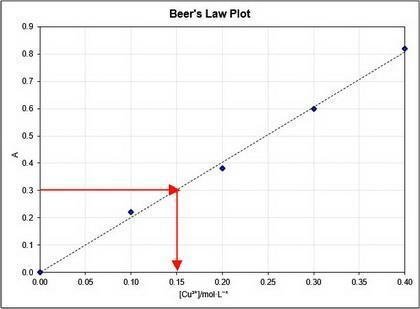
It probably looked like the one below.

You drew the best straight line that went as close as possible to all the points without necessarily going through any of them.

Now you have a CuSO₄ solution with an absorbance of 0.30.

You start at 0.30 on the vertical axis and draw a line horizontally until it hits your best-fit line.

Then you draw a vertical line to the horizontal axis and read the corresponding concentration.

It hits the axis at 0.15 mol·L⁻¹.

You would say that the concentration of CuSO₄ is 0.15 mol·L⁻¹.

You might be interested in
What are the answers to these questions
Virty [35]

Answer:

Explanation:

So basically it just asking you question about that surtain subject .

5 0
2 years ago
What is the reaction energy Q of this reaction? Use c2=931.5MeV/u. Express your answer in millions of electron volts to three si
emmasim [6.3K]

Answer:

Energy= 2.7758 × 10^-11 J ;

71.112×10^-6 kJ.

Mass defect in Kilogram= 3.0885×10^-28 kg.

That is; 3.1×10^-28 kg(to two significant figure).

Explanation:

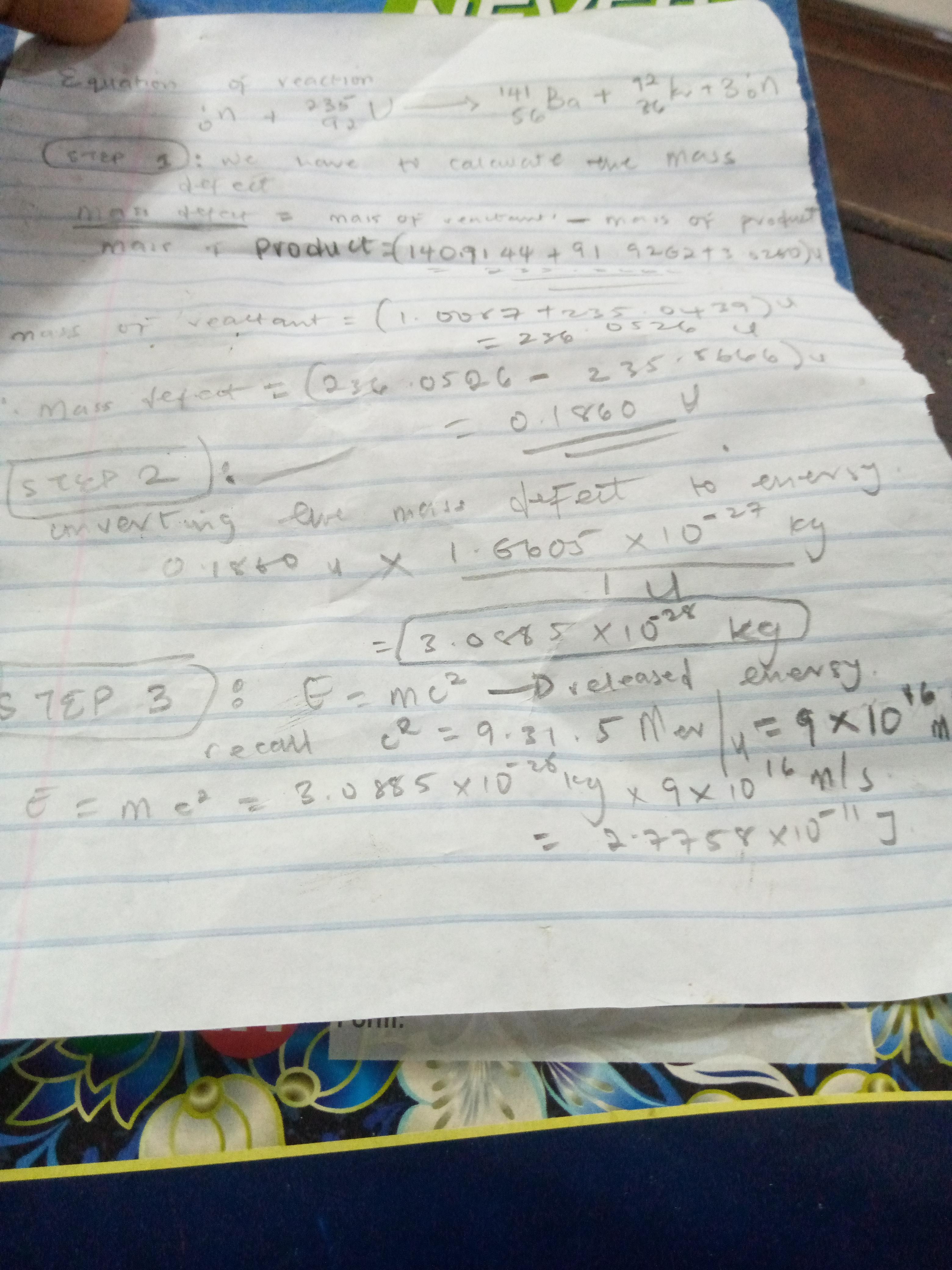
(Note: Check equation of reaction in the attached file/picture).

STEP ONE: we have to calculate the Mass defect.

Mass defect= Mass of reactants -- Mass of products.

Mass of the products: (140.9144+91.9262+3.060) u.

= 235.8666 u.

Mass of reactants: (1.0087+235.0439) u= 236.0526 u.

Therefore, the Mass defect= (236.0526 -- 235.8666) u

= 0.1860 u.

STEP TWO: Converting the Mass defect to energy;

0.18860 × 1.6605 × 10^27 kg

= 3.0885× 10^-28 kg

STEP THREE: Calculating energy released . Recall(from the question) c^2= 931.5 Mev/u. This is also equals to 9×10^16 m/s.

E=Mc^2.

Where E= energy released, c= speed of light, M= Mass.

Slotting in the values;

E= 3.0885×10^-28 kg × 9×10^16 m/s.

E=2.7758 × 10^-11 J.

Know that;( 1g of uranium × 1 mol of uranium ÷ 235.0439 g of uranium) × (6.002×10^23 atom of uranium/ 1 mol of uranium) × 2.7758× 10^-11.

=7.1112×10^-10 J

= 71.112×10^6 kJ.

3 0
2 years ago
Grapefruit juice is approximately ph 3, and tomato juice is approximately ph 4. a glass of grapefruit juice contains _____ h+ as
Elden [556K]
<span>Grapefruit juice is approximately pH 3, andtomato juice is approximately pH 4. A glass of grapefruit juice contains _3_ H+ as a glass of tomato juice.</span><span>
</span>
6 0
2 years ago
The melting point of water is 0°C at 1 atm pressure because under these conditions:
Tems11 [23]

Answer:

The correct answer is option C, that is, ΔS and ΔSsurr for the process H2O (s) ⇒ H2O(l) are equal in magnitude and opposite in sign.

Explanation:

The temperature at which solid state of water get transformed into liquid state is termed as the melting point of 0 °C. It can be shown by the reaction:  

H2O (s) ⇒ H2O (l)

The degree of randomness of a molecule is known as entropy. With the transformation of ice into liquid state, there is an increase in randomness. Thus, the value of entropy becomes positive as shown:  

Entropy change (ΔSsys) = ΔSproduct - ΔSreactant

= (69.9 - 47.89) J mol/K

= 22.0 J mol/K

Therefore, the value of entropy change is positive.  

Now the value of entropy for surrounding ΔSsurr will be,  

ΔSsurr = -ΔHfusion/T  

= -6012 j/mol/273

= -22.0 J/molK

Hence, the value of ΔSsurr and ΔSsys exhibit same magnitude with opposite sign.  

8 0
2 years ago
A student performed an analysis of a sample for its calcium content and obtained the following results:
sweet-ann [11.9K]

Answer:

14.9075 g, 28.67%, 0.11%

Explanation:

The mean concentration of calcium = summation x / frequency

= ( 14.92 + 1491 + 14.88 + 14.92 ) /4 = 14.9075 g

Standard deviation = √(summation (x - μ)² /n) = √ ( ((14.92 - 14.9075)² +(14.91 - 14.9075)² + (14.88 - 14.9075)² + ( 14.92 - 14.9075)²) / 4) = 0.0164

b)  percent error = abs(14.9075 - 20.90) / 20.90 × 100 = 28.67%

c) relative standard deviation = standard deviation / mean × 100 = 0.0164 /  14.9075 × 100 = 0.11%

d) The accuracy of the measure is the measurement compared to the actual which according to the standard set by the instructor (5%error) is not very accurate because the percent error is high (28.67%) while the relative standard deviation is quite low ( 0.11%) which means the measurement precision is very high.

The student will have to redo the experiment because the experiment was not too accurate since the percent error is way higher than the set value (5%) although the precision was high.

5 0
2 years ago
Other questions:
  • If the coefficient 2 is placed in front of the product tetraiodine nonaoxide (I4O9), then, how many atoms of each element must b
    14·1 answer
  • A covalent chemical bond is one in which _____. a covalent chemical bond is one in which _____. outer-shell electrons of two ato
    11·2 answers
  • The half-cell is a chamber in the voltaic cell where one half-cell is the site of the oxidation reaction and the other half-cell
    10·1 answer
  • penicillin. an important antibiotic (antibacterial agent), was discovered accidentally by the scottish bacteriologist alexander
    15·1 answer
  • A student is given a sample of a blue copper sulfate hydrate. He weighs the sample in a dry covered porcelain crucible and got a
    11·1 answer
  • Calculate the heat of reaction, ΔH°rxn, for overall reaction for the production of methane, CH4.
    10·1 answer
  • The infrared spectrum above represents the absorption of certain wavelengths of radiation by molecules of CO2. Which of the foll
    9·1 answer
  • Select the correct answer from each drop-down menu.
    11·2 answers
  • if 5.50 mol of calcium carbide (CaC 2 ) reacts with an excess of water, how many moles of acetylene (C 2 H 2 ) , a gas used in w
    12·1 answer
  • Calculate the number of grams of Mg needed for this reaction to release enough energy to increase the temperature of 78 mL of wa
    10·1 answer
Add answer
Login
Not registered? Fast signup
Signup
Login Signup
Ask question!