answer.
Ask question
Login Signup
Ask question
All categories
  • English
  • Mathematics
  • Social Studies
  • Business
  • History
  • Health
  • Geography
  • Biology
  • Physics
  • Chemistry
  • Computers and Technology
  • Arts
  • World Languages
  • Spanish
  • French
  • German
  • Advanced Placement (AP)
  • SAT
  • Medicine
  • Law
  • Engineering
garri49 [273]
2 years ago
7

Two identical 9.10-g metal spheres (small enough to be treated as particles) are hung from separate 700-mm strings attached to t

he same nail in a ceiling. Surplus electrons are added to each sphere, and then the spheres are brought in contact with each other and released. Their equilibrium position is such that each string makes a 17.0° angle with the vertical.
How many surplus electrons are on each sphere?

Physics
1 answer:
aleksandr82 [10.1K]2 years ago
3 0

Answer:

The number of electrons surplussed on each surface is \bf{2 \times 10^{21}}.

Explanation:

Given:

The masses of the sphere, m = 9.10~g

The length of the strings, L = 700~mm

The angle made by each string with vertical, \theta = 17.0^{0}

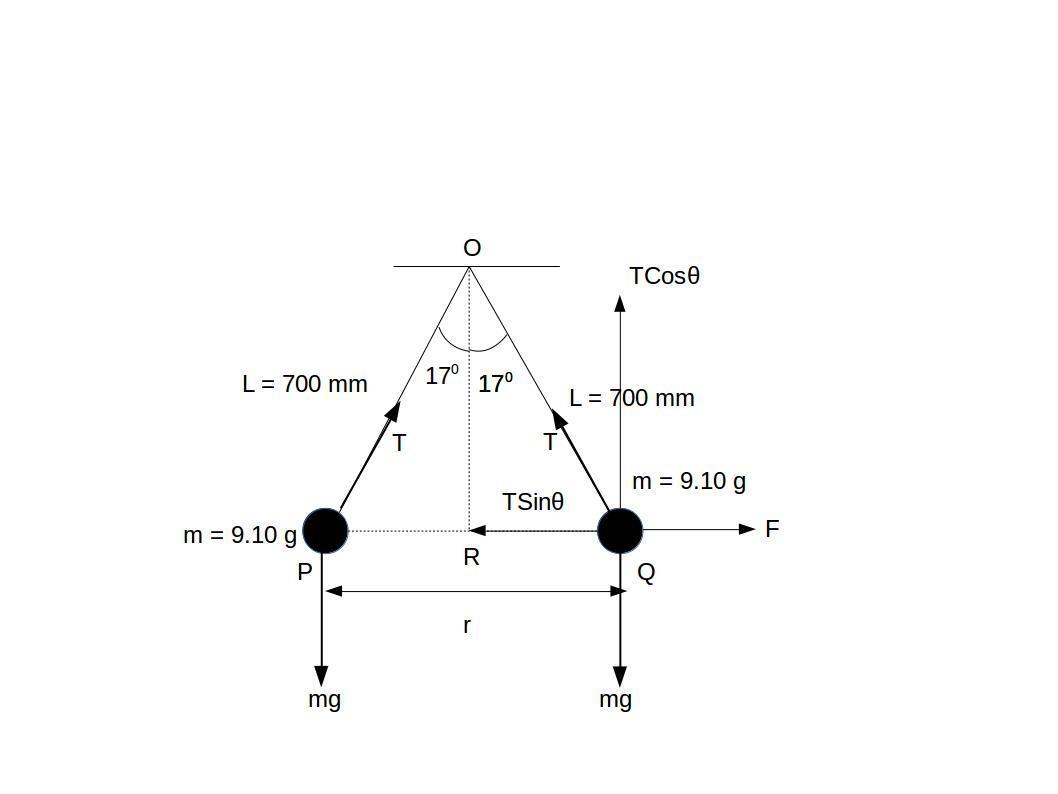
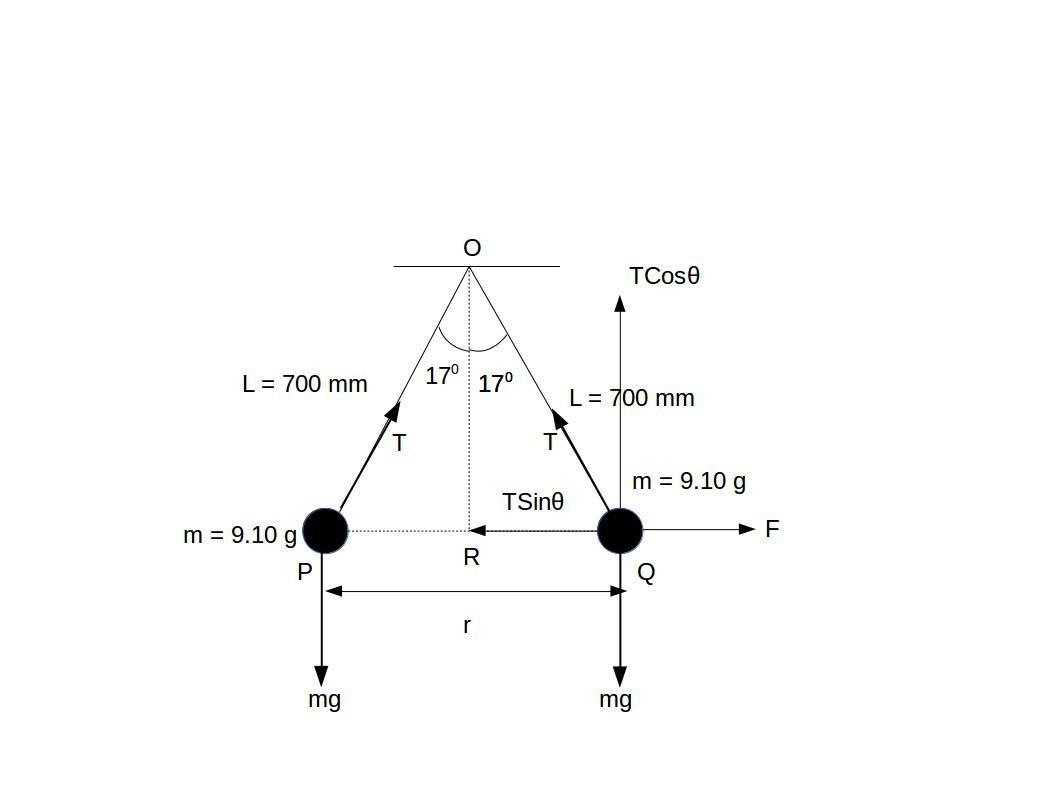
According to the diagram, the equilibrium condition for the vertical components of the forces acting on each sphere can be written as

T \cos \theta = mg~~~~~~~~~~~~~~~~~~~~~~~~~~~~~~~~~~~~~~~~(1)

The equilibrium condition for the horizontal components of the forces acting on each sphere can be written as

T \sin \theta = F~~~~~~~~~~~~~~~~~~~~~~~~~~~~~~~~~~~~~~~~~~~~~(2)

Here, F is the electrostatic force experienced by the metal spheres.

The value of the electrostatic force is given by

F = \dfrac{q^{2}}{r^{2}}~~~~~~~~~~~~~~~~~~~~~~~~~(3)

Here, q is the charge on each sphere and r is the distance between them.

Referring to the figure, from \bigtriangleup QOR,

&& \dfrac{r/2}{L} = \sin \theta\\&or,& r = 2L \sin \theta

Substituting the value of r in equation (3), we have

F = \dfrac{q^{2}}{(2L \sin \theta)^{2}}~~~~~~~~~~~~~~(4)

From equation (1),

T &=& \dfrac{mg}{\cos \theta}\\&=& \dfrac{(9.10~g)(980~cm/s^{2})}{\cos 17^{0}}\\&=& 9325.7~dyn

Substituting the values of T and F in equation (2), we have

&& (9325.7~dyn) \sin 17^{0} = \dfrac{q^{2}}{(2 \times 70 \times \sin 17^{0})}\\&or,& q^{2} = ((9325.7~dyn) \sin 17^{0})(2 \times 70 \times \sin 17^{0})\\&or,& q = 334~C

If n is the number if electron surplussed with the metal sphere, then

ne = q~~~~~~~~~~~~~~~~~~~~~~~~~~(5)

Here, e is the electronic charge.

Substituting the value of e and q in equation (5), we have

n &=& \dfrac{q}{e}\\~~~&=& \dfrac{334~C}{1.6 \times 10^{-19}~C}\\~~~&=& 2 \times 10^{21}

You might be interested in
An open-topped freight car with mass 24,000 kg is coasting without friction along a level track. It is raining very hard, and th
skelet666 [1.2K]

Answer:

(a) v = 3..6 m/s

(b) The rain falling downward has been able to affect the horizontal motion of the car by reducing it's velocity from 4 m/s to 3.6 m/s.

Explanation:

from the question we have the following:

mass of the car (Mc) = 24,000 kg

initial velocity of the car (u) = 4 m/s

mass of water (Mw) = 3000 kg

final velocity of the car (v) = ?

(a) we can calculate the final momentum of the car by applying the conservation of momentum where

initial momentum = final momentum

Mc x U = (Mc + Mw) x V

24000 x 4 = (24000 + 3000) x v

96,000 = 27000v

v =3.6 m/s

(b) The rain falling downward has been able to affect the horizontal motion of the car by reducing it's velocity from 4 m/s to 3.6 m/s.

7 0
2 years ago
One of the main factors driving improvements in the cost and complexity of integrated circuits (ICs) is improvements in photolit
nika2105 [10]

Answer:

0.000003782 m

0.000001891 m

0.000001197125 m

Explanation:

\lambda = Wavelength = 248 nm

D = Diameter of beam = 1 cm

f = Focal length = 0.625 cm

The angle is given by

\theta=\dfrac{1.22\lambda}{D}

The width is given by

d=2\theta f\\\Rightarrow d=2\dfrac{1.22\lambda f}{D}\\\Rightarrow d=2\dfrac{1.22\times 248\times 10^{-9}\times 6.25\times 10^{-2}}{1\times 10^{-2}}\\\Rightarrow d=0.000003782\ m

The required width is 0.000003782 m

Minimum resolvable line separation is given by

\dfrac{0.000003782}{2}=0.000001891\ m

The minimum resolvable line separation between adjacent lines is 0.000001891 m

when \lambda=157\ nm

d=2\dfrac{1.22\times 157\times 10^{-9}\times 6.25\times 10^{-2}}{1\times 10^{-2}}\\\Rightarrow d=0.00000239425\ m

The new minimum resolvable line separation between adjacent lines is

\dfrac{0.00000239425}{2}=0.000001197125\ m

6 0
2 years ago
What is the maximum negative displacement a dog could have if it started its motion at +3 m?
raketka [301]

Answer:

- 3 meter

Explanation:

A dog has started motion from +3 meter. ...(Given)

∴ maximum positive distance = + 3 meter

Magnitude of distance = 3

Maximum negative distance = (-) (magnitude of distance)

Maximum negative distance = (-) (3)

Maximum negative distance = -3 meter

Hence, maximum negative distance is -3 meter.

7 0
2 years ago
The intensity at a distance of 6.0 m from a source that is radiating equally in all directions is 6.0 × 10⁻¹⁰ w/m2 . what is the
satela [25.4K]
The intensity is defined as the ratio between the power emitted by the source and the area through which the power is calculated:
I= \frac{P}{A} (1)
where
P is the power
A is the area

In our problem, the intensity is I=6.0 \cdot 10^{-10} W/m^2. At a distance of r=6.0 m from the source, the area intercepted by the radiation (which propagates in all directions) is equal to the area of a sphere of radius r, so:
A=4 \pi r^2 = 4 \pi (6.0 m)^2 = 452.2 m^2

And so if we re-arrange (1) we find the power emitted by the source:
P=IA = (6.0 \cdot 10^{-10}W/m^2)(452.2 m^2)=2.7 \cdot 10^{-7} W
3 0
2 years ago
Two small aluminum spheres, each of mass 0.0250 kilograms, areseparated by 80.0 centimeters.
sineoko [7]

Answer:

Total number of electrons

N = 7.25 \times 10^{24}

electrons removed from each sphere

N = 5.27 \times 10^{15}

Fraction of electrons transferred is given as

f = 7.27 \times 10^{-10}

Explanation:

As we know that moles is defined as

n =\frac{mass}{molar mass}

n = \frac{0.0250}{0.026982}

n = 0.93

so number of atoms of Al in each sphere is given as

N = 0.93(6.02 \times 10^{23})

N = 5.58 \times 10^{23}

Now number of electrons in each atom is given as

atomic number = number of electrons in each atom = 13

total number of electrons in each sphere is

N = 13 \times (5.58 \times 10^{23})

N = 7.25 \times 10^{24}

Also we know that force of attraction between them is given as

F= \frac{kq_1q_2}{r^2}

1.00 \times 10^4 = \frac{(9\times 10^9)q^2}{0.80^2}

q = 8.4 \times 10^{-4} C

now we have

q = Ne

8.4 \times 10^{-4} = N(1.6 \times 10^{-19}

N = \frac{(8.4 \times 10^{-4})}{1.6 \times 10^{-19}}

N = 5.27 \times 10^{15}

Fraction of electrons transferred is given as

f = \frac{5.27 \times 10^{15}}{7.25 \times 10^{24}}

f = 7.27 \times 10^{-10}

6 0
2 years ago
Other questions:
  • Make a diagram showing the forces acting on a coasting bike rider traveling at 25km/h on a flat roadway.
    14·2 answers
  • Which statement correctly describes magnetism?
    15·2 answers
  • The wavelength of some red light is 700.5 nm. what is the frequency of this red light?
    15·1 answer
  • What’s the force of a pitching machine on a baseball?
    5·2 answers
  • Match each force abbreviation to the correct description. Fg Fp Ff Fn force exerted by a push or pull. Support force at a right
    10·2 answers
  • (a) Aircraft sometimes acquire small static charges. Suppose a supersonic jet has a 0.500 - μC charge and flies due west at a sp
    6·1 answer
  • The oscillating current in an electrical circuit is as follows, where I is measured in amperes and t is measured in seconds. I =
    15·1 answer
  • A charge Q is distributed uniformly along the x axis from x1 to x2. What would be the magnitude of the electric field at x0 on t
    8·1 answer
  • Power is __________________. Power is __________________. the work done by a system the force required to push something the spe
    11·1 answer
  • What is the acceleration of a skier that goes from 2.50 m/s to 14.5 m/s while traveling 505 m down a slope?
    10·1 answer
Add answer
Login
Not registered? Fast signup
Signup
Login Signup
Ask question!