answer.
Ask question
Login Signup
Ask question
All categories
  • English
  • Mathematics
  • Social Studies
  • Business
  • History
  • Health
  • Geography
  • Biology
  • Physics
  • Chemistry
  • Computers and Technology
  • Arts
  • World Languages
  • Spanish
  • French
  • German
  • Advanced Placement (AP)
  • SAT
  • Medicine
  • Law
  • Engineering
anastassius [24]
2 years ago
4

In a similar application than wind turbines, marine turbines transform the rectilinear momentum available in marine flows and ti

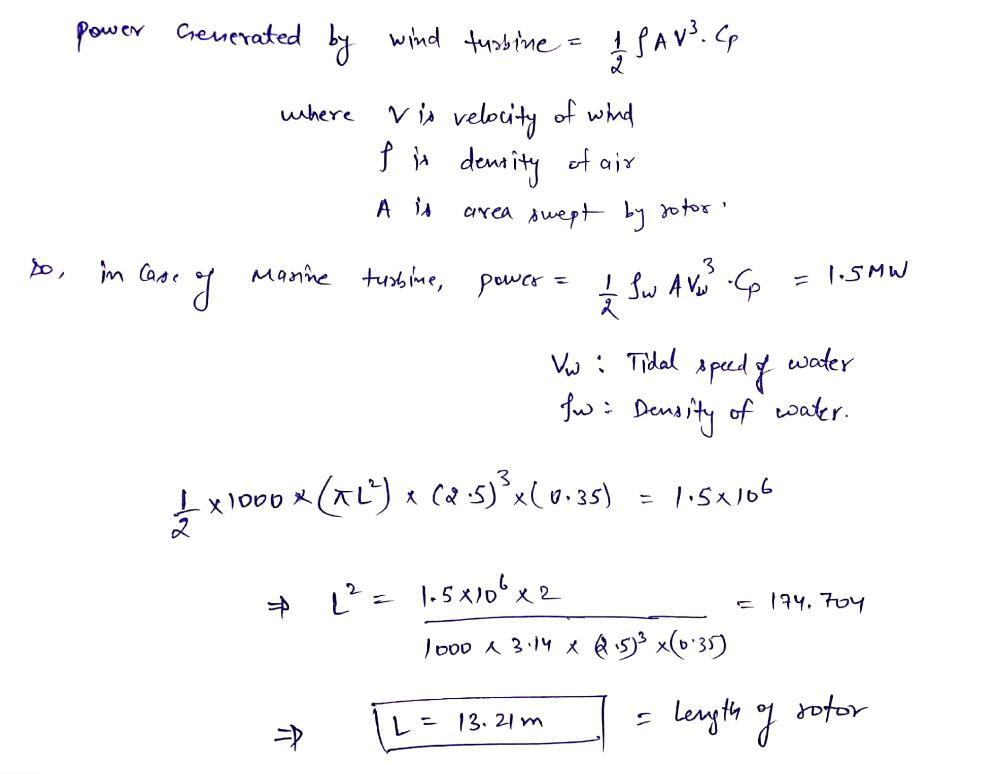
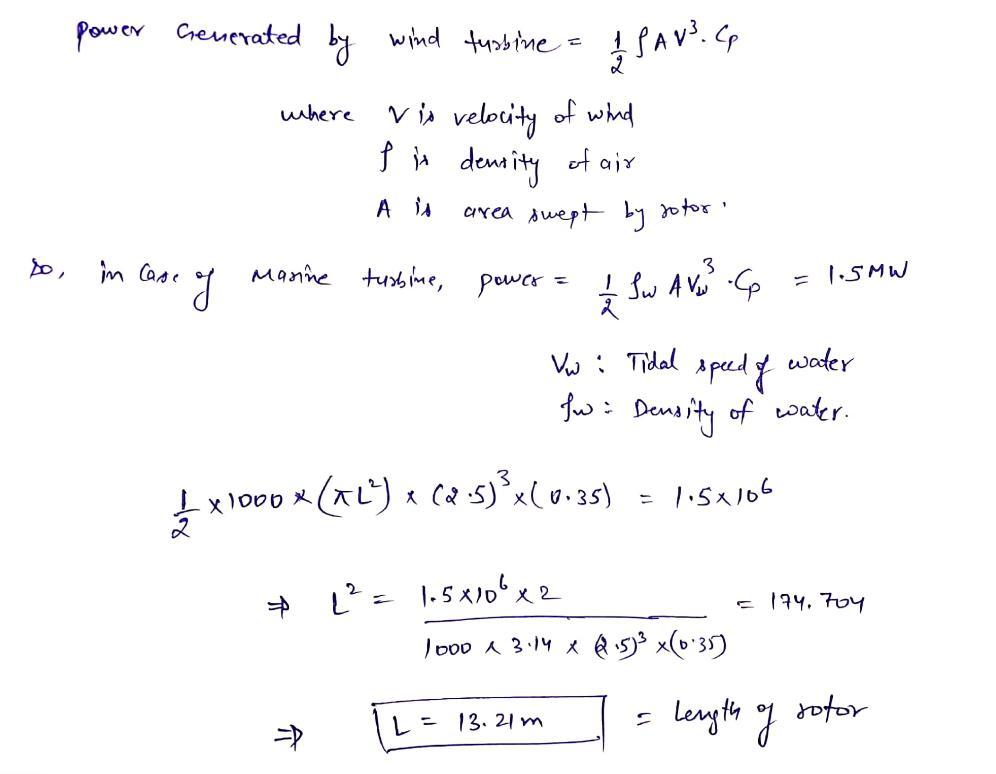
des to electric power. Marine turbines are designed using the same principles as wind turbines. However, because they are used in different flow conditions, the variables used in the power equation are also slightly numerical different. As the marine turbine works in water rather than air, we will use density of water instead of air: Density of water is rhow = 1000 kg/m3. A rated tidal flow speed of v=2.5 m/s is considered typical in geographic regions with attractive marine flows. The average power coefficient, Cp , for marine turbines is also different than that of wind turbines. Currently, the technology for marine turbines is not that much developed to reach the same levels of results as wind turbines. However, the theoretical maximum for marine turbines which is still defined by Betz Law has a limit value of 0.59. In practice, it is acceptable to estimate the power Coefficient for Marine Turbines as 〖Cp〗_m=0.35. Given this information, rearrange the power equation using marine turbine variables to calculate the length of a marine turbine blade that would be needed to produce the same power by the marine turbine as the power produced by the wind turbine in the example in our lecture (1.5 MW).

Physics
1 answer:
pochemuha2 years ago
4 0

Answer:

calculate the length of a marine turbine blade that would be needed to produce the same power by the marine turbine = 13.21m

Explanation:

check attached file below for explanation.

You might be interested in
The current supplied by a battery slowly decreases as the battery runs down. Suppose that the current as a function of time is:
ludmilkaskok [199]

Answer: 8.1 x 10^24

Explanation:

I(t) = (0.6 A) e^(-t/6 hr)

I'll leave out units for neatness: I(t) = 0.6e^(-t/6)

If t is in seconds then since 1hr = 3600s: I(t) = 0.6e^(-t/(6 x 3600) ).

For neatness let k = 1/(6x3600) = 4.63x10^-5, then:

I(t) = 0.6e^(-kt)

Providing t is in seconds, total charge Q in coulombs is

Q= ∫ I(t).dt evaluated from t=0 to t=∞.

Q = ∫(0.6e^(-kt)

= (0.6/-k)e^(-kt) evaluated from t=0 to t=∞.

= -(0.6/k)[e^-∞ - e^-0]

= -0.6/k[0 - 1]

= 0.6/k

= 0.6/(4.63x10^-5)

= 12958 C

Since the magnitude of the charge on an electron = 1.6x10⁻¹⁹ C, the number of electrons is 12958/(1.6x10^-19) = 8.1x10^24 to two significant figures.

5 0
2 years ago
Your boss asks you to design a room that can be as soundproof as possible and provides you with three samples of material. The o
earnstyle [38]

The correct answer is Option C) Sample C would be best, because the percentage of the energy in an incident wave that remains in a reflected wave from this material is the smallest.


As the coefficient of absorption would define the energy present in the reflected wave, the material C has the highest percentage of absorption i.e. 62% and would be best suitable to make a sound proof room.

4 0
2 years ago
Read 2 more answers
Ariel dropped a golf ball from her second story window. The ball starts from rest and hits the sidewalk 3.5 s later with a veloc
Aleks [24]

Answer:

By using the acceleration formula,

a =  \frac{v - u}{t}

a =  \frac{14.7 - 0}{3.5}

a = 4.2m \: s ^{ - 2}

4 0
2 years ago
A measuring cylinder contains 60cm3 of oil at 0 celcius. When a piece of ice was roped into the cylinder it sank completely in o
mariarad [96]

Answer:

S_i=\frac{9}{10} =0.9

Explanation:

Given:

  • volume of oil in the cylinder, V_o=60\ cm^2
  • volume of the oil level when the ice is immersed, V=90\ cm^3
  • the volume level of oil when the ice melted, V'=87\ cm^3

<u>Now, therefore the volume of ice:</u>

V_i=V-V_o

V_i=90-60

V_i=30\ cm^3

<u>Now the volume of water:</u>

V_w=V'-V_o

V_w=87-60

V_w=27\ cm^3

As we know that the relative density is the ratio of density of the substance to the density of water.

<u>So, the relative density of ice:</u>

S_i=\frac{\rho_i}{\rho_w} .....................(1)

as we know that density is given as:

\rm \rho=\frac{mass}{volume}

now eq. (1)

S_i=\frac{m}{V_{i}}\div  \frac{m}{V_w}

where, m = mass of the water or the ice which remains constant in any phase

S_i=\frac{V_w}{V_i}

S_i=\frac{27}{30}

S_i=\frac{9}{10} =0.9

7 0
2 years ago
Arwan finds a piece of quartz while hiking in the mountains. When he returns to school, he takes it to his science teacher. She
bekas [8.4K]

it's 303.4 cm3. i just took the test

8 0
2 years ago
Read 2 more answers
Other questions:
  • Fill in the blanks. The electrostatic force between two objects is proportional to the ____________________ of the distance ____
    5·2 answers
  • In which scenario is an animal doing work? Check all that apply.
    15·2 answers
  • Which formula can be used to calculate the horizontal displacement not of a horizontally launched projectile
    10·1 answer
  • a force of 25.0 newtons is applied so as to move a 5.0 kg mass a distance of 20.0 meters. How much work was done? with work plea
    6·1 answer
  • postal worker on a bicycle travels at an average speed of 4m/s for 3 minutes. Work out how far she travelled.
    7·2 answers
  • If the 80 ohm resistor fails, will the 50 ohm and 100 ohm resistor continue to operate? Why or why not?
    5·1 answer
  • A split highway has a number of lanes for traffic. For traffic going in one direction, the radius for the inside of the curve is
    5·1 answer
  • A person fishing from a pier observes that 6 wave crests pass by in 8.0 s and estimates the distance between two successive cres
    7·1 answer
  • A government agency estimated that air bags have saved over 14,000 lives as of April 2004 in the United States. (They also state
    13·1 answer
  • Q9: Suppose that the metal cylinder in the last problem has a mass of 0.10 kg and the coefficient of static friction between the
    8·1 answer
Add answer
Login
Not registered? Fast signup
Signup
Login Signup
Ask question!