answer.
Ask question
Login Signup
Ask question
All categories
  • English
  • Mathematics
  • Social Studies
  • Business
  • History
  • Health
  • Geography
  • Biology
  • Physics
  • Chemistry
  • Computers and Technology
  • Arts
  • World Languages
  • Spanish
  • French
  • German
  • Advanced Placement (AP)
  • SAT
  • Medicine
  • Law
  • Engineering
EleoNora [17]
2 years ago
4

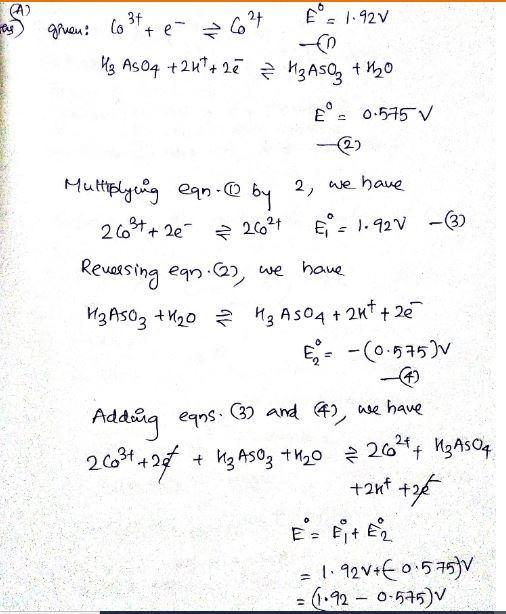
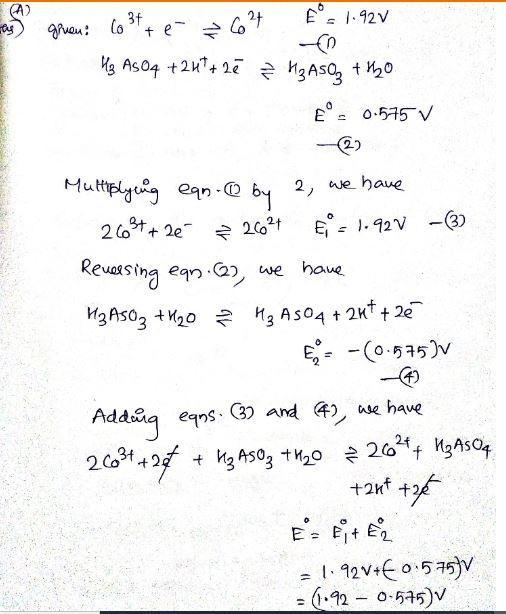
Determine ????∘ , Δ????∘ , and K for the overall reaction from the balanced half-reactions and their standard reduction potentia

ls. 2Co3+H3AsO3+H2O ↽−−⇀ 2Co2++H3AsO4+2H+Co3+e−↽−−⇀ Co2+ ????∘=1.92H3AsO4+2H+2e−↽−−⇀ H3AsO3+H2O????∘=0.575????∘=_________ ?K= _________?Δ????∘= _________?Is the overall reaction spontaneous as written? not spontaneous spontaneousDetermine ????∘E∘, Δ????∘ΔG∘, and KK for the overall reaction from the balanced half-reactions and their standard reduction potentials.4Fe3++2H2O↽−−⇀ 4Fe2++O2+4H+Fe3++e−↽−−⇀ Fe2+ ????∘=0.771 V1/2O2+2H++2e− ↽−⇀ H2O????∘=1.229V????∘=_________K=_________Δ????∘=_________Is the overall reaction spontaneous as written?
A. spontaneous


B. not spontaneous

Chemistry
1 answer:
Llana [10]2 years ago
5 0

Answer:

(a) E₀ = 1.35 V

    K = 3.28*10^45

    ΔG₀  = -260 kJ

(b) E₀ = -0.458 V

    K = 1.00*10^-31

    ΔG₀    = 177 kJ


Explanation:

See the attached file for the calculation.

You might be interested in
The equilibrium reaction below has the Kc = 4.00 at 25°C. If the temperature of the system at equilibrium is increased to 100°C,
professor190 [17]

Answer:

Following are the answer to this question:

Explanation:

In the given question information is missing, that is equation which can be defined as follows:

CH_4(g)+H_2O(g)\rightarrow CO(g)+3H_2(g)   \ \ \bigtraingleup H^0=+206.2KJ

  • Growing temperatures may change its connection to just the way which consumes thermal energy in accordance with Le chatelier concepts Potential connection is endothermic. Answer: shifts to the right  
  • Kc are described as a related to the concentration by the intensity of both the reaction for each phrase which reaches a power equal towards its stoichiometric equation coefficient  Kc = \frac{product}{reactant}   It increases [product] but reduces [reactant] Therefore, Kc increases
6 0
2 years ago
A compound is found to have a molar mass of 598 g/mol. if 35.8 mg of the compound is dissolved in enough water to make 175 ml of
TiliK225 [7]
The computation for molarity is: 
(x) (0.175 L) = 0.0358 g / 598 g/mol 
x = 0.000342093 M 
Whereas the osmotic pressure calculation: 
pi = iMRT 
pi = (1) (0.000342093 mol/L) (0.08206 L atm / mol K) (298 K) 
pi = 0.0083655 atm 
Converting the answer to torr, will give us:
0.0083655 atm times (760 torr/atm) = 6.35778 torr 
which rounds off to 6.36 torr
7 0
2 years ago
Table salt, NaCl, is an example of an amorphous solid.<br> TRUE<br> FALSE
prohojiy [21]
False, it is an example of an Ionic solid
3 0
2 years ago
Read 2 more answers
A student made a graph to show the chemical equilibrium position of a reaction.
pogonyaev

Answer:

Concentration, because the amounts of reactants and products remain constant after equilibrium is reached.

Explanation:

The rate of reaction refers to the amount of reactants converted or products formed per unit time.

As the reaction progresses, reactions are converted into products. This continues until equilibrium is attained in a closed system.

When equilibrium is attained, the rate of forward reaction is equal to the rate of reverse reaction, hence the concentration of reactants and products in the system remain fairly constant over time.

When deducing the rate of reaction, concentration of the specie of interest is plotted on the y-axis against time on the x-axis.

8 0
2 years ago
What is the total mass of a mixture of 3.50x10^22 formula units na2so4, 0.500 mol h2o, and 7.23 g agcl?
Crazy boy [7]
Answer is: mass of the mixture is 24,47 g.
1) N(Na₂SO₄) = 3,5·10²².
n(Na₂SO₄) = 3,5·10²² ÷ 6·10²³ 1/mol.
n(Na₂SO₄) = 0,058 mol.
m(Na₂SO₄) = 0,058 mol · 142 g/mol.
m(Na₂SO₄) = 8,24 g.
2) n(H₂O) = 0,500 mol.
m(H₂O) = 0,5 mol · 18 g/mol.
m(H₂O) = 9 g.
3) m(total) = 8,24 g + 9 g + 7,23 g.
m(total) = 24,47 g.
n - amount of substance.
5 0
2 years ago
Other questions:
  • Which quantity gives the best indication of the relative strength of the hydrogen bonds between the molecules in liquid hydrogen
    9·1 answer
  • Object A has a temperature of 287 Kelvin, object B has a temperature of 374 Kelvin. In what direction will thermal energy flow?
    12·2 answers
  • Express 601 kg as an integer
    11·2 answers
  • Which statements about reducing sugars are true? D‑Glucose (an aldose) is a reducing sugar. The oxidation of a reducing sugar fo
    7·1 answer
  • The energy difference between the 5d and 6s sublevels in gold accounts for its color. Assuming this energy difference is about 2
    14·1 answer
  • Notice that the effective analytical connection for analysis of hypochlorite anion by the thiosulfate anion in this experiment i
    9·1 answer
  • When 15.3 g of sodium nitrate, NaNO₃, was dissolved in water in a constant-pressure calorimeter, the temperature fell from 25.00
    8·2 answers
  • Acetone can be easily converted to isopropyl alcohol by addition of hydrogen to the carbon–oxygen double bond. calculate the ent
    10·1 answer
  • How many milliliters of a 0.8 M solution of citric acid would be needed to react with 15 grams of baking soda? Show your work.
    6·1 answer
  • Could the other molecules in this simulation (argon, oxygen, and water) be considered pure substances? Explain your thinking.
    14·1 answer
Add answer
Login
Not registered? Fast signup
Signup
Login Signup
Ask question!