answer.
Ask question
Login Signup
Ask question
All categories
  • English
  • Mathematics
  • Social Studies
  • Business
  • History
  • Health
  • Geography
  • Biology
  • Physics
  • Chemistry
  • Computers and Technology
  • Arts
  • World Languages
  • Spanish
  • French
  • German
  • Advanced Placement (AP)
  • SAT
  • Medicine
  • Law
  • Engineering
leva [86]
2 years ago
13

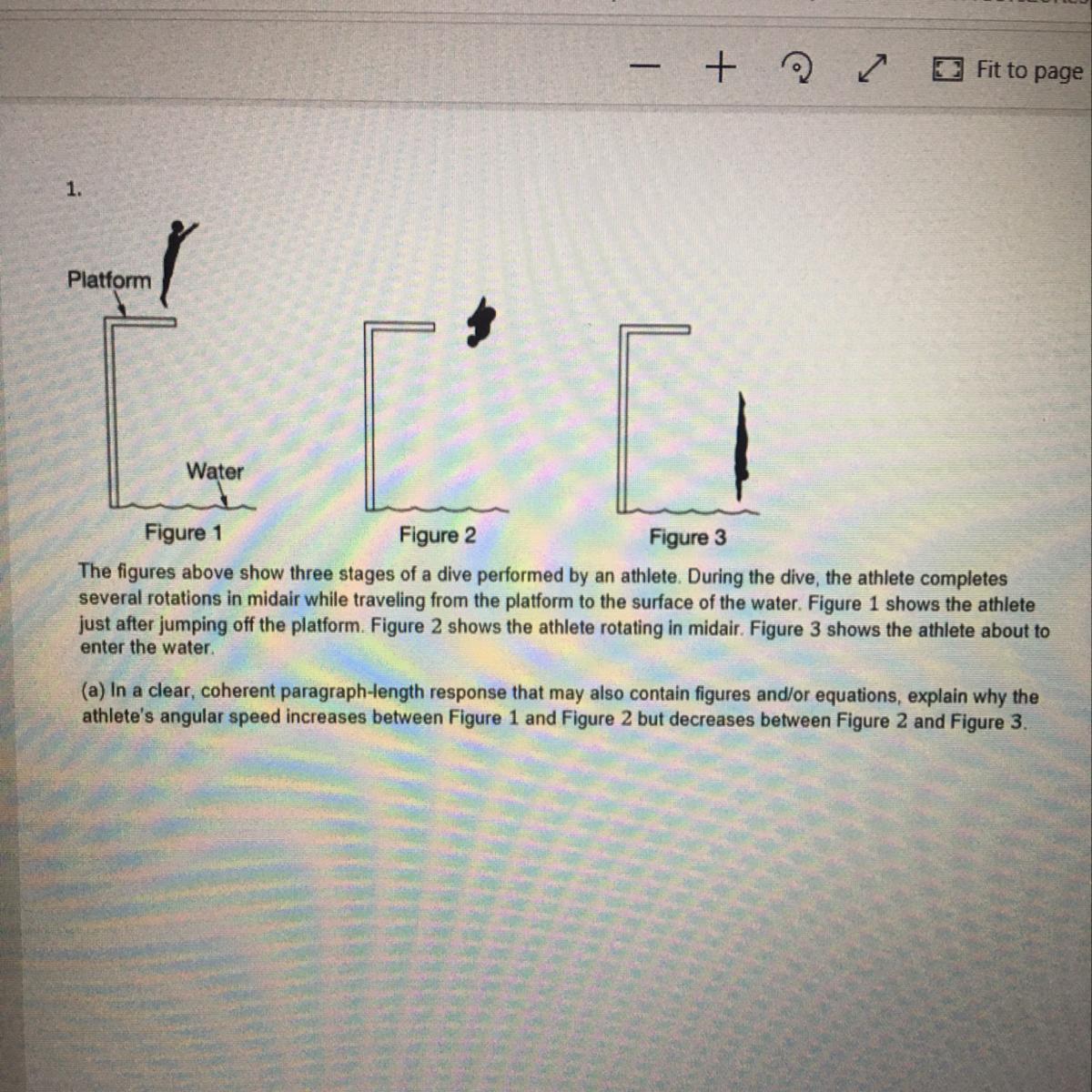
Platform

Physics
1 answer:
Ivahew [28]2 years ago
5 0

a) See explanation

b) K_2>K_1

Explanation:

a)

The angular speed of an object in rotation is the rate of change of its angular displacement:

\omega=\frac{\Delta \theta}{\Delta t}

where

\Delta \theta is the angular displacement

\Delta t is the time elapsed

The angular momentum of an object in rotation is given by

L=I\omega

where I is the moment of inertia of the body.

The moment of inertia of the athlete decreases as we move from figure 1 to figure 2: this is because the athlete pulls his arms and legs towards the body. Since the athlete is an isolated system, the angular momentum L must remain constant; and therefore, since I decreases, \omega (angular speed) must increase.

On the other hand, when we move from figure 2 to figure 3 the moment of inertia of the athlete increases again, and therefore, since L must remain constant, the angular speed will decrease.

b)

The rotational kinetic energy of an object in rotational motion is given by

K=\frac{1}{2}I\omega^2

where

I is the moment of inertia

\omega is the angular speed

Using

L=I\omega

we can rewrite the rotational kinetic energy as:

K=\frac{1}{2}L\omega

In part a), we said that the angular momentum L remains constant, however the angular speed \omega increases as we move from figure 1 to figure 2. Since the rotational kinetic energy is proportional to both the angular momentum and the angular speed, but the angular momentum remains constant, this means that the rotational kinetic energy also increases as we move from figure 1 to figure 2.

So the answer is
K_2>K_1

You might be interested in
Acetone, a component of some types of fingernail polish, has a boiling point of 56°C. What is its boiling point in units of kelv
mixas84 [53]

Answer:

The boiling point of Acetone is 329K (in 3 significant figures)

Explanation:

Boiling point of Acetone = 56°C = 56 + 273K = 329K (in 3 significant figures)

7 0
2 years ago
Read 2 more answers
A 4.00-kg box sits atop a 10.0-kg box on a horizontal table. The coefficient of kinetic friction between the two boxes and betwe
natta225 [31]
First, we have to calculate the normal forces on different surfaces.The normal force on the 4.00 kg, N1 = (4)(9.8) = 39.2 N. The normal force on the 10.0 kg, N2 = (14)(9.8) = 137.2 N. Looking at the 10.0 kg block, the static forces that counteract the pulling force equals the sum of the friction from the two surfaces. Fc = N1 * 0.80 + N2 * 0.80 = 141.12 N. Since the counter force is less than the pulling force, the blocks start to move and hence, kinetic frictions are considered.


Therefore, f1 = uk * N1 = (0.60)(39.2) = 23.52 N.
4 0
2 years ago
A basketball with mass of 0.8 kg is moving to the right with velocity 6 m/s and hits a volleyball with mass of 0.6 kg that stays
IceJOKER [234]

Answer:

26.67 m/s

Explanation:

From the law of conservation of linear momentum, the initial sum of momentum equals the final sum.

p=mv where p is momentum, m is the mass of object and v is the speed of the object

Initial momentum

The initial momentum will be that of basketball and volleyball, Since basketball is initially at rest, its initial velocity is zero

p_i= m_bv_b+m_vv_v=8*6+0.6*0=48 Kg.m/s

Final momentum

p_f= m_bv_b+m_vv_v=8*4+0.6*v_v=32+0.6v Kg.m/s\\32+0.6v_v=48\\0.6v=16\\v_v=16/0.6=26.66666667\approx 26.67 m/s

4 0
2 years ago
Alex has a 100 cm ruler pivoted at the centre. She ties a balloon filled with carbon doxide 16 cm from the pivot The total weigh
Leona [35]
If people send links report them
5 0
2 years ago
When light energy hits the retina, the retinal changes from a _____ to a _____ configuration.
gayaneshka [121]

Answer:

Cis, Trans.

Explanation:

Rhodopsin also known as visual purple, pigment which contains sensory protein that helps to convert light into an electrical signal. Rhodopsin present in wide range of organisms from bacteria to vertebrates.

Rhodopsin is composed of opsin, and 11-cis-retinaldehyde which is derived from vitamin A. When the eye contact with light the 11-cis component converted to all trans-retinal, which results in the changes in configuration fundamental in the rhodopsin molecule.

5 0
2 years ago
Other questions:
  • A microwave oven operates at 3.00 ghz . what is the wavelength of the radiation produced by this appliance?
    9·1 answer
  • Consider a solid, rigid spherical shell with a thickness of 100 m and a density of 3900 kg/m3 . the sphere is centered around th
    5·2 answers
  • How does melting And burning sugar follow the law of conservation of mass
    8·2 answers
  • Seema knows the mass of a basketball. What other information is needed to find the ball’s potential energy? the volume and heigh
    12·3 answers
  • A capacitor with plates separated by distance d is charged to a potential difference ΔVC. All wires and batteries are disconnect
    13·2 answers
  • While sitting in your car by the side of a country road, you are approached by your friend, who happens to be in an identical ca
    14·1 answer
  • The oscillating current in an electrical circuit is as follows, where I is measured in amperes and t is measured in seconds. I =
    15·1 answer
  • A student decides to spend spring break by driving 50 miles due east, then 50 miles 30 degrees south of east, then 50 miles 30 d
    5·1 answer
  • A 0.250 kgkg toy is undergoing SHM on the end of a horizontal spring with force constant 300 N/mN/m. When the toy is 0.0120 mm f
    6·1 answer
  • a block weighing (Fg) 50 N is resting on a steel table (us = 0.74). The minimum force to start this block moving is what N
    8·1 answer
Add answer
Login
Not registered? Fast signup
Signup
Login Signup
Ask question!
