answer.
Ask question
Login Signup
Ask question
All categories
  • English
  • Mathematics
  • Social Studies
  • Business
  • History
  • Health
  • Geography
  • Biology
  • Physics
  • Chemistry
  • Computers and Technology
  • Arts
  • World Languages
  • Spanish
  • French
  • German
  • Advanced Placement (AP)
  • SAT
  • Medicine
  • Law
  • Engineering
iren2701 [21]
2 years ago
3

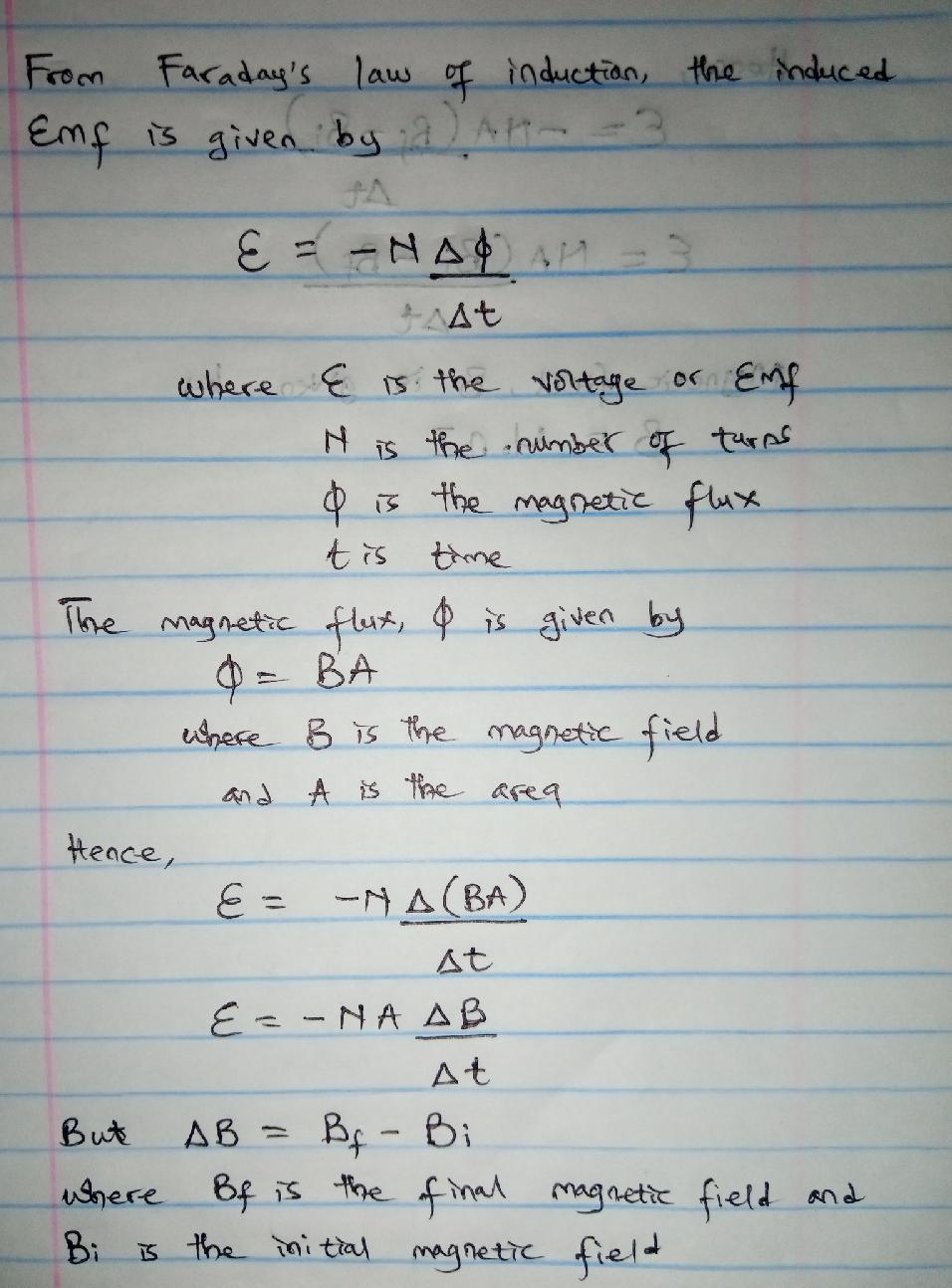
A long, straight solenoid with a cross-sectional area of 8.00cm28.00cm2 is wound with 9090turns of wire per centimeter, and the

windings carry a current of 0.350A0.350A. A second winding of 1212 turns encircles the solenoid at its center. The current in the solenoid is turned off such that the magnetic field of the solenoid becomes zero in 0.0400s0.0400s. What is the average induced emf in the second winding?

Physics
1 answer:
sweet [91]2 years ago
3 0

Answer: The induced emf is 9.50 × 10^-4 V

Explanation: Please see the attachments below

You might be interested in
A sharpening wheel is traveling at 5 rad/s, it slows down to rest in 30 seconds while sharpening an axe. What is its angular acc
Ratling [72]

Answer:

Angular acceleration = 0.167 rad/s^2

Explanation:

Given

Initial Angular velocity (w1) = 5 rad/s

Final Angular velocity (w2) = 0 rad/s

Time taken to change velocity from w1 to w2 = 30 seconds

Angular acceleration is equal to the change in angular velocity to the time taken for making thing change

Hence, Angular acceleration

\frac{w_2 -w_1}{t} \\\frac{5-0}{30}\\0.167rad/s^2

3 0
2 years ago
A 3.00-kg ball swings rapidly in a complete vertical circle of radius 2.00 m by a light string that is fixed at one end. The bal
Setler [38]

Answer

given,

mass of the ball = 3 kg

swing in vertical circle with radius = 2 m

   work done by the gravity = ?          

   work done by the tension = ?            

Work done by the gravity = - m g Δh            

 Δ h = 2 + 2 = 4 m                                                                

Work done by the gravity =- 3 \times 9.8 \times 4

                                           = -117.6 J                  

work done by gravity is equal to -117.6 J            

Work done by tension will be equal to zero.        

Zero because tension is always perpendicular to velocity

work done by tension is equal to 0 J                          

7 0
2 years ago
The image shows the displacement of a motorboat. The data table shows the magnitudes of the components of each displacement vect
Diano4ka-milaya [45]
Rx= 3.5 km

Ry= 2.9 km
4 0
2 years ago
Read 2 more answers
A firecracker breaks up into several pieces, one of which has a mass of 200 g and flies off along the x-axis with a speed of 82.
MakcuM [25]

Answer:

The magnitude of the total momentum is 21.2 kg m/s and its direction is 39.5° from the x-axis.

Explanation:

Hi there!

The total momentum is calculated as the sum of the momenta of the pieces.

The momentum of each piece is calculated as follows:

p = m · v

Where:

p = momentum.

m =  mass.

v = velocity.

The momentum is a vector. The 200 g-piece flies along the x-axis then, its momentum will be:

p = (m · v, 0)

p = (0.200 kg · 82.0 m/s, 0)

p = (16.4 kg m/s, 0)

The 300 g-piece flies along the y-axis. Its momentum vector will be:

p =(0, m · v)

p = (0, 0.300 kg · 45.0 m/s)

p = (0, 13.5 kg m/s)

The total momentum is the sum of each momentum:

Total momentum = (16.4 kg m/s, 0) + (0, 13.5 kg m/s)

Total momentum = (16.4 kg m/s + 0, 0 + 13.5 kg m/s)

Total momentum = (16.4 kg m/s, 13.5 kg m/s)

The magnitude of the total momentum is calculated as follows:

|p| = \sqrt{(16.4 kgm/s)^2+(13.5 kg m/s)^2}= 21.2 kg m/s

The direction of the momentum vector is calculated using trigonometry:

cos θ = px/p

Where px is the horizontal component of the total momentum and p is the magnitude of the total momentum.

cos θ = 16.4 kg m/s / 21.2 kg m/s

θ = 39.3  (39.5° if we do not round the magnitude of the total momentum)

Then, the magnitude of the total momentum is 21.2 kg m/s and its direction is 39.5° from the x-axis.
 

6 0
2 years ago
A 0.50-kg mass attached to the end of a string swings in a vertical circle (radius 2.0 m). When the mass is at the highest point
il63 [147K]

Answer:

31.1 N

Explanation:

m = mass attached to string = 0.50 kg

r = radius of the vertical circle = 2.0 m

v = speed of the mass at the highest point = 12 m/s

T = force of the string on the mass attached.

At the highest point, force equation is given as

T + mg =\frac{mv^{2}}{r}

Inserting the values

T + (0.50)(9.8) =\frac{(0.50)(12)^{2}}{2}

T = 31.1 N

7 0
2 years ago
Read 2 more answers
Other questions:
  • A 1200-kilogram space vehicle travels at 4.8 meters per second along the level surface of Mars. If the magnitude of the gravitat
    8·2 answers
  • An object moving on the x axis with a constant acceleration increases its x coordinate by 82.9 m in a time of 2.51 s and has a v
    7·1 answer
  • A uniform rod of mass M and length L is free to swing back and forth by pivoting a distance x from its center. It undergoes harm
    14·1 answer
  • in a race, Usain Bolt accelerates at 1.99m/s^2 for the first 60.0m, then decelerates at -0.266m/s^2 for the final 40.0m. what wa
    13·1 answer
  • The surface is tilted to an angle of 37 degrees from the horizontal, as shown above in Figure 3. The blocks are each given a pus
    7·1 answer
  • The natural tendency is for entropy to___ over time.
    6·2 answers
  • Kendra wants to use similes to describe the reflection and absorption of waves. Which pair of similes best fit?
    10·1 answer
  • Which optical device can focus light to a point through reflection?
    14·1 answer
  • Which of the following has a particles in most irregular pattern​
    10·1 answer
  • The electric field of a charge is defined by the force on what kind of particle?
    15·1 answer
Add answer
Login
Not registered? Fast signup
Signup
Login Signup
Ask question!
