answer.
Ask question
Login Signup
Ask question
All categories
  • English
  • Mathematics
  • Social Studies
  • Business
  • History
  • Health
  • Geography
  • Biology
  • Physics
  • Chemistry
  • Computers and Technology
  • Arts
  • World Languages
  • Spanish
  • French
  • German
  • Advanced Placement (AP)
  • SAT
  • Medicine
  • Law
  • Engineering
kherson [118]
2 years ago
11

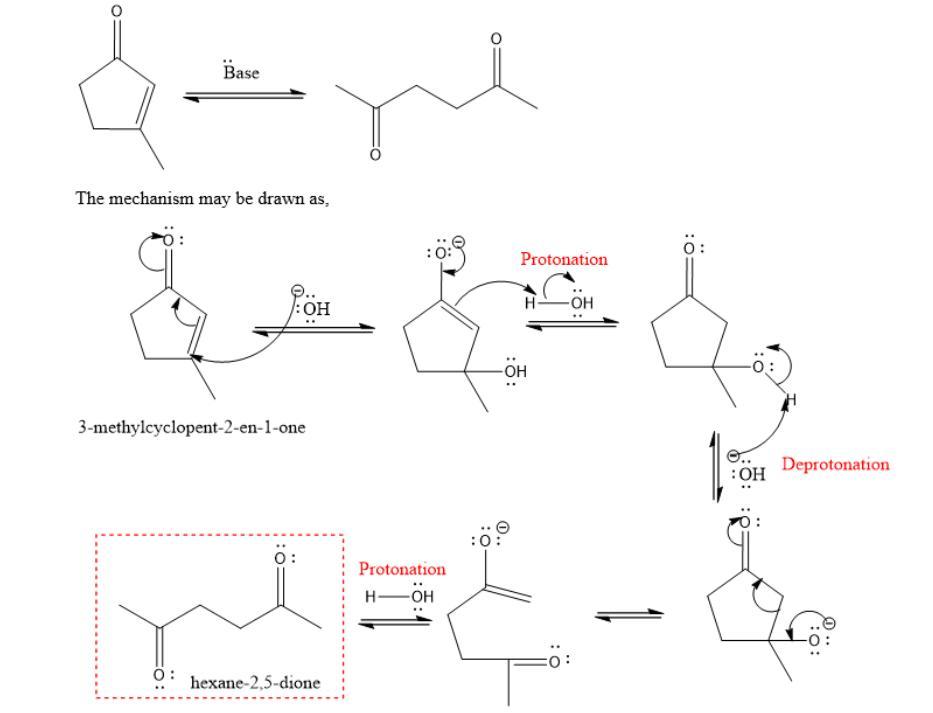
Conceptual Checkpoint 21.22 Draw a mechanism of the following process. That is, draw a mechanism showing conversion of the conju

gated, cyclic enone into the acyclic dione: For the mechanism, draw the curved arrows as needed. Include lone pairs and charges in your answer. Do not draw out any hydrogen explicitly in your products. Do not use abbreviations such as Me or Ph.

Chemistry
1 answer:
elixir [45]2 years ago
5 0

Answer: Provided in the explanation segment

Explanation:

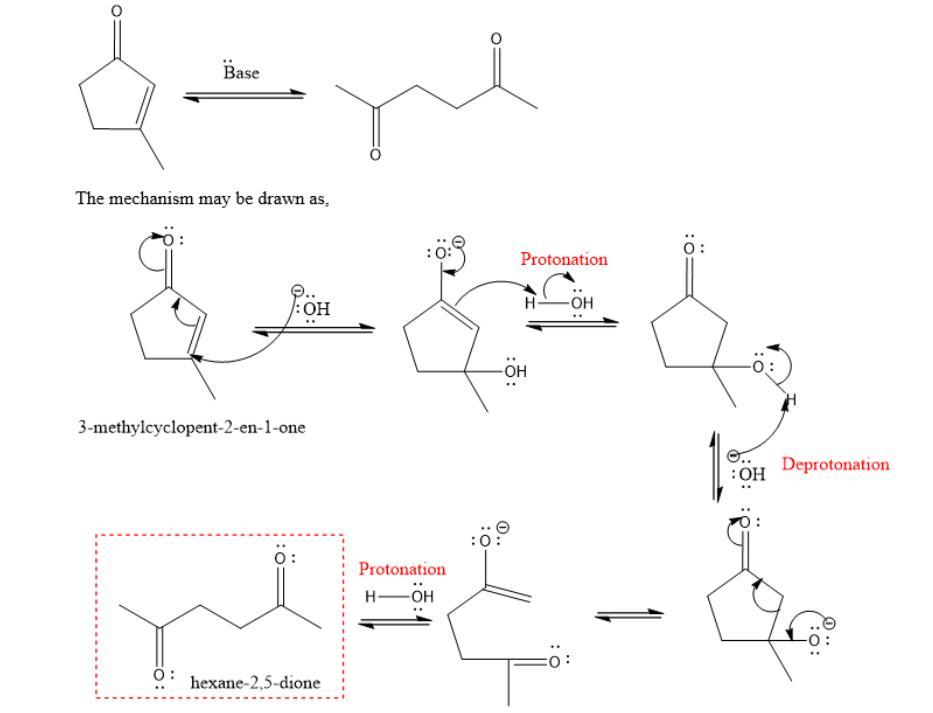
In this question, due to the complexity in actually drawing this manually. i have attached an image that shows how this reaction occurs.

The mechanism as can be seen in the question involves an attack  of  the hydroxide ion which results in the formation of the enolate ion.

From protonation which follows deprotonation, we can see that the molecules give an acyclic di-ketone which is the desrired product.

i hope this solution was helpful.

Cheers i hope this helps!!!

You might be interested in
Which letter indicates a subatomic particle with a mass of 5.489 x 10⁻⁴ amu
Ludmilka [50]

Answer:

electron

Explanation:

The electron is subatomic particle that revolve around outside the nucleus and has negligible mass. It has a negative charge.

Symbol = e⁻

Mass = 9.10938356×10⁻³¹ Kg

Mass in amu = 1/1838 = 5.4 × 10⁻⁴amu

It was discovered by j. j. Thomson in 1897 during the study of cathode ray properties.

While neutron and proton are present inside the nucleus. Proton has positive charge while neutron is electrically neutral. Proton is discovered by Rutherford while neutron is discovered by James Chadwick in 1932.

Symbol of proton= P⁺

Symbol of neutron= n⁰  

Mass of proton=1.672623×10⁻²⁷ Kg

Mass of neutron=1.674929×10⁻²⁷Kg

An atom consist of electron, protons and neutrons. Protons and neutrons are present with in nucleus while the electrons are present out side the nucleus.

All these three subatomic particles construct an atom

4 0
2 years ago
Read 2 more answers
How many moles of NaCl are present in a solution with a molarity of 8.59 M and a volume of 125 mL
Sergio [31]

Answer:

1.07ML

Explanation:

7 0
2 years ago
Read 2 more answers
Three 1.0-l flasks, maintained at 308 k, are connected to each other with stopcocks. initially the stopcocks are closed. one of
Licemer1 [7]

Answer:

0.6103 atm.

Explanation:

  • We need to calculate the vapor pressure of each component after the stopcocks are opened.
  • Volume after the stopcocks are opened = 3.0 L.

<u><em>1) For N₂:</em></u>

P₁V₁ = P₂V₂

P₁ = 1.5 atm & V₁ = 1.0 L & V₂ = 3.0 L.

P₂ of N₂ = P₁V₁ / V₂ = (1.5 atm) (1.0 L) / (3.0 L) = 0.5 atm.

<u><em>2) For H₂O:</em></u>

Pressure of water at 308 K is 42.0 mmHg.

we need to convert from mmHg to atm: <em>(1.0 atm = 760.0 mmHg)</em>.

P of H₂O = (1.0 atm x 42.0 mmHg) / (760.0 mmHg) = 0.0553 atm.

We must check if more 2.2 g of water is evaporated,

n = PV/RT = (0.0553 atm) (3.0 L) / (0.082 L.atm/mol.K) (308 K) = 0.00656 mole.

m = n x cmolar mass = (0.00656 mole) (18.0 g/mole) = 0.118 g.

It is lower than the mass of water in the flask (2.2 g).

<em><u>3) For C₂H₅OH:</u></em>

Pressure of C₂H₅OH at 308 K is 102.0 mmHg.

we need to convert from mmHg to atm: (1.0 atm = 760.0 mmHg).

P of C₂H₅OH = (1.0 atm x 102.0 mmHg) / (760.0 mmHg) = 0.13421 atm.

We must check if more 0.3 g of C₂H₅OH is evaporated,

n = PV/RT = (0.13421 atm) (3.0 L) / (0.082 L.atm/mol.K) (308 K) = 0.01594 mole.

m = n x molar mass = (0.01594 mole) (46.07 g/mole) = 0.7344 g.

<em>It is more than the amount in the flask (0.3 g), so the pressure should be less than 0.13421 atm.</em>

We have n = mass / molar mass = (0.30 g) / (46.07 g/mole) = 0.00651 mole.

So, P of C₂H₅OH = nRT / V = (0.00651 mole) (0.082 L.atm/mole.K) (308.0 K) / (3.0 L) = 0.055 atm.

  • <em>So, </em><em>total pressure</em><em> = </em><em>P of N₂ + P of H₂O + P of C₂H₅OH</em><em> = 0.5 atm + 0.0553 atm + 0.055 atm = </em><em>0.6103 atm</em><em>.</em>

3 0
2 years ago
The density of lead is 11.4 g/cm3 at 20°C. A chemist has a metallic sample that is either pure lead or mostly lead. If the densi
Mekhanik [1.2K]
The sample is most likely lead with lighter substances in it. Pure lead would be closer to the pure lead density, and heavier substances would make the density more, not less.
7 0
2 years ago
Read 2 more answers
How many grams of CO2 will be produced from 12.0 g of CH4 and 133 g of O2?
jek_recluse [69]

Answer:

145 grams

Explanation:

conservation of mass

12.0+133=145

6 0
2 years ago
Other questions:
  • A sample that weighs 107.75 g is a mixture of 30% helium atoms and 70% krypton atoms. How many particles are present in the samp
    10·1 answer
  • Suppose that, from measurements in a microscope, you determine that a certain bacterium covers an area of 1.50μm2. Convert this
    13·1 answer
  • Compound w , c6h13cl, undergoes base-promoted e2 elimination to give a single c6h12 alkene, y. compound x, c6h13br, undergoes a
    13·1 answer
  • Which of these pairs indicates an incorrect coupling of reversible reactions?dehydration synthesis and hydrolysisanabolic and ca
    10·1 answer
  • !!15 points!!Which of the following phrases describes how the position of an electron
    14·2 answers
  • A 0.1873 g sample of a pure, solid acid, H2X (a diprotic acid) was dissolved in water and titrated with 0.1052 M NaOH solution.
    9·1 answer
  • For each set of dilutions (bleach and mouthwash), the first tube contained a 1:11 dilution (0.5 mL of agent was added to 5.0 mL
    5·1 answer
  • Which of the following air pollutants is correctly paired with one of its major effects?
    7·1 answer
  • In a laboratory, Carlos places one plate with grape jelly and another plate with cooked brown rice inside an ant farm. The next
    12·2 answers
  • Morant Bay is 33 km south of Port Antonio a pigeon can fly at a speed of 1.2 m s what is the displacement of morant bay from Por
    11·1 answer
Add answer
Login
Not registered? Fast signup
Signup
Login Signup
Ask question!