answer.
Ask question
Login Signup
Ask question
All categories
  • English
  • Mathematics
  • Social Studies
  • Business
  • History
  • Health
  • Geography
  • Biology
  • Physics
  • Chemistry
  • Computers and Technology
  • Arts
  • World Languages
  • Spanish
  • French
  • German
  • Advanced Placement (AP)
  • SAT
  • Medicine
  • Law
  • Engineering
victus00 [196]
2 years ago
4

Two types of alcohols namely as methylcyclohexanol and 2-methyl-2-hexanol were subjected to dehydration reaction and yield a mix

ture of two isomeric alkenes. Proposed a chemical reaction of both alcohols and determine which one is the major product. Justify your answer.

Chemistry
1 answer:
Burka [1]2 years ago
3 0

Answer:

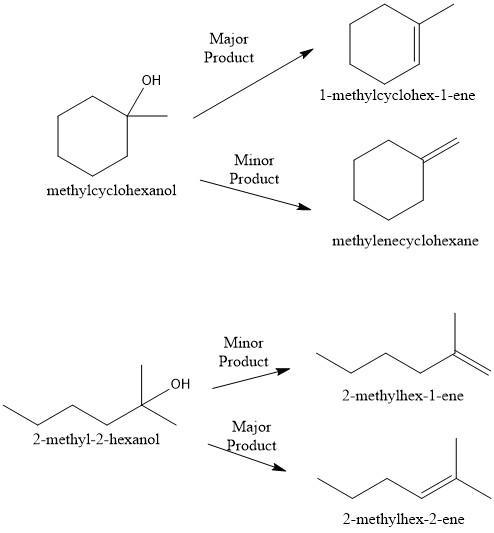
a) Methylcyclohexanol = 1-methylcyclohex-1-ene and methylenecyclohexane

b) 2-methyl-2-hexanol = 2-methylhex-1-ene and 2-methylhex-2-ene

Explanation:

We have to remember that the dehydration of alcohols follows the <u>Zaitsev rule</u>. So, the <u>most substituted alkene</u> would be the major product for both molecules

In the case of methylcyclohexanol we have several options to put the double bond. Inside of the cyclic structure (1-methylcyclohex-1-ene) or between the cyclic structure and the methyl group (methylenecyclohexane). <u>The most substituted one is 1-methylcyclohex-1-ene, so this is our major product</u>.

In the case of 2-methyl-2-hexanol we have again several options for the double bond. Between the tertiary carbon (the carbon that holds the "OH" group) and the carbon in the left (2-methylhex-2-ene). The other option is to put the double between the tertiary carbon the carbon in the right (2-methylhex-1-ene). <u>The most substituted one is 2-methylhex-2-ene, so this is our major product.</u>

<u />

See figure 1

I hope it helps!

You might be interested in
The weight percent of concentrated HClO4(aq) is 70.5% and its density is 1.67 g/mL. What is the molarity of concentrated HClO4
ollegr [7]

Answer:

[HClO₄] = 11.7M

Explanation:

First of all we need to know, that a weight percent represents, the mass of solute in 100 g of solution.

Let's convert the mass to moles → 70.5 g . 1mol/100.45 g = 0.702 moles

Now we can apply the density to calculate the volume.

Density always refers to solution → Solution density = Solution mass / Solution volume

1.67 g/mL = 100 g / Solution volume

Solution volume = 100 g / 1.67 g/mL → 59.8 mL

To determine molarity (mol/L) we must convert the mL to L

59.8 mL . 1L/1000mL = 0.0598 L

Molarity → Moles of solute in 1L of solution → 0.702 mol / 0.0598 L = 11.7M

8 0
2 years ago
Explain the effects of nh3 and hcl on the cuso4 solution in terms of le chatelier's principle
Fittoniya [83]

The Principle of Le Chatelier states that if a system in equilibrium is subjected to a disturbance, the system will react in such a way that it will diminish the effect of that disturbance. Thus, when the concentration of one of the substances in an equilibrium system is changed, the equilibrium varies in such a way that it can compensate for this change.

For example, if the concentration of one of the reactants is increased, the equilibrium shifts to the right or to the side of the products. Also, if you add more reagents, the reaction will move even more to the right until the balance is re-established again, increasing the quantity of products.

In this way, adding HCl to a solution of CuSO4 will produce the following reaction:

CuSO4 (aq) + 2HCl (aq) ⇔ CuCl2 (aq) + H2SO4 (aq)

Initially the solution of CuSO4 in water will be blue, but when adding HCl the solution will change color to green, since the aqueous solutions of CuCl2 are green. By adding more HCl this color will intensify as the balance shifts to the right, producing more CuCl2 and H2SO4.

On the other hand, adding NH3 to a solution of CuSO4 will produce the following reaction

CuSO4 (aq) + 4NH3 (aq) ⇔ [Cu(NH3)4] SO4 (s)

Thus, by adding NH3 to the CuSO4 solution we will observe the formation of a precipitate corresponding to [Cu(NH3) 4] SO4. <u>When adding more NH3, the formation of more precipitate will be observed as the equilibrium moves to the right, producing a greater quantity of [Cu (NH3) 4] SO4.</u>
6 0
2 years ago
At 800 K, the equilibrium constant, Kp, for the following reaction is 3.2 × 10⁻⁷. 2 H2S(g) ⇌ 2 H2(g) + S2(g) A reaction vessel a
djverab [1.8K]

Answer:

0.008945 atm

Explanation:

In the reaction:

2H2S(g) ⇌ 2 H2(g) + S2(g)

Kp is defined as:

Kp = P_{H_{2}}^2P_{S_{2}} / P_{H_{2}S}^2

<em>Where P is the pressure of each compound in equilibrium.</em>

If initial pressure of H2S is 3.00atm, concentrations in equilibrium are:

H2S = 3.00 atm - 2X

H2 = 2X

S2: = X

Replacing:

3.2x10^{-7} = (2X)^2X / (3-2X)^2

3.2x10^{-7} = 4X^3 / 9- 6X+4X^2

0 = 4X³ - 1.28x10⁻⁶X² + 1.92x10⁻⁶X - 2.88x10⁻⁶

Solving for X:

X = 0.008945 atm

As in equilibrium, pressure of S2 is X, <em>pressure is 0.008945 atm</em>

7 0
2 years ago
It takes energy to ionize any atom. It takes progressively more and more energy for each successive electron that is removed and
IrinaVladis [17]

Answer:

Removal of Third Electron

Explanation:

a major jump is required to remove the third electron. In general, successive ionization energies always increase because each subsequent electron is being pulled away from an increasingly more positive ion.

Ionization energy increases from bottom to top within a group, and increases from left to right within a period.

5 0
2 years ago
Stars, such as our sun, use fusion to combine hydrogen atoms into helium atoms, and in the process, create energy. As massive st
Zinaida [17]

Hey there! The answer to your first question is SILICON, Nickle has 28 protons, silicon has 14, 14+14=28. Its the only element thats adds up. I dont know about the 2nd one myself.

4 0
2 years ago
Other questions:
  • If a person burns 2171 Cal each day, how much energy (kJ) does she burn in 2 days??
    7·1 answer
  • How many kilograms are in 4 moles of Na2CO3?
    13·1 answer
  • What mass of calcium carbonate (in grams) can be dissolved by 4.0 g of hcl? (hint: begin by writing a balanced equation for the
    14·2 answers
  • What is the molar mass of 56.75 g of gas exerting a pressure of 2.87 atm on the walls of a 5.29 l container at 230 k?
    15·1 answer
  • the air pressure was 101.3 kPa, but the weatherman said it was 1001.3 kPa. What is the percentage error​
    15·1 answer
  • Which of the following steps correctly converts 6 grams of fluorine to an equivalent number of moles of fluorine?
    7·2 answers
  • Challenge question: This question is worth 6 points. As you saw in problem 9 we can have species bound to a central metal ion. T
    7·1 answer
  • A diver is going through ocean search-and-rescue training. The graph shows the relationship between her depth and the time in se
    13·1 answer
  • What is the IUPAC name of the following compound?
    13·1 answer
  • Question 6 of 15
    8·1 answer
Add answer
Login
Not registered? Fast signup
Signup
Login Signup
Ask question!
