answer.
Ask question
Login Signup
Ask question
All categories
  • English
  • Mathematics
  • Social Studies
  • Business
  • History
  • Health
  • Geography
  • Biology
  • Physics
  • Chemistry
  • Computers and Technology
  • Arts
  • World Languages
  • Spanish
  • French
  • German
  • Advanced Placement (AP)
  • SAT
  • Medicine
  • Law
  • Engineering
solmaris [256]
2 years ago
7

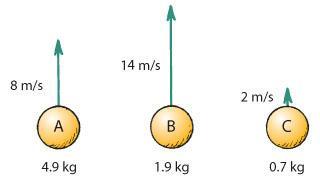
From fastest to slowest, rank the speeds of the balls 1 s after being thrown. Rank the speeds of the balls from fastest to slowe

st. To rank items as equivalent, overlap them. Three balls of different masses are thrown straight upward with initial speeds as indicated: PICTURE
rank speeds
rank acclerations

Physics
2 answers:
Rus_ich [418]2 years ago
8 0

Explanation:

From the given figure,

Mass of ball A is 4.9 kg and its initial speed is 8 m/s.

Mass of ball B is 1.9 kg and its initial speed is 14 m/s.

Mass of ball C is 0.7 kg and its initial speed is 2 m/s.

We need to find the final speed of the balls 1 s after being thrown. They all are thrown upward under the action of gravity. The equation of motion is : v = u -gt, g = 10 m/s²

For ball A,

v = 8-10(1) = = -2 m/s (downward)

For B,

v = 14-10(1) = 4 m/s (upward)

For C,

v = 2-10(1) = -8 m/s (downward)

It means the ranking is B>A>C i.e. the speed of ball B is the most and that of C is least.

All the balls are moving under the action of gravity. It would mean that the acceleration for all balls is same i.e. 10 m/s²

jeka57 [31]2 years ago
6 0

Answer:

what they said

Explanation:

You might be interested in
two students are on a balcony 19.6 m above the street. one student throws a ball vertically downward at 14.7 m:ds. at the same i
NARA [144]

A. The difference in the two ball's time in the air is 3 seconds

B. The velocity of each ball as it strikes the ground is 24.5 m/s

C. The balls 0.500 s after they are thrown are 14.7 m apart

<h3>Further explanation</h3>

Acceleration is rate of change of velocity.

\large {\boxed {a = \frac{v - u}{t} } }

\large {\boxed {d = \frac{v + u}{2}~t } }

<em>a = acceleration ( m/s² )</em>

<em>v = final velocity ( m/s )</em>

<em>u = initial velocity ( m/s )</em>

<em>t = time taken ( s )</em>

<em>d = distance ( m )</em>

Let us now tackle the problem!

<u>Given:</u>

Initial Height = H = 19.6 m

Initial Velocity = u = 14.7 m/s

<u>Unknown:</u>

A. Δt = ?

B. v = ?

C. Δh = ?

<u>Solution:</u>

<h2>Question A:</h2><h3>First Ball</h3>

h = H - ut - \frac{1}{2}gt^2

0 = 19.6 - 14.7t - \frac{1}{2}(9.8)t^2

0 = 19.6 - 14.7t - 4.9t^2

4.9t^2 + 14.7t - 19.6 = 0

t^2 + 3t - 4 = 0

(t + 4)(t - 1) = 0

(t - 1) = 0

\boxed {t = 1 ~ second}

<h3>Second Ball</h3>

h = H + ut - \frac{1}{2}gt^2

0 = 19.6 + 14.7t - \frac{1}{2}(9.8)t^2

0 = 19.6 + 14.7t - 4.9t^2

4.9t^2 - 14.7t - 19.6 = 0

t^2 - 3t - 4 = 0

(t - 4)(t + 1) = 0

(t - 4) = 0

\boxed {t = 4 ~ seconds}

The difference in the two ball's time in the air is:

\Delta t = 4 ~ seconds - 1 ~ second

\large {\boxed {\Delta t = 3 ~ seconds} }

<h2>Question B:</h2><h3>First Ball</h3>

v^2 = u^2 - 2gH

v^2 = (-14.7)^2 + 2(-9.8)(-19.6)

v^2 = 600.25

v = \sqrt {600.25}

\boxed {v = 24.5 ~ m/s}

<h3>Second Ball</h3>

v^2 = u^2 - 2gH

v^2 = (14.7)^2 + 2(-9.8)(-19.6)

v^2 = 600.25

v = \sqrt {600.25}

\boxed {v = 24.5 ~ m/s}

The velocity of each ball as it strikes the ground is 24.5 m/s

<h2>Question C:</h2><h3>First Ball</h3>

h = H - ut - \frac{1}{2}gt^2

h = 19.6 - 14.7(0.5) - \frac{1}{2}(9.8)(0.5)^2

\boxed {h = 11.025 ~ m}

<h3>Second Ball</h3>

h = H + ut - \frac{1}{2}gt^2

h = 19.6 + 14.7(0.5) - \frac{1}{2}(9.8)(0.5)^2

\boxed {h = 25.725 ~ m}

The difference in the two ball's height after 0.500 s is:

\Delta h = 25.725 ~ m - 11.025 ~ m

\large {\boxed {\Delta h = 14.7 ~ m} }

<h3>Learn more</h3>
  • Velocity of Runner : brainly.com/question/3813437
  • Kinetic Energy : brainly.com/question/692781
  • Acceleration : brainly.com/question/2283922
  • The Speed of Car : brainly.com/question/568302

<h3>Answer details</h3>

Grade: High School

Subject: Physics

Chapter: Kinematics

Keywords: Velocity , Driver , Car , Deceleration , Acceleration , Obstacle
6 0
2 years ago
Andy is waiting at the signal. As soon as the light turns green, he accelerates his car at a uniform rate of 8.00 meters/second2
Tatiana [17]
You can reason it out like this:

-- The car starts from rest, and goes 8 m/s faster every second.

-- After 30 seconds, it's going (30 x 8) = 240 m/s.

-- Its average speed during that 30 sec is  (1/2) (0 + 240) = 120 m/s

-- Distance covered in 30 sec at an average speed of 120 m/s

                                                                           =  3,600 meters .
___________________________________

The formula that has all of this in it is the formula for
distance covered when accelerating from rest:

       Distance = (1/2) · (acceleration) · (time)²

                       = (1/2) ·      (8 m/s²)     · (30 sec)²

                       =      (4 m/s²)          ·      (900 sec²)

                       =            3600 meters.

_________________________________

When you translate these numbers into units for which
we have an intuitive feeling, you find that this problem is
quite bogus, but entertaining nonetheless.

When the light turns green, Andy mashes the pedal to the metal
and covers almost 2.25 miles in 30 seconds.

How does he do that ?

By accelerating at 8 m/s².  That's about 0.82 G  !

He does zero to 60 mph in 3.4 seconds, and at the end
of the 30 seconds, he's moving at 534 mph ! 

He doesn't need to worry about getting a speeding ticket.
Police cars and helicopters can't go that fast, and his local
police department doesn't have a jet fighter plane to chase
cars with.
3 0
2 years ago
Human muscles have an efficiency of about __________. A. 9 to 17% B. 18 to 26% C. 27 to 35% D. 36 to 44%
xxTIMURxx [149]

Answer:

The correct answer would be B. 18 to 26%.

The muscle efficiency is calculated by dividing mechanical work output by total metabolic cost.

It is estimated that human muscles have an efficiency of about 18% to 26%.

The efficiency is low because most of the energy is lost when food energy is converted into ATP (adenosine triphophate).

In addition, there is second energy loss when energy in the form of ATP is converted into the mechanical energy such as rowing, cycling et cetera.

3 0
2 years ago
Read 2 more answers
Two planes leave wichita at noon. one plane flies east 30 mi/h faster than the other plane, which is flying west. at what time w
scoundrel [369]
You have to take note of the individual directions of the plane. Since one is heading east, and the other is heading west, the planes are heading at opposite directions. So, it means that their distance between each other would be equal to 1,200 miles which accounts for the sum of their individual distances. The equation is as follows:

Total Distance = Distance of slower plane + Distance of faster plane
1,200 miles = st + (30+s)(t)
where
s is the speed of the slower plane and t is the time. Since both are not given, the final answer would just be in terms of s.
1,200 = t(s + 30 + s)
t = 1200/(30+2s)
t = 600/(15+s)
4 0
2 years ago
A uniform magnetic field of 0.50 T is directed along the positive x axis. A proton moving with a speed of 60 km s enters this fi
tatuchka [14]

Explanation:

It is given that,

Magnetic field, B = 0.5 T

Speed of the proton, v = 60 km/s = 60000 m/s

The helical path followed by the proton shown has a pitch of 5.0 mm, p = 0.005 m

We need to find the  angle between the magnetic field and the velocity of the proton. The pitch of the helix is the product of parallel component of velocity and time period. Mathematically, it is given by :

p=v_{||}\times T

p=v\ cos\theta\times \dfrac{2\pi m}{Bq}

cos\theta=\dfrac{pBq}{2\pi mv}

cos\theta=\dfrac{0.005\times 0.5\times 1.6\times 10^{-19}}{2\pi \times 1.67\times 10^{-27}\times 60000}

\theta=50.58^{\circ}

So, the angle between the magnetic field and the velocity of the proton is 50.58 degrees. Hence, this is the required solution.

3 0
2 years ago
Other questions:
  • A very long, straight horizontal wire carries a current such that 8.15×10¹⁸ electrons per second pass any given point going from
    5·2 answers
  • All of the following are types of perceptual constancies except __________ constancy. A. direction B. size C. shape D. color
    13·3 answers
  • A 0.111 kg hockey puck moving at 55 m/s is caught by a 80. kg goalie at rest. with what speed does the goalie slide on the frict
    5·1 answer
  • A suspicious-looking man runs as fast as he can along a moving sidewalk from one end to the other, taking 2.20 s. Then security
    7·1 answer
  • A student, along with her backpack on the floor next to her, are in an elevator that is accelerating upward with acceleration a.
    12·1 answer
  • Two speakers face each other, and they each emit a sound of wavelength λ. One speaker is 180∘ out of phase with respect to the o
    12·1 answer
  • A 6.0-cm-diameter, 11-cm-long cylinder contains 100 mg of oxygen (O2) at a pressure less than 1 atm. The cap on one end of the c
    6·1 answer
  • The box of negligible size is sliding down along a curved path defined by the parabola y=0.4x2. When it is a A(xA = 2 m, yA = 1.
    14·2 answers
  • Yasmin determines the velocity of a car to be 15 m/s. The accepted value for the velocity of the car is 15.6 m/s. What is Yasmin
    10·2 answers
  • Select the correct expression that gives the block's acceleration at a displacement x from the equilibrium position. Note that x
    12·2 answers
Add answer
Login
Not registered? Fast signup
Signup
Login Signup
Ask question!
