answer.
Ask question
Login Signup
Ask question
All categories
  • English
  • Mathematics
  • Social Studies
  • Business
  • History
  • Health
  • Geography
  • Biology
  • Physics
  • Chemistry
  • Computers and Technology
  • Arts
  • World Languages
  • Spanish
  • French
  • German
  • Advanced Placement (AP)
  • SAT
  • Medicine
  • Law
  • Engineering
Shalnov [3]
2 years ago
11

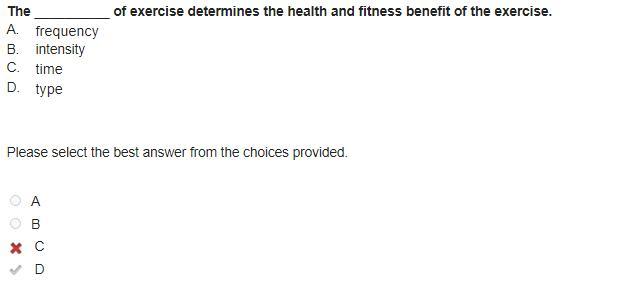
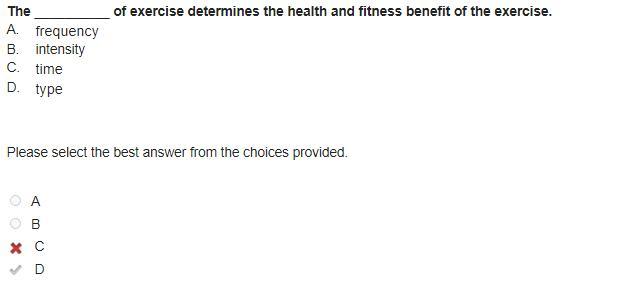
The __________ of exercise determines the health and fitness benefit of the exercise. A. frequency B. intensity C. time D. type

Please select the best answer from the choices provided. A B C D

Physics
2 answers:
gulaghasi [49]2 years ago
7 0

Answer:

The guy above me is wrong the real answer is D

Explanation:

MariettaO [177]2 years ago
6 0

Answer:

c- Time

Explanation:

The time will tell depending on the person who is exercising, the rate of time, the  workout time. & limits on weights....

Guest
1 year ago
its D-
You might be interested in
Many industries are powered via distant power stations. Calculate the current flowing through a 7,300m long 10. copper power lin
Oliga [24]

Answer:

Current, I = 1000 A

Explanation:

It is given that,

Length of the copper wire, l = 7300 m

Resistance of copper line, R = 10 ohms

Magnetic field, B = 0.1 T

\mu_o=4\pi \times 10^{-7}\ T-m/A

Resistivity, \rho=1.72\times 10^{-8}\ \Omega-m

We need to find the current flowing the copper wire. Firstly, we need to find the radius of he power line using physical dimensions as :

R=\rho \dfrac{l}{A}

R=\rho \dfrac{l}{\pi r^2}

r=\sqrt{\dfrac{\rho l}{R\pi}}

r=\sqrt{\dfrac{1.72\times 10^{-8}\times 7300}{10\pi}}

r = 0.00199 m

or

r=1.99\times 10^{-3}\ m=2\times 10^{-3}\ m

The magnetic field on a current carrying wire is given by :

B=\dfrac{\mu_o I}{2\pi r}

I=\dfrac{2\pi rB}{\mu_o}

I=\dfrac{2\pi \times 0.1\times 2\times 10^{-3}}{4\pi \times 10^{-7}}

I = 1000 A

So, the current of 1000 A is flowing through the copper wire. Hence, this is the required solution.

4 0
2 years ago
Suppose a plot of inverse wavelength vs frequency has slope equal to 0.119, what is the speed of sound traveling in the tube to
strojnjashka [21]

Answer:

8.40 m/s

Explanation:

Slope of the plot is 0.119

Slope of a plot is given by the change in y direction divided by the change in x direction

Here, the y axis represents inverse wavelength and the x axis represents frequency.

f = Frequency (Hz, assumed)

v = Phase velocity (m/s, assumed)

λ = Wavelength (m, assumed)

So, slope

m=\frac{\frac{1}{\lambda}}{f}

Now,

\lambda=\frac{v}{f}\\\Rightarrow \lambda^{-1}=\frac{f}{v}

\\\Rightarrow m=\frac{\frac{f}{v}}{f}\\\Rightarrow 0.119=\frac{1}{v}\\\Rightarrow v=\frac{1}{0.119}\\\Rightarrow v=8.40\ m/s

The speed of sound travelling in the tube is 8.40 m/s

5 0
2 years ago
Steam undergoes an adiabatic expansion in a piston–cylinder assembly from 100 bar, 360°C to 1 bar, 160°C. What is work in kJ per
vfiekz [6]

Answer:

work is 130.5 kJ/kg

entropy change is 1.655 kJ/kg-k

maximum  theoretical work is 689.4 kJ/kg

Explanation:

piston cylinder assembly

100 bar, 360°C to 1 bar, 160°C

to find out

work  and amount of entropy  and magnitude

solution

first we calculate work i.e heat transfer - work =   specific internal energy @1 bar, 160°C  - specific internal energy @ 100 bar, 360°C    .................1

so first we get some value from steam table with the help of 100 bar @360°C and  1 bar @ 160°C

specific volume = 0.0233 m³/kg

specific enthalpy = 2961 kJ/kg

specific internal energy = 2728 kJ/kg

specific entropy = 6.004 kJ/kg-k

and respectively

specific volume = 1.9838 m³/kg

specific enthalpy = 2795.8 kJ/kg

specific internal energy = 2597.5 kJ/kg

specific entropy = 7.659 kJ/kg-k

now from equation 1 we know heat transfer q = 0

so - w =   specific internal energy @1 bar, 160°C  - specific internal energy @ 100 bar, 360°C

work = 2728 - 2597.5

work is 130.5 kJ/kg

and entropy change formula is i.e.

entropy change =  specific entropy ( 100 bar @360°C)  - specific entropy ( 1 bar @160°C )

put these value we get

entropy change =  7.659 - 6.004

entropy change is 1.655 kJ/kg-k

and we know maximum  theoretical work = isentropic work

from steam table we know specific internal energy is 2038.3 kJ/kg

maximum  theoretical work = specific internal energy - 2038.3

maximum  theoretical work = 2728 - 2038.3

maximum  theoretical work is 689.4 kJ/kg
3 0
2 years ago
When a hot and cold object are placed in contact, the hot one loses energy. Does this violate energy conservation? Why or why no
blsea [12.9K]

Answer:

This does not violate the conservation of energy.

Explanation:

This does not violate the conservation of energy because the hot body gives energy in the form of heat to the colder body, this second absorbs energy. This will be the case until both bodies reach the same temperature, reaching thermal equilibrium and reducing the transfer of thermal energy. In this way the energy was only transferred from one body to another but the total energy of the system (body 1 plus body 2) will be the same as in the beginning, respecting the principle of conservation of energy or also called the first principle of thermodynamics .

The part of physics that studies these processes is in turn called heat transfer or heat transfer or thermal transfer. Heat transfer occurs whenever there is a thermal gradient or when two systems with different temperatures come into contact. The process persists until thermal equilibrium is reached, that is, until temperatures are equalized. When there is a temperature difference between two objects or regions close enough, the heat transfer cannot be stopped, it can only be slowed down.

8 0
2 years ago
A 25 gram bullet is fired from a gun with a speed of 230 m/s. If the gun has a mass of 0.9 kg what is the recoil speed of gun ?
Step2247 [10]

Given data:

mass of the bullet (m) = 25 g = 0.025 kg,

mass of the gun    (M) = 0.9 kg,

speed of the bullet (v) =230 m/s,

speed of the bullet (V) = ?

From the given data it is clear that, the momentum is conserved. According to "<em>law of conservation of momentum" </em>the total momentum before and after the collision is equal.

In this problem the momentum before collision (bullet+gun) is zero.

Therefore, after the gun fires a bullet, the momentum must be zero.

Mathematically,

          M × V + m × v = 0

           where,

                     M × V = momentum of the gun

                     m × v = momentum of the bullet

            (0. 9 × V) + (0.025 × 230) = 0

             0.9 V = -5.75

                    V = -5.75/0.9

                        = -6.39 m/s  

<em>The gun recoils with a speed of 6.39 m/s</em>

8 0
2 years ago
Other questions:
  • 1. In a single atom, no more than 2 electrons can occupy a single orbital? A. True B. False
    10·2 answers
  • Which vector has a y-component with a length of 1?
    11·2 answers
  • The position function x(t) of a particle moving along an x axis is x = 4.00 - 6.00t2, with x in meters and t in seconds. (a) at
    14·1 answer
  • The particle with charge q is now released and given a quick push; as a result, it acquires speed v. Eventually, this particle e
    10·1 answer
  • A 20~\mu F20 μF capacitor has previously charged up to contain a total charge of Q = 100~\mu CQ=100 μC on it. The capacitor is t
    10·1 answer
  • The study of alternating electric current requires the solutions of equations of the form i equals Upper I Subscript max Baselin
    13·1 answer
  • A 3.45-kg centrifuge takes 100 s to spin up from rest to its final angular speed with constant angular acceleration. A point loc
    5·1 answer
  • Light rays from stars bend toward smaller angles as they enter Earth's atmosphere. a. Explain why this happens using Snell's law
    8·1 answer
  • Calculate the force of gravity between two objects of masses 1300 kg and 7800 kg, which are 0.23 m apart.
    6·1 answer
  • Use the idea of density to explain why the dead creatures sink to the seabed​
    9·2 answers
Add answer
Login
Not registered? Fast signup
Signup
Login Signup
Ask question!