answer.
Ask question
Login Signup
Ask question
All categories
  • English
  • Mathematics
  • Social Studies
  • Business
  • History
  • Health
  • Geography
  • Biology
  • Physics
  • Chemistry
  • Computers and Technology
  • Arts
  • World Languages
  • Spanish
  • French
  • German
  • Advanced Placement (AP)
  • SAT
  • Medicine
  • Law
  • Engineering
Dahasolnce [82]
2 years ago
9

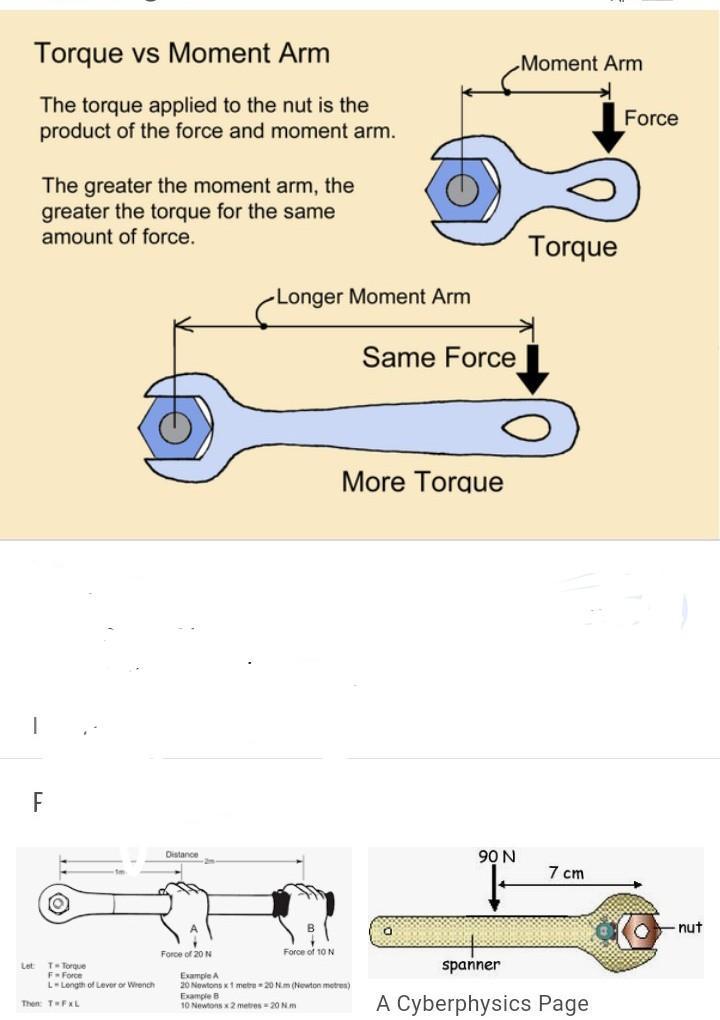
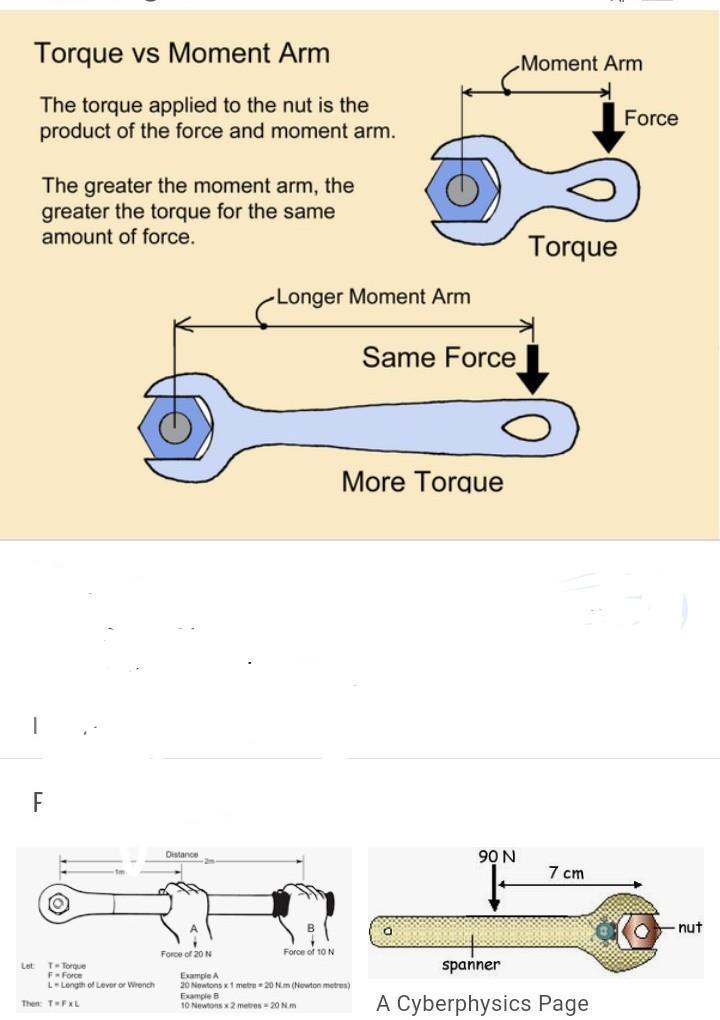
there is a rusted nut we have a two spanners each of i 15 cm and 20 CM respectively which spanner is suitable to open the nut an

d why​

Physics
1 answer:
Novosadov [1.4K]2 years ago
8 0
<h2>Answer : </h2>

20cm spanner is suitable to open this nut , Because we feel easy to apply force at the end of spanner to rusted nut. It means that as the perpendicular distance between force and axis of rotation increase the magnitude of moment also increase.

I think the Answer will helps you.....

Thank you ☺️☺️☺️

You might be interested in
The driver of a car slams on the brakes when he sees a tree blocking the road. The car slows uniformly with acceleration of −5.2
sergejj [24]

Answer:

The car strikes the tree with a final speed of 4.165 m/s

The acceleration need to be of -5.19 m/seg2 to avoid collision by 0.5m

Explanation:

First we need to calculate the initial speed V_{0}

x=V_{0} *t+\frac{1}{2} *a*(t^{2} )\\62.5m=V_{0} *4.15s+\frac{1}{2} *-5.25\frac{m}{s^{2} } *(4.15^{2} )\\V_{0}=25.953\frac{m}{s}

Once we have the initial speed, we can isolate the final speed from following equation:

V_{f} =V_{0} +a*t  V_{f}= 4.165 \frac{m}{s}  

Then we can calculate the aceleration where the car stops 0.5 m before striking the tree.

To do that, we replace 62 m in the first formula, as follows:

x=V_{0} *t+\frac{1}{2} *a*(t^{2} )\\62m=25.953\frac{m}{s}*4.15s+\frac{1}{2} *-a\frac{m}{s^{2} } *(4.15^{2} )\\a=-5.19\frac{m}{s^{2} }

3 0
2 years ago
Read 2 more answers
A sailboat starts from rest and accelerates at a rate of 0.21 m/s^2 over a distance of 280 m. find the magnitude of the boat's f
sasho [114]

We use the kinematic equations,

v=u+at                                          (A)

S= ut + \frac{1}{2} at^2                  (B)

Here, u is initial velocity, v is final velocity, a is acceleration and t is time.

Given,  u=0, a=0.21 \ m/s^2 and s= 280 m.

Substituting these values in equation (B), we get

280 \ m = 0 +\frac{1}{2} (0.21 m/s^2) t^2 \\\\ t^2 = \frac{280 \times 2}{0.21 } \\\\ t= 51.63 \ s.

Therefore from equation (A),

v = 0 + (0.21) \times (51.63 s)= 10.84 \ m/s

Thus, the magnitude of the boat's final velocity is 10.84 m/s and the time taken by boat to travel the distance 280 m is 51.63 s


8 0
2 years ago
At a certain instant after jumping from the airplane A, a skydiver B is in the position shown and has reached a terminal (consta
Lubov Fominskaja [6]

Answer:

a=2330

b= 0.223secs

Explanation:

pb=2330m

t=0.223secs

6 0
2 years ago
In the late 19th century, great interest was directed toward the study of electrical discharges in gases and the nature of so-ca
gizmo_the_mogwai [7]

Answer:

A) He finds the same value of q / m for different materials , B)      y = ½ (q / m) E L² / v₀ₓ² , C) v = E / B , D)   B = 2.13 10⁻⁶ T, E) For the first part I have two off-center points., For the second part I can center one point but the other is off center

Therefore the third statement is correct
Explanation:

Part A

Thomson's experiments are the first proof that the atoms that until now were considered indivisible were constituted by different elements, in these experiments Thomson himself the ratio q / m of several cathodes and always found the same value, which allowed to establish that In atoms there are two types of particles, some of which are mobile and others are still.

When examining his statements the correct one is: He finds the same value of q / m for different materials

Part B

For this part let's use Newton's second law

        F = ma

        q E = m a

        a = q / m E

We use the kinematic relationship

          y = voy t - ½ to t²

          x = v₀ₓ t

The initial vertical velocity of electrons is zero

           y = ½ a (x / v₀ₓ)²

We replace

           y = ½ (q / m) E L² / v₀ₓ²

Part C

If there is no deflection, the electric and magnetic forces are the same and in the opposite direction

         Fm = Fe

         q v B = q E

          v = E / B

Part D


        We replace

        y = ½ (q / m) E L² / (E / B)²

         y = ½ (q / m) L² B² / E

If we do not want any deflection the magnetic field has to return the electrons the amount that they lower y = -4.12 cm

      -4.12 10⁻² = ½ q / m 0.12² B² / 1.1 10³

       -16.97 10⁻⁴ = 6.54 10⁻³ B² q / m

      B² = -2.59 10⁻¹ q / m

      q / m = -1.758 10¹¹ C/ kg

      B = √ 0.259 1.758 10¹¹ = √ 4.55 10⁻¹²

      B = 2.13 10⁻⁶ T

Part E

As the charge that the two particles is different

For the first part I have two off-center points.

For the second part I can center one point but the other is off center

Therefore the third statement is correct
8 0
2 years ago
Susan and Hannah are each riding a swing. Susan has a mass of 25 kilograms, and Hannah has a mass of 30 kilograms. Susan’s swing
Charra [1.4K]

Answer:

Kinetic energy is given by:

K.E. = 0.5 m v²

Susan has mass, m = 25 kg

Velocity with which Susan moves is, v = 10 m/s

Hannah has mass, m' = 30 kg

Velocity with which Hannah moves is, v' = 8.5 m/s

<u>Kinetic energy of Susan:</u>

0.5 m v² = 0.5 × 25 kg × (10 m/s)² = 1250 J

<u>Kinetic energy of Hannah:</u>

0.5 m v'² = 0.5 × 30 kg × (8.5 m/s)² = 1083.75 J

Susan's kinetic energy is <u>1250 J </u>and Hannah's kinetic energy is <u>1083.75 J</u>.

Since kinetic energy is dependent on mass and square of speed. Thus, speed has a greater effect than mass. As it is evident from the above example. Susan has greater kinetic energy due to higher speed than Hannah.

4 0
2 years ago
Other questions:
  • Light has wavelength 600 nm in a vacuum. it passes into glass, which has an index of refraction of 1.5. what is the frequency of
    5·1 answer
  • A hydrogen atom contains a single electron that moves in a circular orbit about a single proton. Assume the proton is stationary
    8·1 answer
  • A lab assistant drops a 400.0-g piece of metal at 100.0°C into a 100.0-g aluminum cup containing 500.0 g of water at In a few mi
    5·1 answer
  • You are wallpapering two walls of a room. One wall measures 15 ft by 12 ft and the other measures 9 ft by 12 ft. The wall paper
    10·1 answer
  • Two trucks with equal mass are attracted to each other with a gravitational force of 5.3 x 10 -4 N. The trucks are separated by
    12·1 answer
  • A charge Q is distributed uniformly along the x axis from x1 to x2. What would be the magnitude of the electric field at x0 on t
    8·1 answer
  • Betelgeuse is the bright red star representing the left shoulder of the constellation Orion. All the following statements about
    7·1 answer
  • A diffraction grating is illuminated with yellow light at normal incidence. The pattern seen on a screen behind the grating cons
    9·1 answer
  • an elastic cord 61 cm long when a weight of 75N hangs from it, but 85cm when a weight of 210N hangs from it. what is the spring
    12·1 answer
  • If John mows 11.5 meters of lawn from east
    12·1 answer
Add answer
Login
Not registered? Fast signup
Signup
Login Signup
Ask question!
