answer.
Ask question
Login Signup
Ask question
All categories
  • English
  • Mathematics
  • Social Studies
  • Business
  • History
  • Health
  • Geography
  • Biology
  • Physics
  • Chemistry
  • Computers and Technology
  • Arts
  • World Languages
  • Spanish
  • French
  • German
  • Advanced Placement (AP)
  • SAT
  • Medicine
  • Law
  • Engineering
GuDViN [60]
2 years ago
4

suspension are mixtures composed of materials that are visible to the naked eyes true or false? in science subject​

Chemistry
1 answer:
Rufina [12.5K]2 years ago
5 0

Answer:

True

Explanation:

Suspensions are referred to as mixtures composed of materials which are visible to the naked eyes . They are usually insoluble in the solvent .

The mixtures which are composed of materials and at the same time non visible to the naked eyes due to their very tiny size are referred to as colloids or colloidal particles in the field of science.

You might be interested in
Consider the two electron arrangements for neutral atoms A and B. What is the difference between atom A and atom B? A - 1s2, 2s2
antiseptic1488 [7]
The outer electron of atom B has moved to a higher energy state.<span>B - 1s2, 2s2, 2p6, 5s1 </span>
3 0
2 years ago
Read 2 more answers
Refer to the map of "The Major North American Land Biomes" to answer the question.
Misha Larkins [42]

Answer:

all i can help you with is one of them is Canada. If im

wrong i am sorry.

8 0
2 years ago
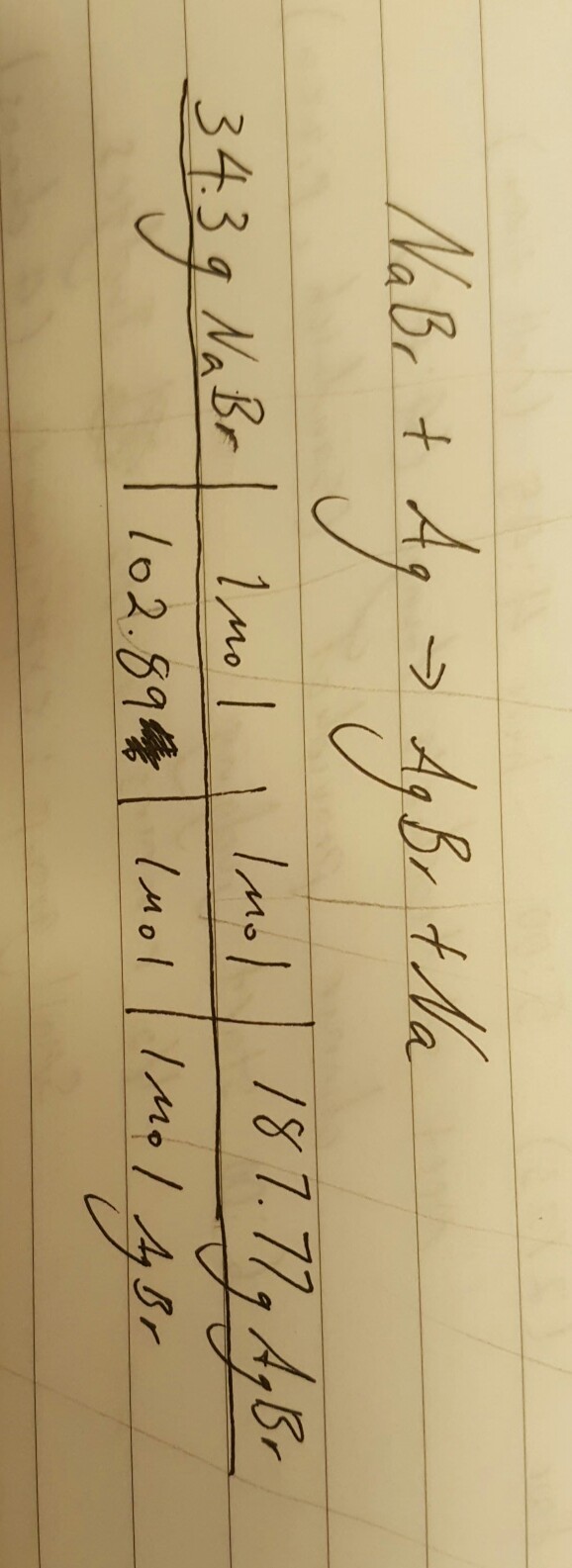
What mass of AgBr can be produced starting with 34.3G of NaBr? (Stoichiometry method)
olga nikolaevna [1]
The equation is already balanced so the mole ratio is just 1/1 and from the question you could conclude that the equation is a single displacement

5 0
2 years ago
A sample of an unknown substance has a mass of .158 kg if 2,510 J of heat is required to heat the substance from 32°C to 61°C wh
ziro4ka [17]

Answer: 0.548J/g°C

Explanation:

Q = s × m × DeltaT

Q = Heat (J)

S = Specific Heat Capacity

M = mass (g)

DeltaT = Change in temperature (°C)

0.158Kg x 1000 = 158g

2.510J = s x 158g x (61°C-32°C)

2.510J/(158g x 29°C) = s

S = 0.54779.... J/g°C

S = 0.548 J/g°C

7 0
2 years ago
In 200 g of a concentrated solution of 70.4 wt% nitric acid (r = 1.41 g/mL, FW(HNO3) = 63.01 g/mol), how many grams of water are
mars1129 [50]

Answer:

59.2 grams

Explanation:

We are given that 70.4% of the weight of the total 200 g of the concentration is made up of nitric acid, the remaining information is not required to solve the problem. Since water and nitric acid are the only components of the solution, the total weight of water is given by:

W = 200*(1-0.704)\\W=59.2\ g

There are 59.2 grams of water in this solution.

5 0
2 years ago
Other questions:
  • An electron in the n=6 level of the hydrogen atom relaxes to a lower energy level, emitting light of ?=93.8nm. find the principa
    7·2 answers
  • Compare and contrast the outer core and the inner core.
    8·2 answers
  • Give the nuclide symbol for an atom that has<br> mass number 64 and 35 neutrons.
    5·1 answer
  • if 20.g of a radioactive isotope are present at 1:00 pm and 5.0g remain at 2:00 pm, what is the half life of the isotope?
    9·1 answer
  • Using two spring scales, students pull on opposite sides of a dynamic cart at rest. 7 Newtons of force is pulling left and 5 New
    7·1 answer
  • What does X represent in the formula for the compound XCl4?
    10·1 answer
  • If you add a chunk of zinc to a beaker of acid and zinc shavings to another beaker of acid, the sample with the zinc shavings wi
    13·1 answer
  • An athlete has 15% body fat by mass. What is the weight of fat, in pounds, of a 74 kg-athlete?
    13·1 answer
  • A student buys a rope at the store. The label on the packaging says that the rope is 2.15 meters in length. The student measures
    14·1 answer
  • The mass of radium-226 in a sample is found to have decreased from 45.00g to 5.625g in a period of 4800 years.From this informat
    13·1 answer
Add answer
Login
Not registered? Fast signup
Signup
Login Signup
Ask question!