answer.
Ask question
Login Signup
Ask question
All categories
  • English
  • Mathematics
  • Social Studies
  • Business
  • History
  • Health
  • Geography
  • Biology
  • Physics
  • Chemistry
  • Computers and Technology
  • Arts
  • World Languages
  • Spanish
  • French
  • German
  • Advanced Placement (AP)
  • SAT
  • Medicine
  • Law
  • Engineering
Digiron [165]
2 years ago
10

A cathode ray tube is made of glass with a small amount of some kind of gas in it. It has metal electrodes at each end to pick u

p an electric current. The electrodes are named "positive” and "negative."
What are one of the main uses of this device ?
Chemistry
1 answer:
Butoxors [25]2 years ago
5 0

Answer:

One of the main uses of the cathode ray tube is in the Cathode  ray oscilloscope

Explanation:

Cathode rays are produced when a gas in an evacuated glass at very low pressure and high pressure breaks up into positive and negative ions. the negative ions move towards the anode(positive electrode) while the positive ions move towards the cathode(negative electrode), and there they knock off electrons (which are known as cathode rays) from the metal plate of the cathode.

Cathode ray tubes are mainly used in oscilloscopes, television picture tubes and in computer screens.

The cathode ray oscilloscope is used in a.c. and d.c. voltage measurements, observation of waveforms, time measurements, etc.

You might be interested in
Vinegar is an aqueous solution of acetic acid, ch3cooh. a 5.00 ml sample of a particular vinegar requires 26.90 ml of 0.175 m na
Fed [463]

  The molarity  of  acetic acid in the  vinegar is  0.94 M


 <u><em> calculation</em></u>

Step 1:  write  the balanced equation between CH3COOH  + NaOH

that is CH3COOH   + NaOH  →  CH3COONa  + H2O


step 2 :  find the moles of NaOH

moles  =molarity  x volume in L

volume in liters = 26.90/1000=0.0269 l

moles = 0.175 mol /L x 0.0269 L  =0.0047  moles  of NaOH


Step 3: use the mole  ratio to find moles of CH3COOH

that is the  mole ratio of  CH3COOH: NaOH is 1:1 therefore  the moles of CH3COOH is  =0.0047  moles


Step 4:  find the  molarity  of  CH3COOH

molarity = moles/volume in liters

volume in liter = 5.00/1000 =0.005 l

molarity  is therefore=0.0047 moles/ 0.005 l = 0.94 M

4 0
2 years ago
Kaia, a chemical engineering graduate, has documented all titration procedures in her project report. She refers to this report
vagabundo [1.1K]

Answer:

The correct option is;

d. Explicit knowledge

Explanation:

Explicit knowledge is the knowledge that can be easily articulated documented stored in a retrieval system accesses, transmitted and shared with others

Tacit knowledge is the skill developed by an individual based on actual experience such that such knowledge comprise of both facts and perspectives

Hence explicit knowledge and tacit knowledge are complementary

The operations performed by Kaia include documentation, storing in a retrieval system (her project report) and accessing what she documented, this is an example of explicit knowledge.

7 0
2 years ago
How much maleic anhydride would you need to react 178 mg of anthracene? Assume 1:1 ratio from maleic anhydride to anthracene.
Licemer1 [7]

Answer:

(1) 0.10      (2) 17.8 g

Explanation:

Since the reaction ratio is 1:1 what we need is to convert the given masses to moles and you will have the answer:

MW anthracene = 178.23 g/mol

MW maleic anhydride = 98.06 g/mol

a) mass anthracene = 178 mg x 1 g/ 1000 mg = 0.178 g anthracene

Moles anthracene = 0.178 g anthracene/ 178.23 g/mol

= 0.001 mol anthracene

0.001 mol anthracene x 1 mol maleic acid/mol anthracene

= 0.001 mol maleic anhydride

mass maleic anhydride  = 0.001 mol x 98.06 g/mol =  0.10 g

b) moles maleic anhydride = 9.8 g/ 98.06 g/mol = 0.099 moles

0.099 moles maleic anhydride x 1 mol anthracene/mol  maleic anhydride =

0.099 mol anthracene

g anthracene = 0.10mol x 178 g/mol = 17.8 g

8 0
2 years ago
What mass of solid NaOH (97.0 % by mass) is required to prepare 1.00 L of a 10.0% solution of NaOH by mass? The density of the 1
Lelechka [254]

<u>Answer:</u> The mass of 97 % of NaOH solution required is 114.33 g

<u>Explanation:</u>

To calculate mass of a substance, we use the equation:

\text{Density of substance}=\frac{\text{Mass of substance}}{\text{Volume of substance}}

We are given:

Density of 10 % solution = 1.109 g/mL

Volume of 10% solution = 1 L = 1000 mL     (Conversion factor:  1 L = 1000 mL)

Putting values in above equation, we get:

1.109g/mL=\frac{\text{Mass of }10\%\text{ solution}}{1000mL}\\\\\text{Mass of }10\%\text{ solution}=1109g

The mass of 10 % solution is 1109 g.

To calculate the mass of concentrated solution, we use the equation:

c_1m_1=c_2m_2

where,

c_1\text{ and }m_1 are the concentration and mass of concentrated solution.

c_2\text{ and }m_2 are the concentration and mass of diluted solution.

We are given:

c_1=97\%\\m_1=?g\\c_2=10\%\\m_2=1109g

Putting values in above equation, we get:

97\times m_1=10\times 1109\\\\m_1=114.33g

Hence, the mass of 97 % of NaOH solution required is 114.33 g

3 0
2 years ago
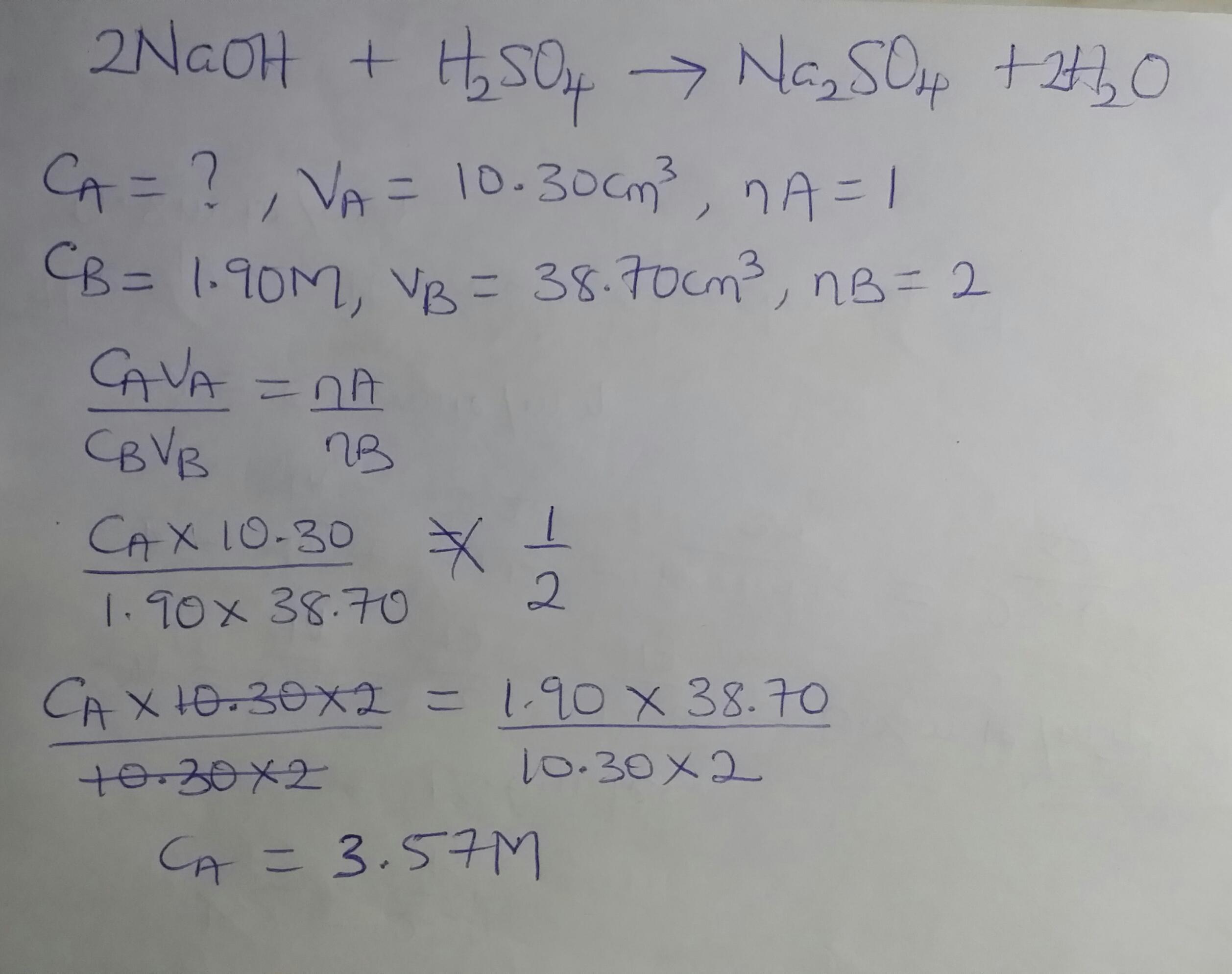
If it takes 38.70cm³ of 1.90 M NaOH to neutralize 10.30cm³ of H2SO4 in a battery, What's the Molarity of the H2SO4 ?​
arlik [135]

Answer: 3.57M

Explanation:Please see attachment for explanation

3 0
2 years ago
Read 2 more answers
Other questions:
  • PLEASE HELP!!! Which of John Dalton's contributions are present in the modern atomic model and which were eventually disproven a
    12·1 answer
  • Solar energy travels to the Earth in many forms, such as ultraviolet radiation, infrared radiation, and visible rays. These vari
    9·1 answer
  • Impure benzoic acid was dissolved in hot water. the container of solution was placed in an ice-water bath instead of being allow
    14·1 answer
  • ASAP PLEASE HELP:
    11·2 answers
  • What is the molarity of potassium ions in a 0.122 M K2CrO4 solution
    12·2 answers
  • Phosphorous and chlorine gases combine to produce phosphorous trichloride: P2(g)+3Cl2(g)→2PCl3(g) ΔG∘ at 298K for this reaction
    14·1 answer
  • A 1000.0 ml sample of lake water in titrated using 0.100 ml of a 0.100 M base solution. What is the molarity (M) of the acid in
    13·1 answer
  • Tritium 3 1H decays to 3 2He by beta emission. Find the energy released in the process. Answer in units of keV.
    13·1 answer
  • In an experiment, the reaction of 100.0 g of iodine produced 144.9 g of a compound formed from iodine and fluorine.
    14·1 answer
  • What is the hybridization and shape for an XeF6 2+ molecule?
    8·1 answer
Add answer
Login
Not registered? Fast signup
Signup
Login Signup
Ask question!