answer.
Ask question
Login Signup
Ask question
All categories
  • English
  • Mathematics
  • Social Studies
  • Business
  • History
  • Health
  • Geography
  • Biology
  • Physics
  • Chemistry
  • Computers and Technology
  • Arts
  • World Languages
  • Spanish
  • French
  • German
  • Advanced Placement (AP)
  • SAT
  • Medicine
  • Law
  • Engineering
Ivenika [448]
2 years ago
12

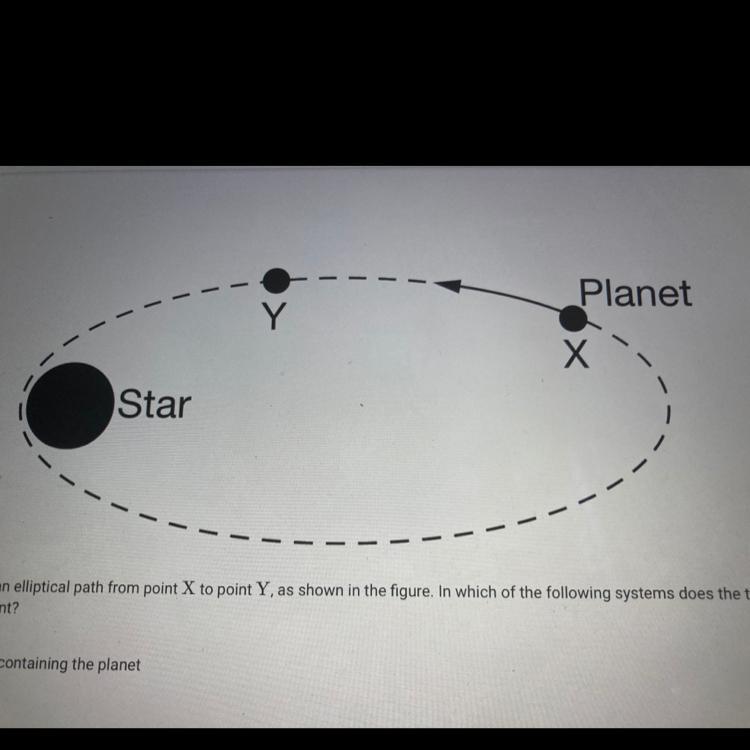
A planet orbits a star along an elliptical path from point X to point Y, as shown in the figure. In which of the following syste

ms does the total mechanical energy
of the system remain constant?
A
The open system containing the planet
B
The open system containing the planet and the star
с
The closed system containing the planet
D
The closed system containing the planet and the star

Physics
1 answer:
8090 [49]2 years ago
4 0

Answer:

The correct answer is Option D, the closed system containing the planet and the star.

Explanation:

To start, we need to define mechanical energy: the energy an object has from its motion and position.

The fundamental principle in physics is that the total energy in a closed system stays constant, even if it transforms. By saying "closed system," we refer to a system isolated from its surroundings. Energy never leaves the system; it only moves from one part to another.

This statement only applies to closed systems, however. An open system that interacts with its environment works differently. Energy may enter and leave the system through interaction with external forces, and this includes mechanical energy. For this reason, Option A and Option B are incorrect.

The remaining two options, C and D, only vary with the objects in the closed system. Option D includes the star; Option C does not.

However, we should take a closer look at Option C. Can an object have potential energy with itself? No, it cannot. It only has potential energy with other bodies. If the system is defined as the planet only, the only type of energy present is kinetic energy. We know a planet orbiting a star has more kinetic energy near and more gravitational potential energy further from its star. Thus it has less kinetic energy further from its star and less mechanical energy. Because of this, Option C is incorrect.

The only answer left is Option D. If we define the planet and star as a closed system, we find no net external force acting on it. Consequently, it obeys the law of conservation of energy. From prior reasoning, we know mechanical energy includes potential energy and kinetic energy and that the amounts of these energies vary with its orbit. As a result, mechanical energy is always conserved and always the same. In the end, the correct answer is Option D.

You might be interested in
What’s 2.3 miles into kilometers
True [87]
3.701 kilometers hope that helps
8 0
2 years ago
A 2.0-kg object is lifted vertically through 3.00 m by a 150-N force. How much work is done on the object by gravity during this
noname [10]

Answer:

-58.8 J

Explanation:

The work done by a force is given by:

W=Fdcos \theta

where

F is the magnitude of the force

d is the displacement of the object

\theta is the angle between the direction of the force and the displacement.

In this problem, we are asked to find the work done by gravity, so we must calculate the magnitude of the force of gravity first, which is equal to the weight of the object:

F=mg=(2.0 kg)(9.8 m/s^2)=19.6 N

The displacement of the object is d = 3.00 m, while \theta=180^{\circ}, because the displacement is upward, while the force of gravity is downward; therefore, the work done by gravity is

W=Fdcos \theta=(19.6 N)(3.00 m)(cos 180^{\circ})=-58.8 J

And the work done is negative, because it is done against the motion of the object.


6 0
2 years ago
Read 2 more answers
A 30.0-kg child sits on one end of a long uniform beam having a mass of 20.0 kg, and a 40.0-kg child sits on the other end. The
qaws [65]

let the length of the beam be "L"

from the diagram

AD = length of beam = L

AC = CD = AD/2 = L/2

BC = AC - AB = (L/2) - 1.10

BD = AD - AB = L - 1.10

m = mass of beam = 20 kg

m₁ = mass of child on left end = 30 kg

m₂ = mass of child on right end = 40 kg

using equilibrium of torque about B

(m₁ g) (AB) = (mg) (BC) + (m₂ g) (BD)

30 (1.10) = (20) ((L/2) - 1.10) + (40) (L - 1.10)

L = 1.98 m

4 0
2 years ago
You are a particle physicist at the Large Hadron Collider who is tasked with designing an apparatus to separate annihilation pro
JulijaS [17]

Find solution in the attachments

4 0
2 years ago
At 213.1 K a substance has a vapor pressure of 45.77 mmHg. At 243.7 K it has a vapor pressure of 193.1 mm Hg. Calculate its heat
vlabodo [156]

Answer:

20.3125 kJ/mol

Explanation:

P_{i} = initial vapor pressure = 45.77 mm Hg

P_{f} = final vapor pressure = 193.1 mm Hg

T_{i} = initial temperature = 213.1 K

T_{f} = final temperature = 243.7 K

H = Heat of vaporization

Using the equation

ln\left ( \frac{P_{f}}{P_{i}} \right ) = \left ( \frac{-H}{R} \right )\left ( \frac{1}{T_{f}} - \frac{1}{T_{i}}\right)

ln\left ( \frac{193.1}{45.77} \right ) = \left ( \frac{-H}{8.314} \right )\left ( \frac{1}{243.7} - \frac{1}{213.1}\right)

H = 20312.5 J/mol

H = 20.3125 kJ/mol

8 0
2 years ago
Other questions:
  • A race car completes the final lap of a race on a 2-kilometer circular track. At the start of the lap, it crosses the line at 60
    9·1 answer
  • The starter armature is rubbing on the field coils. technician a says the bushings need to be replaced. technician b says the br
    13·2 answers
  • If 500 J of energy were added to 1 kg of each of these samples, which would experience the LEAST temperature increase? aluminum,
    6·2 answers
  • a satellite is orbiting Earth at a distance of 35 kilometers. The satellite has a mass of 500 kilograms. what is the force betwe
    7·2 answers
  • For each of the motions described below, determine the algebraic sign (+, -, or 0) of the velocity and acceleration of the objec
    14·1 answer
  • An airplane travels horizontally at a constant velocity v. An object is dropped from the plane and one second later another obje
    15·1 answer
  • A diamond is cut such that the angle between its top surface and its bottom surface is α. For α=45∘, find the largest possible v
    14·1 answer
  • The box of negligible size is sliding down along a curved path defined by the parabola y=0.4x2. When it is a A(xA = 2 m, yA = 1.
    14·2 answers
  • Tech A says that some electric actuators are positioned by an A/C ECU which checks the air flow with sensors. Tech B says that e
    12·1 answer
  • A train runs from New Delhi to Hyderabad it covers first of 420 km in 7 hours and the next distance of 360 km in 6 hours​
    10·2 answers
Add answer
Login
Not registered? Fast signup
Signup
Login Signup
Ask question!