answer.
Ask question
Login Signup
Ask question
All categories
  • English
  • Mathematics
  • Social Studies
  • Business
  • History
  • Health
  • Geography
  • Biology
  • Physics
  • Chemistry
  • Computers and Technology
  • Arts
  • World Languages
  • Spanish
  • French
  • German
  • Advanced Placement (AP)
  • SAT
  • Medicine
  • Law
  • Engineering
sasho [114]
2 years ago
6

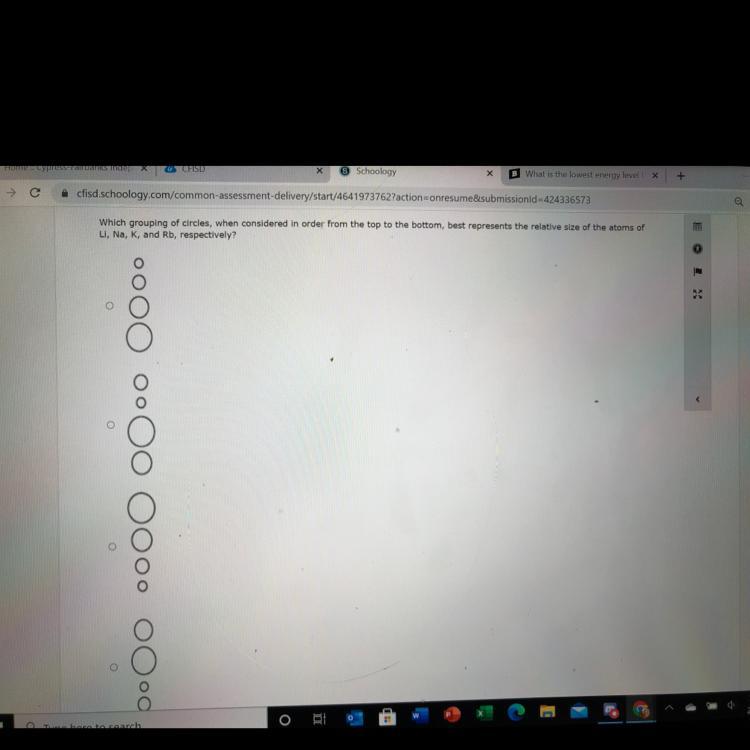
Which grouping of circles, when considered in order from the top to the bottom, best represents the relative size of the atoms o

f
LI, Na, K, and Rb, respectively?

Chemistry
1 answer:
Nimfa-mama [501]2 years ago
6 0

Answer:

answers number 1

Explanation:

You might be interested in
In every balanced chemical equation, each side of the equation has the same number of _____.
Ber [7]

The correct answer is option d, that is, atoms of the element.  

As the atoms are neither destroyed nor created in a chemical reaction, the sum of the mass of the products in a reaction must be equivalent to the sum of the mass of the reactants.  

The chemical reactions must be balanced, they must exhibit a similar number of atoms of each element on both the sides of the equation. As a consequence, the mass of the reactants must be equivalent to the mass of the products of the reaction.  


7 0
2 years ago
Read 2 more answers
Alka‑Seltzer is marketed as a remedy for stomach problems, such as heartburn or indigestion, and pain relief. It contains aspiri
Papessa [141]

Answer:

The equation for the reaction of one sodium bicarbonate ( NaHCO3 ) molecule with one citric acid (C6H8O7) molecule is the following:

Sodium Bicarbonate + Citric Acid ⇒ Water + Carbon Dioxide + Sodium Citrate

NaHCO3 + C6H8O7 ⇒ 3 CO2 + 3 H2O + Na3C6H5O7

Explanation:

The reaction is in balance, that is, the whole H2CO3 is not finished, but a little bit of this acid is left in the solution. Therefore, when sodium bicarbonate is added to the solution with citric acid, sodium citrate salt (C6H5O7Na3) and carbonic acid (H2CO3) are formed, which is rapidly broken down into water (H2O) and carbonic oxide (CO2).

C6H8O7 + NaHCO3 ⇒ C6H5O7Na3 + 3 H2CO3

C6H5O7Na3 + 3 H2CO3 ⇔ C6H5O7Na3 + 3 H2O + 3 CO2

5 0
2 years ago
The four rows of data below show the boiling points for a solution with no solute, sucrose (C12H22O11), sodium chloride (NaCl),
choli [55]

Answer:

The four rows of data below show the boiling points for a solution with no solute, sucrose (C12H22O11), sodium chloride (NaCl), and calcium chloride (CaCl2) (not in that order). Which boiling point corresponds to calcium chloride?

A. 101.53° C

B. 100.00° C

C. 101.02° C

D. 100.51° C

Which of the following solutions will have the lowest freezing point?

A. 1.0 mol/kg sucrose (C12H22O11)

B. 1.0 mol/kg lithium chloride (LiCl)

C. 1.0 mol/kg sodium phosphide (Na3P)

D. 1.0 mol/kg magnesium fluoride (MgF2)

Which of the following compounds will be most effective in melting the ice on the roads when the air temperature is below zero?

A. sodium iodide (NaI)

B. magnesium sulfate (MgSO4)

C. potassium bromide (KBr)

D. All will be equally effective.

Four different solutions have the following vapor pressures at 100°C. Which solution will have the greatest boiling point?

A. 98.7 kPa

B. 96.3 kPa

C. 101.3 kPa

D. 100.2 kPa

Four different solutions have the following boiling points. Which boiling point corresponds to a solution with the lowest freezing point?

A. 101.2°C

B. 105.9°C

C. 102.7°C

D. 108.1°C

Explanation:

The following are the answers to the different questions: 

The four rows of data below show the boiling points for a solution with no solute, sucrose (C12H22O11), sodium chloride (NaCl), and calcium chloride (CaCl2) (not in that order). Which boiling point corresponds to calcium chloride?

A. 101.53° C

Which of the following solutions will have the lowest freezing point?

D. 1.0 mol/kg magnesium fluoride (MgF2)

Which of the following compounds will be most effective in melting the ice on the roads when the air temperature is below zero?

A. sodium iodide (NaI)

Four different solutions have the following vapor pressures at 100°C. Which solution will have the greatest boiling point?

B. 96.3 kPa

Four different solutions have the following boiling points. Which boiling point corresponds to a solution with the lowest freezing point?

D. 108.1°C
5 0
2 years ago
A gas sample enclosed in a rigid metal container at room temperature (20.0∘C∘C) has an absolute pressure p1p1p_1. The container
choli [55]

Answer: p2 = 1.06p1

Explanation: pressure increases with temperature increase.

According to Gass law

P1/T1 = P2/T2

T1 = 20°c = 20 +273 = 293k

T2 = 40°c = 40 +373 = 313k

Therefore

P2 = P1T2/T1 = 313P2/293

P2 = 1.06P1

3 0
2 years ago
The volume of a gas is 27.5 mL at 22.0°C and 0.974 atm. What will the volume be at 15.0°C and 0.993 atm? Use Ideal Gas Law (PV =
Scorpion4ik [409]

Answer:

26.3 mL

Explanation:

Step 1:

Obtaining an appropriate gas law from the ideal gas equation.

This is illustrated below:

From the ideal gas equation:

PV = nRT

Divide both side by T

PV/T = nR

At this stage, we'll assume the number of mole (n) to be constant.

Note: R is the gas constant.

PV/T = constant.

We can thus, write the above equation as:

P1V1/T1 = P2V2/T2

The above equation is called the general gas equation.

Step 2:

Data obtained from the question. This includes the following:

Initial volume (V1) = 27.5 mL

Initial temperature (T1) = 22.0°C = 22.0°C + 273 = 295K

Initial pressure (P1) = 0.974 atm.

Final temperature (T2) = 15.0°C = 15.0°C + 273 = 288K

Final pressure (P2) = 0.993 atm

Final volume (V2) =..?

Step 3:

Determination of the final volume of the gas using the general gas equation obtained. This is illustrated below:

P1V1 /T1 = P2V2/T2

0.974 x 27.5/295 = 0.993 x V2/288

Cross multiply to express in linear.

295x0.993xV2 = 0.974x27.5x288

Divide both side by 295 x 0.993

V2 = (0.974x27.5x288)/(295x0.993)

V2 = 26.3 mL

Therefore, the new volume of the gas is 26.3 mL

4 0
2 years ago
Other questions:
  • At STP, fluorine is a gas and iodine is a solid. This observation can be explained by the fact that fluorine has
    8·2 answers
  • X-ray photons with a wavelength of 0.135 nm . express the energy numerically in kilojoules per mole.
    7·2 answers
  • What is the name of a hydrocarbon that has the formula CH3(CH2)4CCH?
    11·1 answer
  • To carry out a particular reaction, you determine that you need 0.0500 moles of ammonium chloride. What volume of the solution d
    13·1 answer
  • the height of a column of mercury in barometer is 754.3mm. what us the atmospheric pressure in atm. in kPa.
    6·1 answer
  • If a reaction produces 1.506 kJ of heat, which is trapped in 30.0 g of water initially at 26.5 C on a clorimetr liake hat in Fig
    15·1 answer
  • A gas of potassium chlorate molecules KClO3 all decompose into potassium chloride, KCl, and diatomic oxygen, O2. The products an
    9·1 answer
  • If K3PO4= 0.250M, how many grams of K3PO4 are in 750.0ml of solution? Remember that M is the same as mol/L. Answer: 39.8g
    14·1 answer
  • HELP! Ethanol has a density of 0.8 g/cm3. a. What is the mass of 225 cm3 of ethanol? b. What is the volume of 75.0 g of ethanol?
    12·1 answer
  • The specific rotation of (R) carvone is (+) 61°. The optical rotation of a sample of a mixture of R &S carvone is measured a
    5·2 answers
Add answer
Login
Not registered? Fast signup
Signup
Login Signup
Ask question!
