answer.
Ask question
Login Signup
Ask question
All categories
  • English
  • Mathematics
  • Social Studies
  • Business
  • History
  • Health
  • Geography
  • Biology
  • Physics
  • Chemistry
  • Computers and Technology
  • Arts
  • World Languages
  • Spanish
  • French
  • German
  • Advanced Placement (AP)
  • SAT
  • Medicine
  • Law
  • Engineering
kogti [31]
2 years ago
3

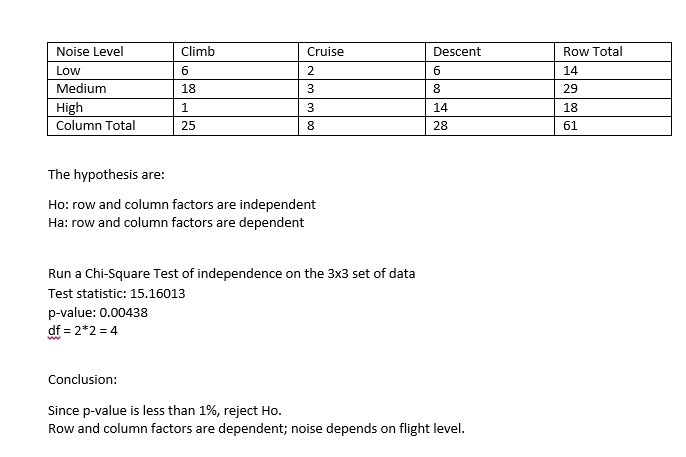
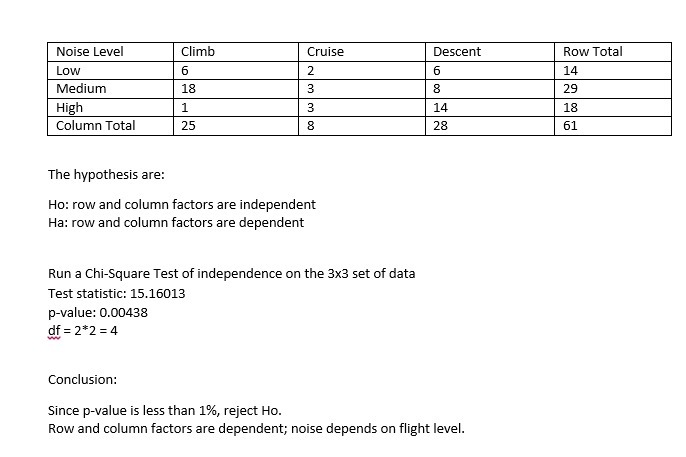
High levels of cockpit noise in an aircraft can damage the hearing of pilots who are exposed to this hazard for many hours. cock

pit noise in a jet aircraft is mostly due to airflow at hundreds of miles per hour. this 3 × 3 contingency table shows 61 observations of data collected by an airline pilot using a handheld sound meter in a certain aircraft cockpit. noise level is defined as “low” (under 88 decibels), “medium” (88 to 91 decibels), or “high” (92 decibels or more). there are three flight phases (climb, cruise, descent).

Physics
1 answer:
trasher [3.6K]2 years ago
6 0
See attached file for the solution.

You might be interested in
While dangling a hairdryer by its cord, you observe that the cord is vertical when the hairdryer isoff and, once it is turned on
jekas [21]

Answer:

The speed of the air leaving the hairdryer is 10m/s.

Explanation:

The thrust that the dryer produces is what keeps it elevated at an angle of 5° from the vertical; therefore, from the force diagram we get

(1).\: tan (5^o) = \dfrac{F_t}{Mg}

putting in M =0.420kg, g = 9.8m/s^2 and solving for F_t we get:

F_t = Mg\:tan(5^o)

F_t = (0.420kg)(9.8m/s^2)\:tan(5^o)

\boxed{F_t = 0.3601N.}

Now, this thrust produced is related to to the air ejection speed v by the relation

(2).\: F_t = v\dfrac{dM}{dt}

where dM/dt is the rate of air ejection which we know is

0.06m^3/2s  = 0.03m^3/s

and since 1m^3 = 1.2kg,

0.03m^3/s \rightarrow 0.036kg/s

\dfrac{dM}{dt}  = 0.036kg/s,

putting this into equation (2) and the value of F_t we get:

0.3601N = 0.036v

which gives

v= \dfrac{0.3601}{0.036}

\boxed{v =10m/s.}

which is the speed of the air ejected.

6 0
2 years ago
A thin layer of oil with index of refraction no = 1.47 is floating above the water. The index of refraction of water is nw = 1.3
garik1379 [7]

Answer:

A thin layer of oil with index of refraction ng = 1.47 is floating above the water. The index of refraction of water is nw = 1.3. The index of refraction of air is na= 1. A light with wavelength λ = 775 nm goes in from the air to oil and water.

 Part (a) Express the wavelength of the light in the oil,  λ₀, in terms of  λ  and n⁰ (b) Express the minimum thickness of the film that will result in destructive interference, t min, in terms of  λ o

(c) Express tmin in terms of  λ  and no.

(d) Solve for the numerical value of tmin in nm.

Explanation:

n₀ = 1.47

refraction of water = 1.3

refraction of air = 1

wavelength λ = 775 nm

(a) wavelength of light in water ⇒  λ₀ = λ / n₀

(b) minimum thickness of the film that will result in destructive interference

t(min) = λ₀ / 2

(c) the express t(min)

t =  λ /2n₀

(d) the thickness is

t = 775 / 2(1.47)

= 263.61 nm

4 0
2 years ago
Maria drove to the store, did some shopping, and then came home. During Maria's trip, when was her displacement equal to zero? A
Aleks [24]
I think it’s a) but I’m not sure.
7 0
2 years ago
Read 2 more answers
What mass of water must evaporate from the skin of a 70.0 kg man to cool his body 1.00 ∘C? The heat of vaporization of water at
Stolb23 [73]

Answer:

m = 0.111 kg

Explanation:

Heat required to release from the body of the person when his temperature cool down by 1 degree C is given as

Q = m s\Delta T

here we know that

m = 70 kg

s = 3840 J/kg K

\Delta T = 1.00^o C

now we know that

Q = (70 kg)(3840 J/kg ^oC)(1 ^o C)

Q = 268800 J

now the same heat is used to vaporize water of the body

so it is given as

Q = mL

268800 = m(2.42 \times 10^6)

m = 0.111 kg

7 0
2 years ago
Isabella drops a pen off her balcony by accident while celebrating the successful completion of a physics problem. assuming air
expeople1 [14]
U = 0, initial vertical velocity

Neglect air resistance, and g = 9.8 m/s².

The time, t, required for the pen to attain a vertical velocity of 19.62 m/s is given by
19.62 m/s = 0 + (9.8 m/s²)*(t s)
t = 19.62/9.8 = 2.00 s

Answer:  2.0 s
8 0
2 years ago
Other questions:
  • A car drives around a racetrack for 30 seconds. what do you need to know to calculate the average velocity of the car?
    9·2 answers
  • Platinum (pt) has the fcc crystal structure, an atomic radius of 0.1387 nm, and an atomic weight of 195.08 g/mol. what is its th
    15·2 answers
  • A rock, which weighs 1400 n in air, has an apparent weight of 900 n when submerged in fresh water (998 kg/m3). the volume of the
    14·1 answer
  • Which description best explains a molecular bonding?
    5·1 answer
  • A weatherman carried an aneroid barometer from the ground floor to his office atop the Sears Tower in Chicago. On the level grou
    10·1 answer
  • A hydraulic system at the mechanic shop can perform up to 180,000 joules of work in a day. if throughout the day it can lift 10
    15·1 answer
  • Consider a large truck and a small car driving up a straight, steep hill. The truck is moving at 60 miles per hour and the car a
    9·1 answer
  • A world class runner can run long distances at a pace of 15 km/hour. That runner expends 800 kilocalories of energy per hour. a)
    15·1 answer
  • The velocity of a car increases from 2.0 m/s to 16.0 m/s in a time period of 3.5 s. What was the average acceleration?
    13·2 answers
  • Consider the position vs. time graph below for a woman's movement in a hallway. What is the woman's velocity from 4 to 5 s?
    8·1 answer
Add answer
Login
Not registered? Fast signup
Signup
Login Signup
Ask question!