answer.
Ask question
Login Signup
Ask question
All categories
  • English
  • Mathematics
  • Social Studies
  • Business
  • History
  • Health
  • Geography
  • Biology
  • Physics
  • Chemistry
  • Computers and Technology
  • Arts
  • World Languages
  • Spanish
  • French
  • German
  • Advanced Placement (AP)
  • SAT
  • Medicine
  • Law
  • Engineering
Goshia [24]
2 years ago
13

Randy observed that cooked onions in his food taste very differently from the raw onions that he had on his salad. He wondered w

hy that was so. He thinks that he has an idea, but he is not sure.
What has he developed in his mind?
Physics
2 answers:
Travka [436]2 years ago
6 0
It's called a hypothesis :D
Oksana_A [137]2 years ago
3 0

Answer:

Hypothesis.

Explanation:

Hypothesis is defined as the assumption or can be say that an idea that is proposed for the sake of an argument so that it can be tested or might be occur in future.

A hypothesis is basically tentative. It is usually made an assumption for the experiment to be tested.

Basically Randy made a hypothesis by which he thinks that he has an idea but he is not sure about that.

You might be interested in
A figure skater rotating at 5.00 rad/s with arms extended has a moment of inertia of 2.25 kg·m2. If the arms are pulled in so t
Serggg [28]

a) 6.25 rad/s

The law of conservation of angular momentum states that the angular momentum must be conserved.

The angular momentum is given by:

L=I\omega

where

I is the moment of inertia

\omega is the angular speed

Since the angular momentum must be conserved, we can write

L_1 = L_2\\I_1 \omega_1 = I_2 \omega_2

where we have

I_1 = 2.25 kg m^2 is the initial moment of inertia

\omega_1 = 5.00 rad/s is the initial angular speed

I_2 = 2.25 kg m^2 is the final moment of inertia

\omega_2 is the final angular speed

Solving for \omega_2, we find

\omega_2 = \frac{I_1 \omega_1}{I_2}=\frac{(2.25 kg m^2)(5.00 rad/s)}{1.80 kg m^2}=6.25 rad/s

b) 28.1 J and 35.2 J

The rotational kinetic energy is given by

K=\frac{1}{2}I\omega^2

where

I is the moment of inertia

\omega is the angular speed

Applying the formula, we have:

- Initial kinetic energy:

K=\frac{1}{2}(2.25 kg m^2)(5.00 rad/s)^2=28.1 J

- Final kinetic energy:

K=\frac{1}{2}(1.80 kg m^2)(6.25 rad/s)^2=35.2 J

7 0
2 years ago
Rotational dynamics about a fixed axis: A person pushes on a small doorknob with a force of 5.00 N perpendicular to the surface
FrozenT [24]

Answer:

I = 2 kgm^2

Explanation:

In order to calculate the moment of inertia of the door, about the hinges, you use the following formula:

\tau=I\alpha     (1)

I: moment of inertia of the door

α: angular acceleration of the door = 2.00 rad/s^2

τ: torque exerted on the door

You can calculate the torque by using the information about the Force exerted on the door, and the distance to the hinges. You use the following formula:

\tau=Fd        (2)

F: force = 5.00 N

d: distance to the hinges = 0.800 m

You replace the equation (2) into the equation (1), and you solve for α:

Fd=I\alpha\\\\I=\frac{Fd}{\alpha}

Finally, you replace the values of all parameters in the previous equation for I:

I=\frac{(5.00N)(0.800m)}{2.00rad/s^2}=2kgm^2

The moment of inertia of the door around the hinges is 2 kgm^2

3 0
2 years ago
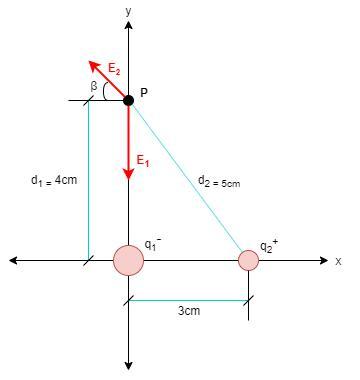
Fields of Point Charges Two point charges are fixed in the x-y plane. At the origin is q1 = -6.00 nC . and at a point on the x-a
My name is Ann [436]

Answer:

Part A) Electric fields at the point due to q₁ and q₂:

E₁ = 33.75*10³ N/C (-j) , E₂= ( 6.48 (-i) + 8.64 (+j) )*10³ N/C

Part B) Net electric field at P (Ep)

Ep=   (6.48*10³ (-i)+25.11 10³ (-j) )N/C

Explanation:

Conceptual analysis

The electric field at a point P due to a point charge is calculated as follows:

E = k*q/d²

E: Electric field in N/C

q: charge in Newtons (N)

k: electric constant in N*m²/C²

d: distance from charge q to point P in meters (m)

Equivalence

1nC= 10⁻⁹C

1cm= 10⁻²m

Data

k= 9*10⁹ N*m²/C²

q₁ = -6.00 nC = -6 *10⁻⁹C

q₂ = +3.00 nC = +3*10⁻⁹C

d₁ = 4cm = 4 *10⁻²m

d_{2} =\sqrt{(4*10^{-2})^{2}+((3*10^{-2})^{2} }

d₂ = 5 *10⁻²m

Part A) Calculation of the electric fields at the point due to q₁ and q₂

Look at the attached graphic:

E₁: Electric Field at point  P(0,4) cm due to charge q₁. As the charge q₁ is negative (q₁-), the field enters the charge

E₂: Electric Field at point  P(0,4) cm  due to charge q₂. As the charge q₂ is positive (q₂+) ,the field leaves the charge

E₁ = k*q₁/d₁² = 9*10⁹ *6 *10⁻⁹/ (4 *10⁻²)² = 33.75*10³ N/C

E₂ = k*q₂/d₂²= 9*10⁹ *3*10⁻⁹/(5 *10⁻²)² =  10.8*10³ N/C

E₁ = 33.75*10³ N/C (-j)

E₂x=E₂cosβ = 10.8*(3/5) = 6.48*10³ N/C

E₂y=E₂sinβ = 10.8*(4/5) =  8.64*10³ N/C

E₂= ( 6.48 (-i) + 8.64 (+j) )*10³ N/C

Part B) Calculation of the net electric field at P (Ep)

The electric field at a point P due to several point charges is the vector sum of the electric field due to individual charges.

Ep=Epx (i) + Epy (j)

Epx= E₂x= 6.48*10³ N/C (-i)

Epy= E₁y+E₂y= (33.75*10³ (-j) + 8.64*10³ (+j) ) N/C=25.11 10³ (-j) N/C

Ep=   (6.48*10³ (-i)+25.11 10³ (-j) )N/C

Ep=   (6.48*10³ (-i)+25.11 10³ (-j) )N/C

3 0
2 years ago
You and your surfing buddy are waiting to catch a wave a few hundred meters off the beach. The waves are conveniently sinusoidal
bekas [8.4K]

Answer:

(a): The frequency of the waves is f= 0.16 Hz

Explanation:

T/4= 1.5 s

T= 6 sec

f= 1/T

f= 0.16 Hz (a)

6 0
2 years ago
Read 2 more answers
A bucket of mass M (when empty) initially at rest and containing a mass of water is being pulled up a well by a rope exerting a
Naily [24]

Answer:

V=\dfrac{PT}{m}\ ln\dfrac{M+m}{M}-gT

Explanation:

Given that

Constant rate of leak =R

Mass at time T ,m=RT

At any time t

The mass = Rt

So the total mass in downward direction=(M+Rt)

Now force equation

(M+Rt) a =P- (M+Rt) g

a=\dfrac{P}{M+Rt}-g

We know that

a=\dfrac{dV}{dt}

\dfrac{dV}{dt}=\dfrac{P}{M+Rt}-g

\int_{0}^{V}V=\int_0^T \left(\dfrac{P}{M+Rt}-g\right)dt

V=\dfrac{P}{R}\ ln\dfrac{M+RT}{M}-gT

V=\dfrac{PT}{m}\ ln\dfrac{M+m}{M}-gT

This is the velocity of bucket at the instance when it become empty.

6 0
2 years ago
Other questions:
  • A rock of mass m is thrown horizontally off a building from a height h. the speed of the rock as it leaves the thrower's hand at
    10·1 answer
  • Identify the false statement: Select one:
    12·2 answers
  • Two flat 4.0 cm × 4.0 cm electrodes carrying equal but opposite charges are spaced 2.0 mm apart with their midpoints opposite ea
    15·1 answer
  • A 1.0-m-diameter vat of liquid is 2.0 m deep. The pressure at the bottom of the vat is 1.3 atm. What is the mass of the liquid i
    6·1 answer
  • Which occurrence would lead you to conclude that lights are connected in a
    13·1 answer
  • In some amazing situations, people have survived falling large distances when the surface they land on is soft enough. During a
    15·1 answer
  • A man climbs a ladder. Which two quantities can be used to calculate the energy stored of the man at the top of the ladder.
    12·1 answer
  • Difference between calorimeter and thermometer ?
    8·2 answers
  • evaluate the numerical value of the vertical velocity of the car at time t=0.25 s using the expression from part d, where y0=0.7
    10·1 answer
  • Starting at t = 0 a net external force in the +x-direction is applied to an object that has mass 5.00 kg. A graph of the force a
    7·1 answer
Add answer
Login
Not registered? Fast signup
Signup
Login Signup
Ask question!