answer.
Ask question
Login Signup
Ask question
All categories
  • English
  • Mathematics
  • Social Studies
  • Business
  • History
  • Health
  • Geography
  • Biology
  • Physics
  • Chemistry
  • Computers and Technology
  • Arts
  • World Languages
  • Spanish
  • French
  • German
  • Advanced Placement (AP)
  • SAT
  • Medicine
  • Law
  • Engineering
LUCKY_DIMON [66]
2 years ago
15

A car traveling at a steady 20 m/s rounds an 80-m radius horizontal unbanked curve with the tires on the verge of slipping. what

is the maximum speed with which this car can round a second unbanked curve of radius 320 m if the coefficient of static friction between the car's tires and the road surface is the same in both cases?

Physics
2 answers:
Serjik [45]2 years ago
7 0
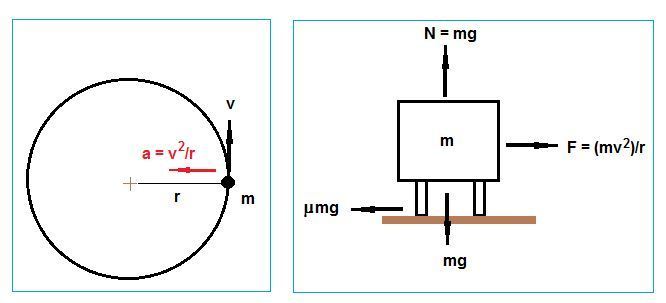
Refer to the diagram shown below.

r = the radius of the curve
m =  the mass of the car
μ = the coefficient of kinetic friction
N = normal reaction

When rounding the curve, the centripetal acceleration is
a = \frac{v^{2}}{r}

The inertial force tending to make the car skid is balanced by the frictional force, therefore
\mu mg = m \frac{v^{2}}{r} \\ \mu =  \frac{v^{2}}{rg}

When r = 80 m and v = 20 m/s, obtain
\mu =  \frac{(20 m/s)^{2}}{(80 \, m)*(9.8 \, m/s^{2})} = 0.51

When r = 320 m and μ remains the same, obtain
\frac{(v \, m/s)^{2}}{(320 \, m)*(9.8 \, m/s^{2})} =0.51 \\\\ v^{2} = 1.6 \times 10^{3} \\\\ v = 40 \, m/s

Answer: 40 m/s

Evgesh-ka [11]2 years ago
4 0

The maximum speed with which this car can round a second unbanked curve is 40 m/s

\texttt{ }

<h3>Further explanation</h3>

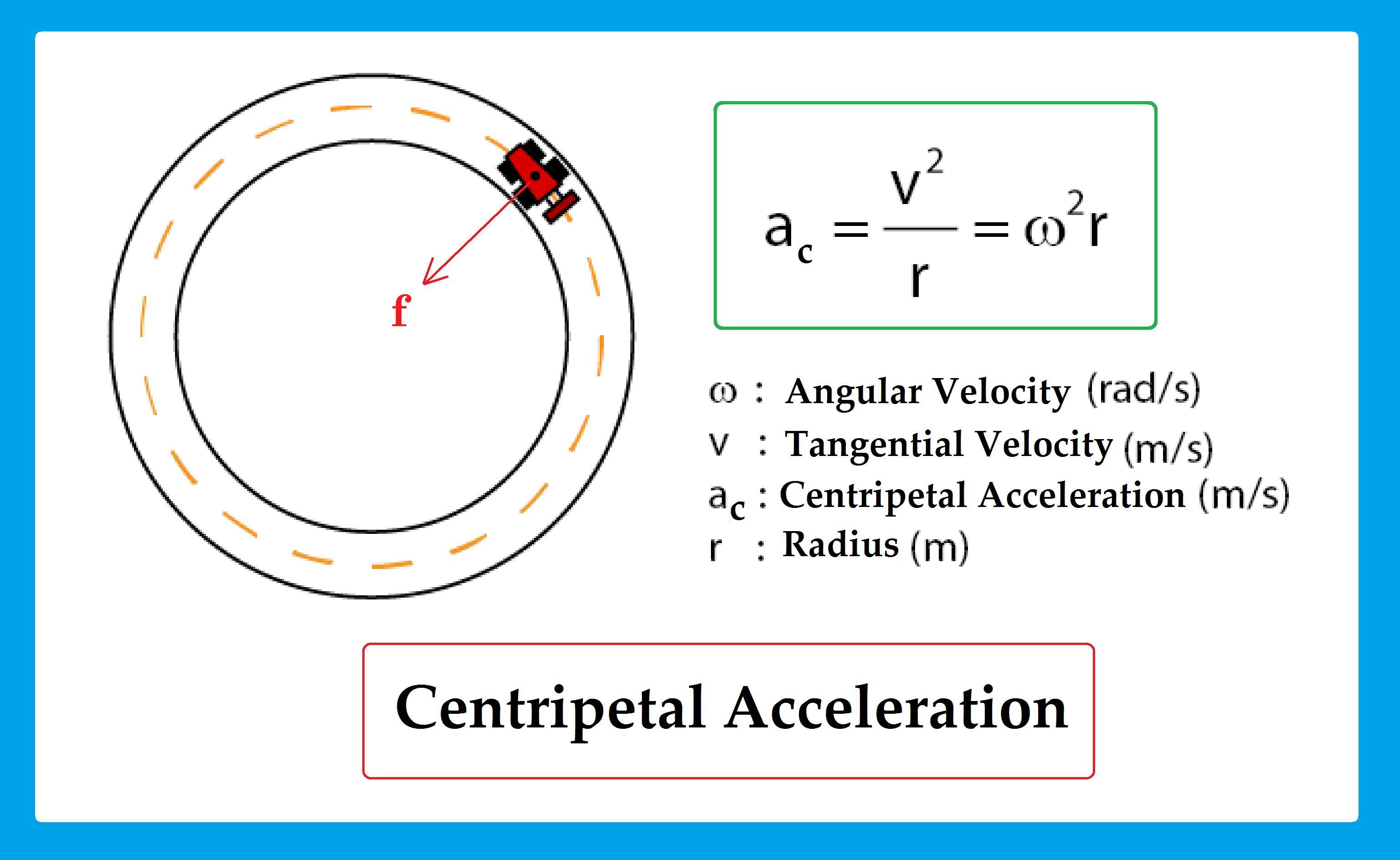
Centripetal Acceleration can be formulated as follows:

\large {\boxed {a = \frac{ v^2 } { R } }

<em>a = Centripetal Acceleration ( m/s² )</em>

<em>v = Tangential Speed of Particle ( m/s )</em>

<em>R = Radius of Circular Motion ( m )</em>

\texttt{ }

Centripetal Force can be formulated as follows:

\large {\boxed {F = m \frac{ v^2 } { R } }

<em>F = Centripetal Force ( m/s² )</em>

<em>m = mass of Particle ( kg )</em>

<em>v = Tangential Speed of Particle ( m/s )</em>

<em>R = Radius of Circular Motion ( m )</em>

Let us now tackle the problem !

\texttt{ }

<u>Given:</u>

initial speed of the car = v₁ = 20 m/s

radius of first curve = R₁ = 80 m

radius of second curve = R₂ = 320 m

<u>Asked:</u>

final speed of the car = v₂ = ?

<u>Solution:</u>

<em>Firstly , we will derive the formula to calculate the maximum speed of the car:</em>

\Sigma F = ma

f = m \frac{v^2}{R}

\mu N = m \frac{v^2}{R}

\mu m g = m \frac{v^2}{R}

\mu g = \frac{v^2}{R}

v^2 = \mu g R

\boxed {v = \sqrt { \mu g R } }

\texttt{ }

<em>Next , we will compare the maximum speed of the car on the first curve and on the second curve:</em>

v_1 : v_2 = \sqrt { \mu g R_1 } : \sqrt { \mu g R_2 }

v_1 : v_2 = \sqrt { R_1 } : \sqrt { R_2 }

20 : v_2 = \sqrt { 80 } : \sqrt { 320 }

20 : v_2 = 1 : 2

v_2 = 2(20)

\boxed {v_2 = 40 \texttt{ m/s}}

\texttt{ }

<h3>Learn more</h3>
  • Impacts of Gravity : brainly.com/question/5330244
  • Effect of Earth’s Gravity on Objects : brainly.com/question/8844454
  • The Acceleration Due To Gravity : brainly.com/question/4189441

\texttt{ }

<h3>Answer details</h3>

Grade: High School

Subject: Physics

Chapter: Circular Motion
You might be interested in
An object moving at a velocity of 32m/s slows to a stop in 4 seconds. What was its acceleration?
Romashka [77]

Answer:

8m/s

Explanation:

a=d/t

a=32/4

a=8 m/s

6 0
2 years ago
Read 2 more answers
A physics student walks 100 meters in 80 seconds. The student stops for 30 seconds, and then walks 200 meters farther in 90 seco
Elan Coil [88]

Answer:

B i think is the answer

Explanation:

i feel like it is B because if you put them together and the answer is 1.5 so it is B

8 0
2 years ago
Acetone, a component of some types of fingernail polish, has a boiling point of 56°C. What is its boiling point in units of kelv
mixas84 [53]

Answer:

The boiling point of Acetone is 329K (in 3 significant figures)

Explanation:

Boiling point of Acetone = 56°C = 56 + 273K = 329K (in 3 significant figures)

7 0
2 years ago
Read 2 more answers
In springboard diving, the diver strides out to the end of the board, takes a jump onto its end, and uses the resultant spring-l
Ksenya-84 [330]

Answer:

10.4 m/s

Explanation:

The problem can be solved by using the following SUVAT equation:

v=u+at

where

v is the final velocity

u is the initial velocity

a is the acceleration

t is the time

For the diver in the problem, we have:

u=+6.3 m/s is the initial velocity (positive because it is upward)

a=g=-9.8 m/s^2 is the acceleration of gravity (negative because it is downward)

By substituting t = 1.7 s, we find the velocity when the diver reaches the water:

v=+6.3 + (-9.8)(1.7)=-10.4 m/s

And the negative sign means that the direction is downward: so, the speed is 10.4 m/s.

3 0
2 years ago
Read 2 more answers
Discuss the production, transmission, and usage of electricity in the context of conservation of energy. When electricity is “us
mr Goodwill [35]

There are huge losses in the transmission, production and usage of electricity and the reduction of these losses in order to save electricity is called as conservation of energy.

As per the statistics, there is loss of nearly 4% while the transmission of electricity. Like wise during production also, lot of electricity get wasted due to the inefficient material used. None of the production material nor the equipment used have 100% efficiency and thus there is always a possibility of energy wastage.

When it is said that the energy is wasted , it simply means that the energy production which should have been 100% as per calculation is not completely derived from the source due to the inefficient conversion process. For example, a turbine while rotating must convert 100 % of the water energy or water falling on it into electrical energy but the turbine is not able to do so as some of the water is lost or its energy is lost before conversion while going through the mechanical process.

3 0
2 years ago
Other questions:
  • A 1200-kilogram space vehicle travels at 4.8 meters per second along the level surface of Mars. If the magnitude of the gravitat
    8·2 answers
  • A ramp 20 m long and 4 m high is used to lift a heavy box. A pulley system with 4 rope sections supporting the load is used to l
    7·1 answer
  • Essam is abseiling down a steep cliff. How much gravitational potential energy does he lose for every metre he descends? His mas
    10·2 answers
  • Suppose a police officer is 1/2 mile south of an intersection, driving north towards the intersection at 30 mph. at the same tim
    13·2 answers
  • Energy is observed in two basic forms: potential and kinetic. Which of the following correctly matches these forms with a source
    7·1 answer
  • A child on a sled starts from rest at the top of a 15.0° slope. If the trip to the bottom takes 22.6 s how long is the slope? As
    11·1 answer
  • Calculate the mag-netic field (magnitude and direc-tion) at a point p due to a current i=12.0 a in the wire shown in fig. p28.68
    10·1 answer
  • A 30-m-long rocket train car is traveling from Los Angeles to New York at 0.5c when a light at the center of the car flashes. Wh
    6·1 answer
  • Select all the correct answers.
    10·1 answer
  • An overhead projector lens is 32.0 cm from a slide (the object) and has a focal length of 30.1 cm. What is the magnification of
    5·1 answer
Add answer
Login
Not registered? Fast signup
Signup
Login Signup
Ask question!