answer.
Ask question
Login Signup
Ask question
All categories
  • English
  • Mathematics
  • Social Studies
  • Business
  • History
  • Health
  • Geography
  • Biology
  • Physics
  • Chemistry
  • Computers and Technology
  • Arts
  • World Languages
  • Spanish
  • French
  • German
  • Advanced Placement (AP)
  • SAT
  • Medicine
  • Law
  • Engineering
natka813 [3]
2 years ago
11

An unknown liquid has a mass of 4.25 × 10⁸ mg and a volume of 0.250 m3. what is the density of the liquid in units of g/ml?

Chemistry
2 answers:
mrs_skeptik [129]2 years ago
8 0
Density= mass/volume
             step  one :
  convert  m3  to  ml
1m^3  =1000000ml
0.250m^3 x1000000=250000ml
         
           step  two:  convert  mg   to  g
 1mg=0.001g,  therefore 4.25 x10⁸mg=0.459g
density  is  therefore= 0.459g/250000=1.836 x10^-6g/ml
Kamila [148]2 years ago
6 0

Density of the liquid in units of g/ml is 1.836 \times 10^{-6} g / \mathrm{ml}

<u>Explanation:</u>

Density of liquid is the mass of the liquid ids divided by its volume.

Density =\frac{\text { Mass }}{\text { Volume }}

Given Mass = 4.25×10⁸ mg

                      = 459mg

                      = 0.459g

        Volume = 0.250 m^{3}

Therefore, density = \frac{0.459}{0.250}

                              =   1.836 \mathrm{g} / \mathrm{m}^{3}

converting to m^{3} to ml (m^{3} = 1000000ml)

                              = 1.836 \times 10^{-6} g / \mathrm{ml}

You might be interested in
A particular sheet of paper measures 8.5 × 6.5 inches. What is the surface area of one side of the paper in cm2? (2.54 cm = 1 in
Zanzabum
<span>In order to calculate the surface are of the sheet of paper in square centimeters you must first convert the dimensions of the paper to centimeters. You can do this by multiplying 8.5 * 2.54 and 6.5 * 2.54. The paper measures 21.59cm by 16.51cm. To find the surface area you multiply the dimensions of the paper to equal 356.4509cm2</span>
4 0
2 years ago
Which of the following statements describe chemical properties?
Y_Kistochka [10]

Answer:

  • <em><u>A. Oxygen gas supports combustion.</u></em>
  • <em><u>B. Hydrofluoric acid reacts with glass.</u></em>
  • <em><u>C. Fertilizers help to increase agricultural production. </u></em>

Explanation:

<em>Chemical properties</em> can only be observed when a chemical change, i.e. a change in the chemical composition, occurs.

On the other hand,  physical properties are observed or measured without altering the composition of the substances.

Typical examples of chemical properties are reactivity, flammability, combustion, oxidation states, acidity, among others that require to carry out a chemical reaction to be observed.

Typical examples of physical properties are freezing point, melting point, boiling point, density, solubility, corrosiveness, among others.

Thus, as for the choices you have:

<em><u>A. Oxygen gas supports combustion:</u></em> the only way to observe this property is by carrying out a combustion reaction, so this describes a chemical property.

<u><em>B. Hydrofluoric acid reacts with glass:</em></u> again, only by letting hydrofluoric acid react with glass this can be observed, so this is another example of a chemical property.

<u><em>C. Fertilizers help to increase agricultural production:</em></u> fertilizers are absorbed by the plants and converted by biochemical reactions, so this also describes a chemical property.

<em><u>D. Water boils below 100°C on top of a mountain:</u></em> boiling is a change of state, the water is H₂O and continues having the same composition after boiling, so this describes a physical property.

<em><u>E. Lead is denser than aluminum: </u></em>density is measured by physical media, measuring mass and volume; so this is a physical property.


4 0
2 years ago
At a temperature of __________ °c, 0.444 mol of co gas occupies 11.8 l at 889 torr.
Novay_Z [31]
<span>ideal gas law is: PV = nRT P = pressure (torr) = 889 torr V = volume (Liters) = 11.8 L n = moles of gas = 0.444 mol R = gas constant = 62.4 (L * torr / mol * k) solve for T (in kelvin) T = PV/nR T = (889*11.8)/(.444*62.4) T = 378.6 K convert to C (subtract 273) T = 105.6 deg C</span>
3 0
2 years ago
Read 2 more answers
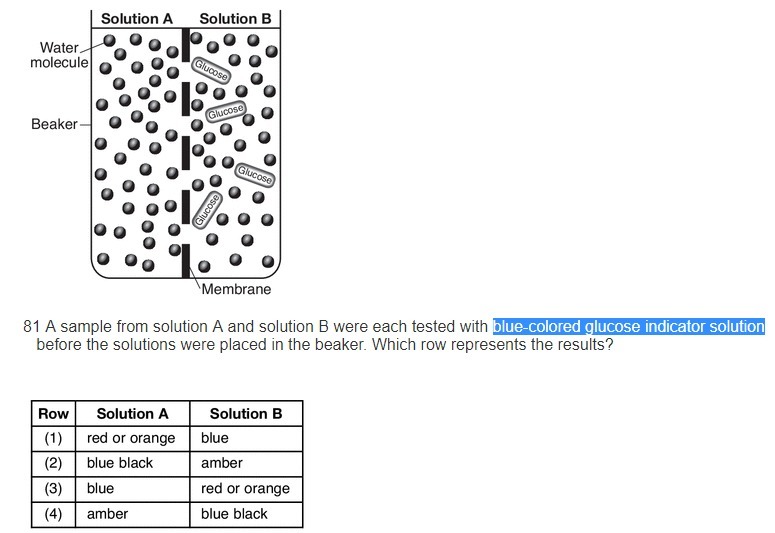
A sample from solution a and solution b were each tested with blue colored glucose indicator solution before the solutions were
vova2212 [387]
With the given problem you gave here, I can't answer the question because I need more details. Luckily, I found a similar problem that's provided with a diagram and a table shown in the attached picture.

This test is called the Benedict's test which is used as test for presence of sugars. If the solution contains sugar, like glucose, the solution would turn from blue to red. If not, it would stay blue. <em>Therefore, the correct results would be that in row 3.</em>

3 0
2 years ago
How does 0.5 m sucrose (molecular mass 342) solution compare to 0.5 m glucose (molecular mass 180) solution?
mash [69]

Answer : Both solutions contain 3.011 X 10^{23} molecules.

Explanation : The number of molecules of 0.5 M of sucrose is equal to the number of molecules in 0.5 M of glucose. Both solutions contain 3.011 x 10^{23} molecules.

Avogadro's Number is  N_{A} =  6.022 X 10^{23} which represents particles per mole and particles may be typically molecules, atoms, ions, electrons, etc.

Here, only molarity values are given; where molarity is a measurement of concentration in terms of moles of the solute per liter of solvent.

Since each substance has the same concentration, 0.5 M, each will have the same number of molecules present per liter of solution.

Addition of molar mass for individual substance is not needed. As if both are considered in 1 Liter they would have same moles which is 0.5.

We can calculate the number of molecules for each;

Number of molecules  = N_{A} X M;

∴  Number of molecules =  6.022 X 10^{23} X 0.5 mol/L X 1 L which will be  = 3.011 X 10^{23}

Thus, these solutions compare to each other in that they have not only the same concentration, but they will have the same number of solvated sugar molecules. But the mass of glucose dissolved will be less than the mass of sucrose.

7 0
2 years ago
Read 2 more answers
Other questions:
  • How many grams of Cl are in 38.0 g of each sample of chlorofluorocarbons (CFCs)?
    15·1 answer
  • How many grams of o2 are required to produce 358.5 grams of zno??
    10·2 answers
  • To neutralize 1.65g LiOH, how much .150 M HCl would be needed?
    6·1 answer
  • Calculate the nuclear binding energy for 5525mn in megaelectronvolts per nucleon (mev/nucleon). express your answer numerically
    10·1 answer
  • An element with an electronegativity of 0.9 bonds with an element with an electronegativity of 3.1 what phrases best describes t
    6·1 answer
  • You have a 1.153 g sample of an unknown solid acid, HA, dissolved in enough water to make 20.00 mL of solution. HA reacts with K
    7·1 answer
  • As Danny was pouring cereal for his breakfast, he noticed that the cereal box says that the cereal contains 5 milligrams of iron
    7·1 answer
  • ANSWER FAST PLEASE!!
    6·1 answer
  • the actual yield of a certain reaction is 38.0 g while the theoretical yield is 50.0 g calculate the percent yield
    8·1 answer
  • Janine is trying to separate some ethanol from water. Which method should she use does anyone know this
    15·1 answer
Add answer
Login
Not registered? Fast signup
Signup
Login Signup
Ask question!