answer.
Ask question
Login Signup
Ask question
All categories
  • English
  • Mathematics
  • Social Studies
  • Business
  • History
  • Health
  • Geography
  • Biology
  • Physics
  • Chemistry
  • Computers and Technology
  • Arts
  • World Languages
  • Spanish
  • French
  • German
  • Advanced Placement (AP)
  • SAT
  • Medicine
  • Law
  • Engineering
Rasek [7]
2 years ago
5

A plane takes off in san francisco at noon and flies toward the southeast. an hour later, it is 400 kilometers east and 300 kilo

meters south of its starting location. assuming the plane flew in a straight line, how far did it travel? how many degrees south of east did the plane fly?

Physics
1 answer:
eduard2 years ago
5 0
This first step involves a right triangle. If the plane is 400 km east and 300 km south of the origin, and it flew in a straight line, then you can construct a right triangle with side lengths 300, 400, and c. You may recognize that these are multiples of the Pythagorean triple 3, 4, 5, so the side length c is 500 km. Otherwise, you would write 
c^2 = 300^2+400^2 \\ c = 500. 

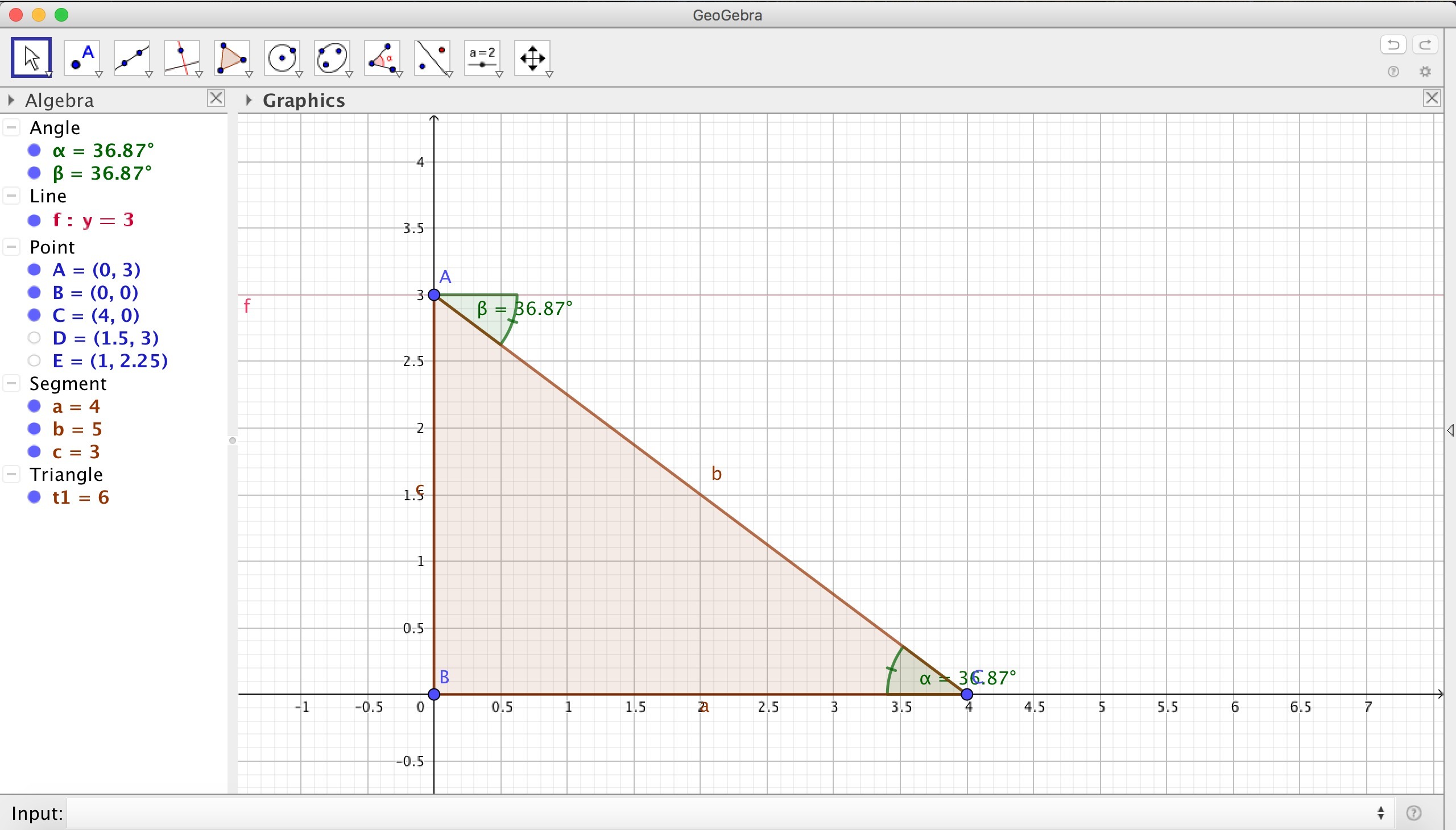
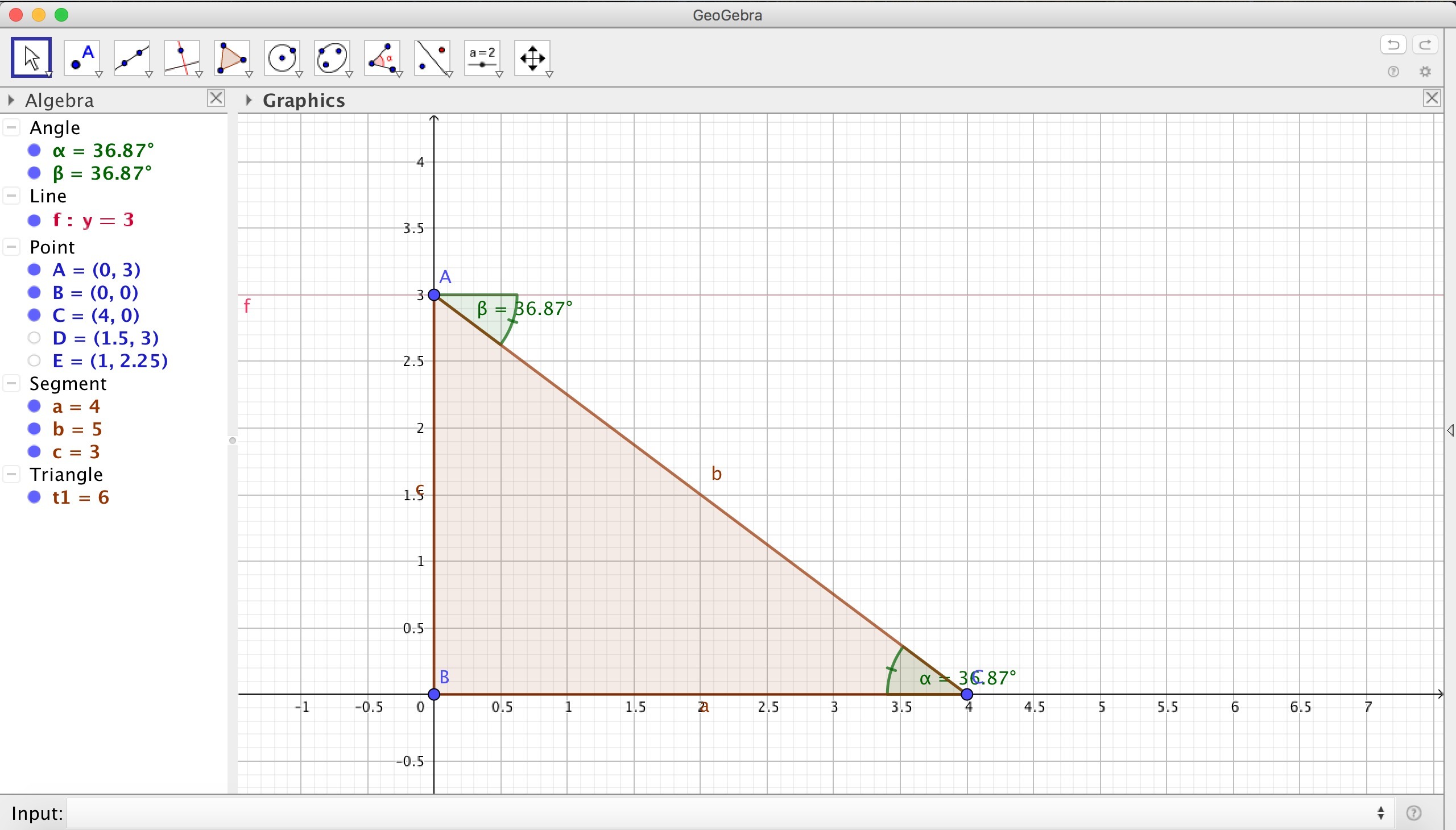
This second step is, if I am correctly interpreting "degrees south of east," to find the angle formed by the horizontal line representing the east and the path of the plane. I made a diagram that does just that (see attached). You can use a trig function of one of the angles to solve. I chose
tan(C)= \frac{3}{4}  \\  arctan( \frac{3}{4})=36.870. Thus, I believe it is 37° south of east.

You might be interested in
An observer O is standing on a platform of length L = 90 m on a station. A rocket train passes at a relative (constant) speed of
Natali [406]

Answer:

Explanation:

Since the front and back of the rocket simultaneously line up with forward and backward end of the platform respectively .

Then length of the platform = length of the train rocket .

A )

Time to cross a particular point on the platform

= length of rocket train / .96 x 3 x 10⁸

= 90 /  .96 x 3 x 10⁸

= 31.25 x 10⁻⁸ s

B)  Rest length of the rocket = length of platform = 90 m

C ) length of platform  as viewed by moving observer =

\frac{90}{\sqrt{1-\frac{v^2}{c^2 } } }

= \frac{90}{\sqrt{1-\frac{0.92}{1 } } }

= 321 m

D )  For the observer on platform time taken = 31.25 x 10⁻⁸ s

for the observer in the rocket , time will be dilated so time recorded by observer in motion ,

31.25\times10^{-8} \times \sqrt{1-\frac{.96^2}{1} }

8.75 x 10⁻⁸ s .

8 0
2 years ago
The weight of spaceman Speff at the surface of planet X, solely due to its gravitational pull, is 389 N. If he moves to a distan
miv72 [106K]

Answer:

mass of the planet X = 5.6 × 10²³ kg.

Explanation:

According to Newtons law of universal gravitation,

F = GM₁M₂/r²

Where F = gravitational force, M₁ = mass of the speff, M₂ = mass of the planet X, G = gravitational constant r = distance between the speff and the planet X

making M₂ The subject of the equation above,

M₂ = Fr²/GM₁ .......................... equation 2

Where F = 24.31 N, r = 1.08×18⁴km ⇒( convert to m ) =1.08 × 10⁴  × 1000 m

r = 1.08  × 10⁷ m, G = 6.67  × 10 ⁻¹¹ Nm²/kg², M₁ = 75 kg

Substituting this values in equation 2,

M₂ = 24.13(1.08  × 10⁷ )²/75( 6.67  × 10 ⁻¹¹)

M₂ = 24.13 × 1.17 × 10¹⁴/500.25 × 10⁻¹¹

M₂ = (28.23 × 10¹⁴)/(500.25 × 10⁻¹¹)

M₂ = 0.056 × 10²⁵

M₂ = 5.6 × 10²³ kg.

Therefore mass of the planet X = 5.6 × 10²³ kg.
8 0
2 years ago
Some of the fastest dragsters (called "top fuel) do not race for more than 300-400m for safety reasons. Consider such a dragster
Masja [62]

Answer:

1.10261 times g

416.17506 mph

Explanation:

t = Time taken

u = Initial velocity

v = Final velocity

s = Displacement

a = Acceleration

g = Acceleration due to gravity = 9.81 m/s²

s=ut+\frac{1}{2}at^2\\\Rightarrow 400=0\times 8.6+\frac{1}{2}\times a\times 8.6^2\\\Rightarrow a=\frac{400\times 2}{8.6^2}\\\Rightarrow a=10.81665\ m/s^2

Dividing by g

\dfrac{a}{g}=\dfrac{10.81665}{9.81}\\\Rightarrow \dfrac{a}{g}=1.10261\\\Rightarrow a=1.10261g

The acceleration is 1.10261 times g

v^2-u^2=2as\\\Rightarrow v=\sqrt{2as+u^2}\\\Rightarrow v=\sqrt{2\times 10.81665\times 1.6\times 10^3+0^2}\\\Rightarrow v=186.04644\ m/s

In mph

186.04644\times \dfrac{3600}{1609.34}=416.17506\ mph

The speed of the dragster is 416.17506 mph

5 0
2 years ago
Un pendule est constitue par une masse ponctuelle m= 0,1kg accrocher a un fil sans masse de longueur L = 0,4 m on ecarte ce pend
BabaBlast [244]
I could help
If I know what I was reading I’m sorry I need to translate
3 0
2 years ago
Physics in motion unit 6a the nature of waves
mylen [45]
What’s the question?
7 0
2 years ago
Other questions:
  • A boy throws a steel ball straight up. consider the motion of the ball only after it has left the boy's hand but before it touch
    11·2 answers
  • 13. An aircraft heads North at 320 km/h rel:
    5·1 answer
  • While spinning down from 500.0 rpm to rest, a solid uniform flywheel does 5.1 kJ of work. If the radius of the disk is 1.2 m, wh
    8·1 answer
  • Fill in the terms that accurately complete the statements. The nucleus contains positively charged particles called and neutral
    11·2 answers
  • Points a and b lie in a region where the y-component of the electric field is Ey=α+β/y2. The constants in this expression have t
    9·1 answer
  • Suppose that the coefficient of kinetic friction between Zak's feet and the floor, while wearing socks, is 0.250. Knowing this,
    11·1 answer
  • Elias serves a volleyball at a velocity of 16 m/s. The mass of the volleyball is 0.27 kg. What is the height of the volleyball a
    14·1 answer
  • A hockey puck with a mass of 0.16 kg travels at a velocity of 40 m/s toward a goalkeeper. The goalkeeper has a mass of 120 kg an
    9·1 answer
  • An oil drop of mass 3.25X10^-15 kg falls vertically with uniform velocity, through the air between vertical parallel plates whic
    11·1 answer
  • The diagram shows a heater above a thermometer. The thermometer bulb is in the position shown. Which row shows how the heat ener
    8·1 answer
Add answer
Login
Not registered? Fast signup
Signup
Login Signup
Ask question!