answer.
Ask question
Login Signup
Ask question
All categories
  • English
  • Mathematics
  • Social Studies
  • Business
  • History
  • Health
  • Geography
  • Biology
  • Physics
  • Chemistry
  • Computers and Technology
  • Arts
  • World Languages
  • Spanish
  • French
  • German
  • Advanced Placement (AP)
  • SAT
  • Medicine
  • Law
  • Engineering
sdas [7]
2 years ago
7

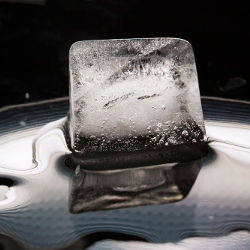
The photograph shows matter changing states. Which statement best describes what happens to the particles of matter during this

change? Tightly-packed particles gain energy, allowing them to move more freely. Particles move more slowly and bump into one another less frequently. Particles pack closely together, giving the matter a definite shape and volume. A loss of energy strengthens the attraction between particles.

Physics
2 answers:
AfilCa [17]2 years ago
6 0
Its a tightly-packed particles gain energy, allowing them to move more freely.
defon2 years ago
4 0

Answer: The correct answer is "Tightly-packed particles gain energy, allowing them to move more freely".

Explanation:

The three states of the matter are: Solid, liquid and gas.

Solid: In the solid state, the particles are tightly packed. The particles of the solid are not free to move. Solids are rigid. They have definite shape and volume.

Liquid: In the liquid state, the particles are loosely packed in comparison to solid. The particles of the liquid are free to move. They do not have definite shape.

Gas: In the gaseous state, the particles are more loosely packed in comparison to liquid. The particles of the gas are more free to move. They do not have definite shape.

In the given photograph, matter is changing its state. Here, ice is solid and it is changing its state. It starts melting after gaining energy from the surrounding. Then, the particles can move more freely.

Therefore, the correct option is "Tightly-packed particles gain energy, allowing them to move more freely".
You might be interested in
You start with spring that's already been stretched an unknown amount from equilibrium. After stretching it an additional 2.0 cm
maxonik [38]

Answer: 35*10^3 N/m

Explanation: In order to explain this problem we know that the potential energy for spring is given by:

Up=1/2*k*x^2 where k is the spring constant and x is the streching or compresion position from the equilibrium point for the spring.

We  also know that with additional streching of 2 cm of teh spring,  the potential energy is 18J. Then it applied another additional streching of 2 cm and the energy is 25J.

Then the difference of energy for both cases is 7 J so:

ΔUp= 1/2*k* (0.02)^2 then

k=2*7/(0.02)^2=35000 N/m

7 0
2 years ago
Acetone, a component of some types of fingernail polish, has a boiling point of 56°C. What is its boiling point in units of kelv
mixas84 [53]

Answer:

The boiling point of Acetone is 329K (in 3 significant figures)

Explanation:

Boiling point of Acetone = 56°C = 56 + 273K = 329K (in 3 significant figures)

7 0
2 years ago
Read 2 more answers
If vx=9.80 units and vy=-6.40 units, determine the magnitude and direction of v
dexar [7]
The resultant vector can be determined by the component vectors. The component vectors are vector lying along the x and y-axes. The equation for the resultant vector, v is:

v = √(vx² + vy²)
v = √[(9.80)² + (-6.40)²]
v = √137 or 11.7 units
5 0
2 years ago
A pendulum is made of a small sphere of mass 0.250 kg attached to a lightweight string 1.20 m in length. As the pendulum swings
forsale [732]

Answer:v=2 m/s

Explanation:

Given

Length of string L=1.2 m

mass of pendulum m=0.25 kg

maximum inclination with vertical \theta =34

vertical Rise of Pendulum from its mean position  is given by

\Delta h=L(1-\cos \theta )

Conserving Energy at top and bottom point

Potential Energy of sphere is converted into kinetic energy of sphere

mgL(1-\cos \theta )=\frac{mv^2}{2}

v=\sqrt{2gL(1-\cos \theta )}

v=\sqrt{2\times 9.8\times 1.2(1-\cos 34)}

v=\sqrt{4.021}

v=2 m/s

5 0
2 years ago
A pet-store supply truck moves at 25.0 m/s north along a highway. inside, a dog moves at 1.75 m/s at an angle of 35.0° east of
koban [17]

<u>Answer:</u>

 Velocity of the dog relative to the road = 26.04 m/s 3.15⁰ north of east.

<u>Explanation:</u>

  Let the east point towards positive X-axis and north point towards positive Y-axis.

  Speed of truck = 25 m/s north = 25 j m/s

  Speed of dog = 1.75 m/s at an angle of 35.0° east of north = (1.75 cos 35 i + 1.75 sin 35 j)m/s

                          = (1.43 i + 1.00 j) m/s

    Velocity of the dog relative to the road = 25 j + 1.43 i + 1.00 j = 1.43 i + 26.00 j

    Magnitude of velocity = 26.04 m/s

    Angle from positive horizontal axis = 86.85⁰

 So Velocity of the dog relative to the road = 26.04 m/s 86.85⁰ east of north = 26.04 m/s 3.15⁰ north of east.

4 0
2 years ago
Other questions:
  • An object is thrown horizontally off a cliff with an initial velocity of 5.0 meters per second. the object strikes the ground 3
    9·2 answers
  • A crane with output power of 200W will lift a 600N object a vertical distance of 4.0 meters in seconds
    10·1 answer
  • A point charge of 6.8 C moves at 6.5 × 10⁴ m/s at an angle of 15° to a magnetic field that has a field strength of 1.4 T.
    5·2 answers
  • If the 80 ohm resistor fails, will the 50 ohm and 100 ohm resistor continue to operate? Why or why not?
    5·1 answer
  • A substance has a heat of vaporization of 16.69 kJ/mole. At 254.3 K it has a vaporpressure of 92.44 mm Hg. Calculate its vapor p
    8·1 answer
  • A carousel that is 5.00 m in radius has a pair of 600-Hz sirens mounted on posts at opposite ends of a diameter. The carousel ro
    8·1 answer
  • Two fun-loving otters are sliding toward each other on a muddy (and hence frictionless) horizontal surface. One of them, of mass
    10·2 answers
  • g A cylinder of mass m is free to slide in a vertical tube. The kinetic friction force between the cylinder and the walls of the
    5·1 answer
  • A series of waves with decreasing wavelength labeled radio waves, microwaves, infrared, visible light, ultraviolet, X-rays, gamm
    13·2 answers
  • The energy transfer diagram shows energy transfer in an MP3 player. Useful energy is transferred away from the MP3 player by lig
    12·1 answer
Add answer
Login
Not registered? Fast signup
Signup
Login Signup
Ask question!
