answer.
Ask question
Login Signup
Ask question
All categories
  • English
  • Mathematics
  • Social Studies
  • Business
  • History
  • Health
  • Geography
  • Biology
  • Physics
  • Chemistry
  • Computers and Technology
  • Arts
  • World Languages
  • Spanish
  • French
  • German
  • Advanced Placement (AP)
  • SAT
  • Medicine
  • Law
  • Engineering
Pachacha [2.7K]
2 years ago
6

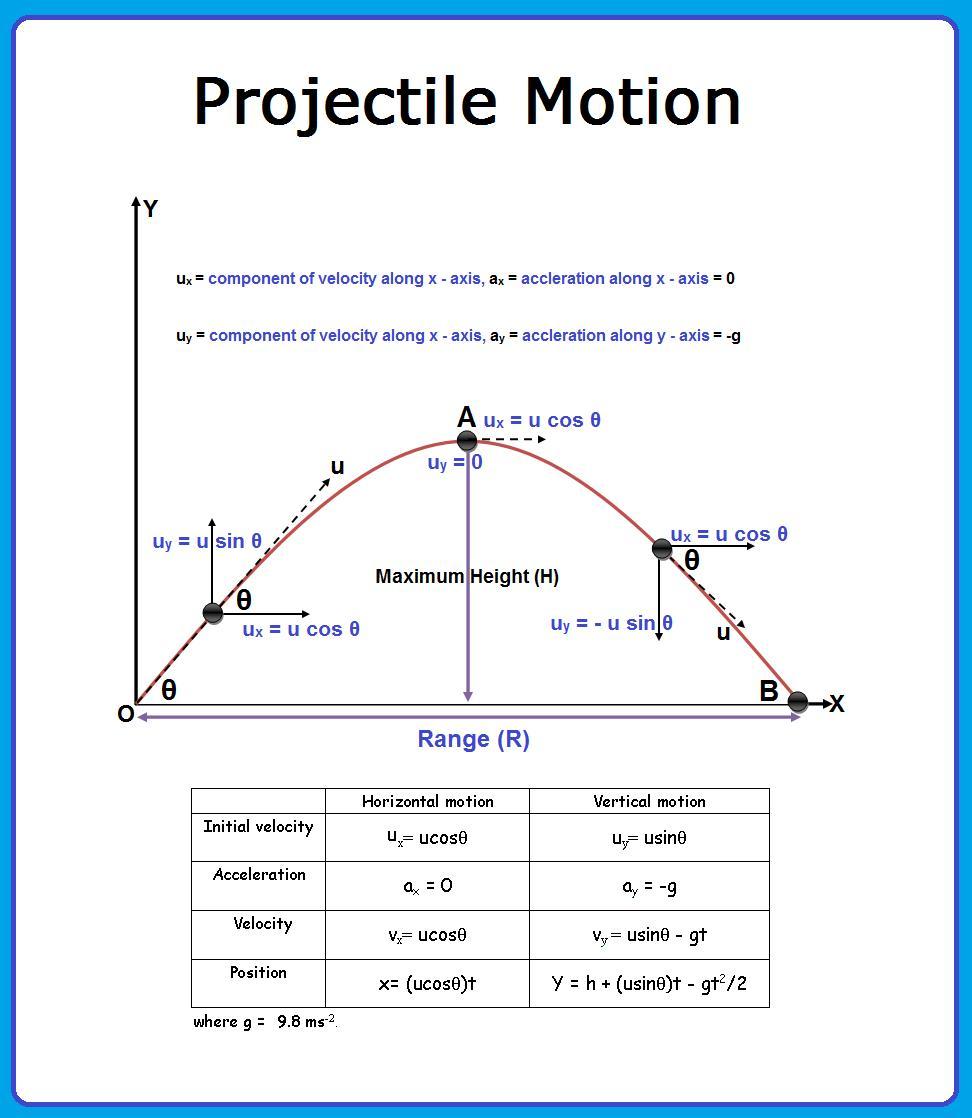
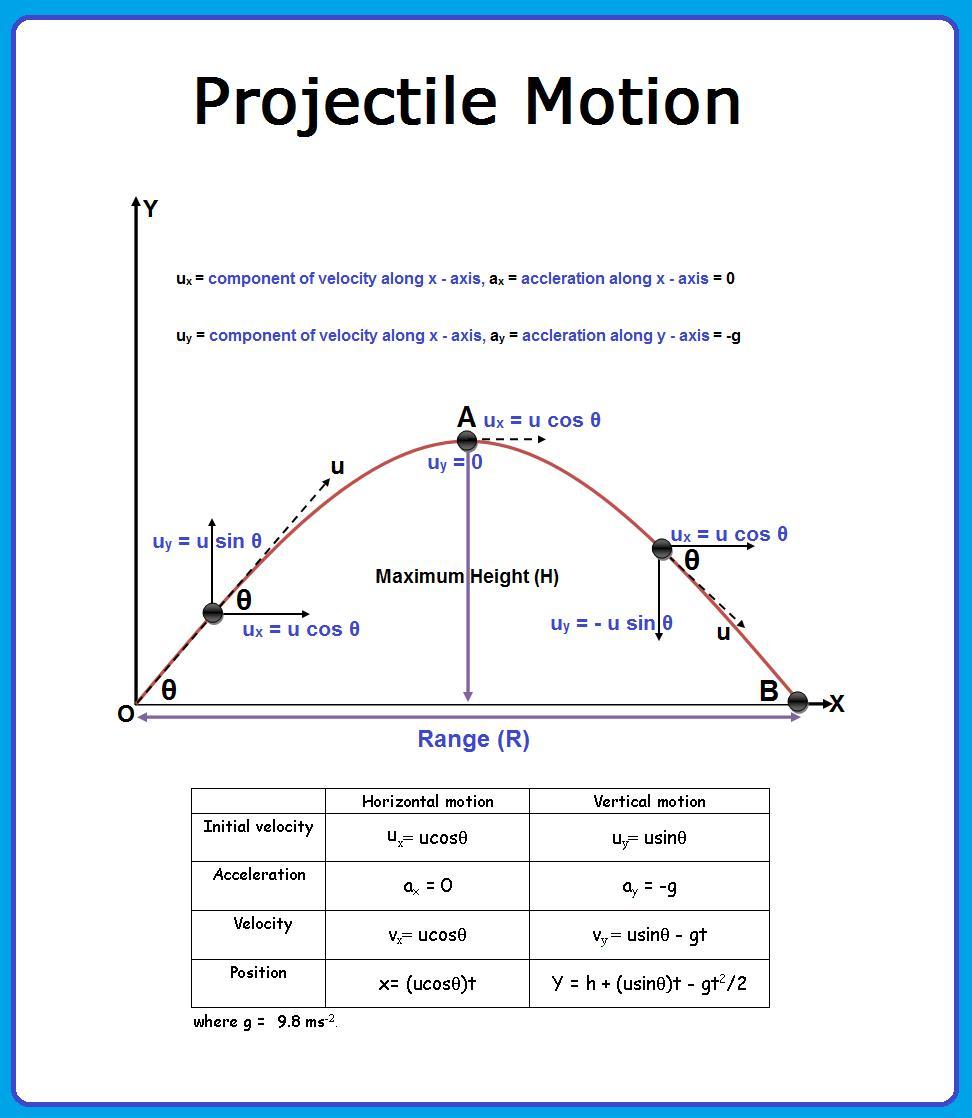
A student solving a physics problem for the range of a projectile has obtained the expression r= v20sin(2θ)g where v0=37.2meter/

second, θ=14.1∘, and g=9.80meter/second2. use your calculator to evaluate r.

Physics
2 answers:
Alika [10]2 years ago
6 0

The range of a projectile is about 66.7 m

\texttt{ }

<h3>Further explanation</h3>

Acceleration is rate of change of velocity.

\boxed {a = \frac{v - u}{t} }

\boxed {d = \frac{v + u}{2}~t }

<em>where:</em>

<em>a = acceleration ( m/s² )</em>

<em>v = final velocity ( m/s )</em>

<em>u = initial velocity ( m/s )</em>

<em>t = time taken ( s )</em>

<em>d = distance ( m )</em>

\texttt{ }

Let's recall Range of Projectile formula as follows:

\boxed{ R = \frac{ v_o^2 \sin 2\theta}{g} }

<em>where:</em>

<em>R = range of projectile ( m )</em>

<em>v₀ = initial speed of projectile ( m/s )</em>

<em>θ = angle of projection</em>

<em>g = gravitational acceleration ( m/s² )</em>

Let us now tackle the problem!

\texttt{ }

<u>Given:</u>

initial speed of projectile = v₀ = 37.2 m/s

angle of projection = θ = 14.1°

gravitational acceleration = g = 9.80 m/s²

<u>Asked:</u>

the range of a projectile = R = ?

<u>Solution:</u>

R = \frac{ v_o^2 \sin 2\theta}{g}

R = \frac{ 37.2^2 \sin 2 (14.1^o)}{9.80}

\boxed {R = 66.7 \texttt{ m}}

\texttt{ }

The range of a projectile is about 66.7 m

\texttt{ }

<h3>Learn more</h3>
  • Velocity of Runner : brainly.com/question/3813437
  • Kinetic Energy : brainly.com/question/692781
  • Acceleration : brainly.com/question/2283922
  • The Speed of Car : brainly.com/question/568302

\texttt{ }

<h3>Answer details</h3>

Grade: High School

Subject: Physics

Chapter: Kinematics
DedPeter [7]2 years ago
5 0

Formula of range is given by

R = \frac{v_o^2 sin2\theta}{g}

here given that

v_0=37.2m/s

θ=14.1∘

g=9.80m/s^2

now by above equation

R = \frac{37.2^2 sin2*14.1}{9.80}

R = 66.7 m

so range will be 66.1 m

You might be interested in
A particle is in uniform circular motion. Assume a standard rtz coordinate system. If you deconstruct the net force acting on th
Kitty [74]

Answer:

a) One

Explanation:

In a uniform circular motion there must be a force acting to keep it in the circular track. This force can either be centripetal or a centrifugal force.

According to the Newton's first law of motion a particle continues to be in state of rest or in uniform motion until acted upon by an external force.

Here the term uniform motion need to be understood which refers to the uniform velocity of the particle in accordance to the vector laws.

3 0
2 years ago
The magnitude J(r) of the current density in a certain cylindrical wire is given as a function of radial distance from the cente
kipiarov [429]

Answer:

I=68.31\times 10^{-6}\ A

Explanation:

Given that

J(r) = Br

We know that area of small element

dA = 2 π dr

I = J A

dI = J dA

Now by putting the values

dI = B r . 2 π dr

dI= 2π Br² dr

Now by integrating above equation

\int_{0}^{I}dI= \int_{r_1}^{r_2}2\pi Br^2 dr

I={2\pi B}\times \dfrac{r_2^3-r_1^3}{3}

Given that

B= 2.35 x 10⁵ A/m³

r₁ = 2 mm

r₂ = 2+ 0.0115 mm

r₂ = 2.0115 mm

I={2\pi B}\times \dfrac{r_2^3-r_1^3}{3}

By putting the values

I={2\pi \times 2.35 \times 10^5 }\times \dfrac{(2.0115\times 10^{-3})^3-(2\times 10^{-3})^3}{3}\ A

I=68.31\times 10^{-6}\ A

7 0
2 years ago
Read 2 more answers
A satellite, orbiting the earth at the equator at an altitude of 400 km, has an antenna that can be modeled as a 1.76-m-long rod
ivann1987 [24]

Answer:

The inducerd emf is 1.08 V

Solution:

As per the question:

Altitude of the satellite, H = 400 km

Length of the antenna, l = 1.76 m

Magnetic field, B = 8.0\times 10^{- 5}\ T

Now,

When a conducting rod moves in a uniform magnetic field linearly with velocity, v, then the potential difference due to its motion is given by:

e = - l(vec{v}\times \vec{B})

Here, velocity v is perpendicular to the rod

Thus

e = lvB           (1)

For the orbital velocity of the satellite at an altitude, H:

v = \sqrt{\frac{Gm_{E}}{R_{E}} + H}

where

G = Gravitational constant

m_{e} = 5.972\times 10^{24}\ kg = mass of earth

R_{E} = 6371\ km = radius of earth

v = \sqrt{\frac{6.67\times 10^{- 11}\times 5.972\times 10^{24}}{6371\times 1000 + 400\times 1000} = 7670.018\ m/s

Using this value value in eqn (1):

e = 1.76\times 7670.018\times 8.0\times 10^{- 5} = 1.08\ V

5 0
2 years ago
If period of the pendulum in preceding sample problem were 24s how tall would the tower be ?
frutty [35]

Answer:

So length of pendulum is 143.129 m

Explanation:

We have given period of simple pendulum is 2 sec

We have to find the length of simple pendulum

Let the length of pendulum is l

Acceleration due to gravityg=9.8m/sec^2 is

Time period is given by T=2\pi \sqrt{\frac{l}{g}}

So 24=2\times 3.14\times  \sqrt{\frac{l}{9.8}}

\sqrt{\frac{l}{9.8}}=3.821

Squaring both side

{\frac{l}{9.8}}=14.60

l =143.129 m

So length of pendulum is 143.129 m

8 0
2 years ago
Read 2 more answers
A child pushes her toy across a level floor at a steady velocity of 0.50 m/s using an applied force of 2.0 N. If the weight of t
choli [55]
Since toy is moving at constant speed that means that force that child is applying on toy is equal to force of friction.

Rate of speed that toy is moving is irelevant.

childs force is:
Fc = 2N
Fc = Ff  (Ff -friction force)

Ff = a*Q

where Q is weight of the toy and a is friction

if we express a we get
a = F/Q = 2/8 = 0.25
8 0
2 years ago
Read 2 more answers
Other questions:
  • While looking at bromine (Br) on the periodic table, a student needs to find another element with very similar chemical properti
    13·2 answers
  • The short vertical parts adjacent to it also reach into the magnetic field and should experience forces. why can we neglect them
    7·1 answer
  • A 1.00 l sample of a gas at 25.0◦c and 1.00 atm contains 50.0 % helium and 50.0 % neon by mass. what is the partial pressure of
    12·2 answers
  • A 36,287 kg truck has a momentum of 907,175 kg • m/s. What is the trucks velocity.
    5·1 answer
  • A boy throws a 15 kg ball at 4.7 m/s to a 65 kg girl who is stationary and standing on a skateboard. After catching the ball, th
    13·1 answer
  • X-rays with an energy of 300 keV undergo Compton scattering from a target. If the scattered rays are detected at 30 relative to
    8·2 answers
  • Calculate the orbital period of a dwarf planet found to have a semimajor axis of a = 4.0x 10^12 meters in seconds and years.
    6·1 answer
  • The electric field of a charge is defined by the force on what kind of particle?
    15·1 answer
  • Suppose we have a radar dish that generates a strong signal that travels out to hit an asteroid 10^9 kilometres away.
    14·1 answer
  • ASAP PLEASE HELPPP
    8·1 answer
Add answer
Login
Not registered? Fast signup
Signup
Login Signup
Ask question!