answer.
Ask question
Login Signup
Ask question
All categories
  • English
  • Mathematics
  • Social Studies
  • Business
  • History
  • Health
  • Geography
  • Biology
  • Physics
  • Chemistry
  • Computers and Technology
  • Arts
  • World Languages
  • Spanish
  • French
  • German
  • Advanced Placement (AP)
  • SAT
  • Medicine
  • Law
  • Engineering
Pavel [41]
2 years ago
6

6. Using trigonometry, solve for the x and y components of the following: a. 17.0 m/s @ 30.0o c. 13.0 m/s2 @ 120o b.

dn-cgi/l/email-protection" class="__cf_email__" data-cfemail="3b0a02150b567b090f0b54">[email protected] d. 22.0m/[email protected] 7. Usingthecomponentsbelow,sketchthevectorwithlabeledcomponentsand calculate its magnitude and direction. a. Ax =34.0m,Ay =-34.0m b. Bx =0.00km,By =150.0km c. Cx = -8.00 m/s2, Cy = 6.00 m/s2 8. A girl holds a stick at an angle with one end on the ground and the other end 0.750 m above the ground. The Sun shines straight downward on the stick, and the stick makes a shadow on the ground that is 1.25 m long. What is the length of the stick and the angle it makes with the ground? 9. A boat travels on a heading of 40.0o north of east for a distance of 300 km. How far north and how far east of its starting point does the boat sail? 10.A weather station releases a weather balloon. The balloon’s buoyancy accelerates it upward at 15 m/s2. At the same time, a wind accelerates it horizontally to the right at 6.5 m/s2. What is the resulting acceleration? 11.Using the analytical method of vector addition, sketch and solve the following: a. [email protected] [email protected] b. 22.0 m/s @ 225o + 40.0 m/s @ 315o c. 17.0 m/s2 @ 330o - 11.0 m/s2 @ 270o 12.A car travels along a curved section of road. Initially the car has velocity 30.0 m/s @ 90.0o. After 5.00 s the car has a velocity of 30.0 m/s @ 95.0o. a. Calculate the change in the car's velocity. b. Calculate the car's average acceleration.
I have all of the answers already, but I need to show work. If you could pls show the work for me that would be such a help!! Thanks!

Physics
1 answer:
Jet001 [13]2 years ago
4 0

6a) Vector: 17.0 m/s @ 30.0^{\circ}

x-component: a_x = (17.0) cos 30.0^{\circ}=14.7 m/s

y-component: a_y = (17.0) sin 30.0^{\circ}=8.5 m/s

6b) Vector: 13.0 m/s^2 @ 120^{\circ}

x-component: b_x = (13.0) cos 120.0^{\circ}=-6.5 m/s^2

y-component: b_y = (13.0) sin 120.0^{\circ}=11.3 m/s^2

6c) Vector: 19.0 m @ 240^{\circ}

x-component: c_x = (19.0) cos 240.0^{\circ}=-9.5 m

y-component: c_y = (19.0) sin 240.0^{\circ}=-16.4 m/s

6d) Vector: 22.0 m/s @ 300^{\circ}

x-component: d_x = (22.0) cos 300.0^{\circ}=11 m/s

y-component: d_y = (22.0) sin 300.0^{\circ}=-19.0 m/s


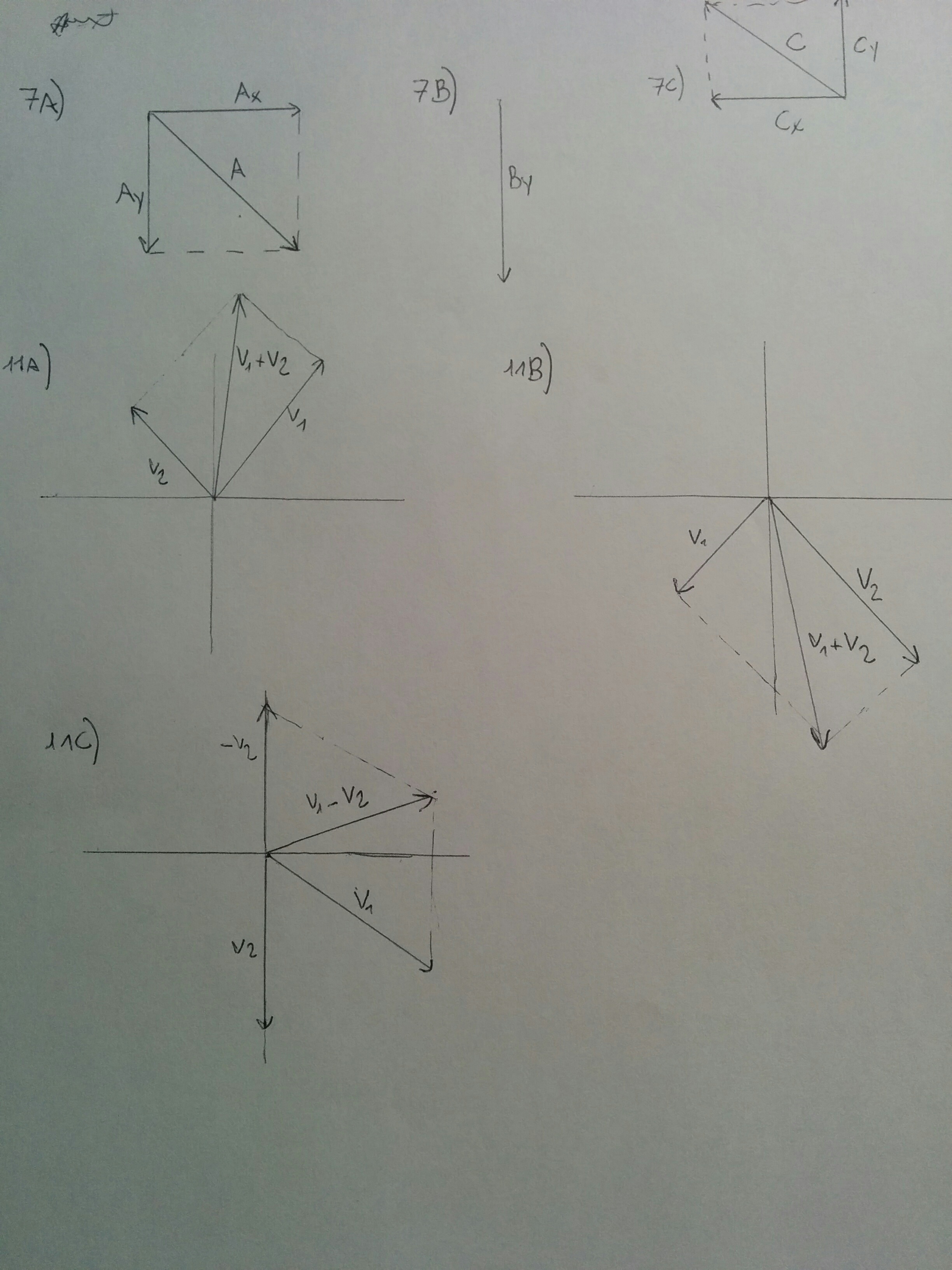
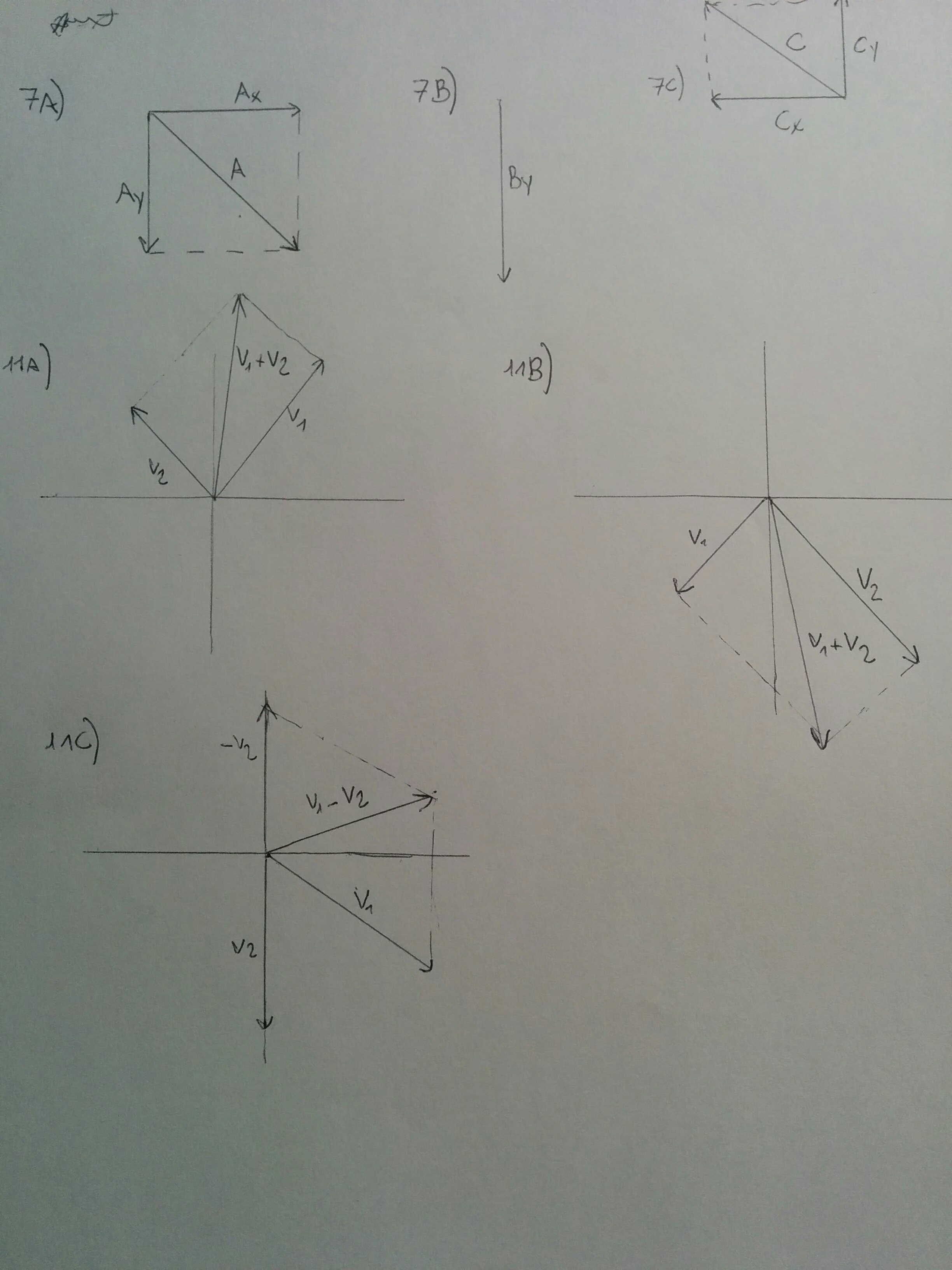
7a) Components: Ax =34.0m,Ay =-34.0m

Magnitude: |a|= \sqrt{A_x^2 +A_y^2}=\sqrt{(34.0)^2+(-34.0)^2}=48.0 m

Direction: \theta=arctan(\frac{A_y}{A_x})=arctan(\frac{-34.0}{34.0})=arctan(-1)=-45^{\circ}

7b) Components: Bx =0.00km,By =150.0km

Magnitude: |b|= \sqrt{B_x^2 +B_y^2}=\sqrt{(0)^2+(150.0)^2}=150.0 km

Direction: \theta=90^{\circ} since it is in the y-direction (no component on x)

7c) Components: Cx = -8.00 m/s2, Cy = 6.00 m/s2

Magnitude: |c|= \sqrt{C_x^2 +C_y^2}=\sqrt{(-8.0)^2+(6.0)^2}=10.0 m/s^2

Direction: \theta=arctan(\frac{C_y}{C_x})=arctan(\frac{6.0}{-8.0})=arctan(-0.75)=-36.8^{\circ}


8) In this problem, 0.750 m corresponds to the vertical side and 1.25 m corresponds to the horizontal side of a right triangle. The length of the stick corresponds to the length of the hypothenuse of this triangle, that can be found using the Pytagorean's theorem:

L=\sqrt{(0.750 m)^2+(1.25 m)^2}=1.458 m

The angle the stick makes with the ground is given by:

\theta=arctan (\frac{0.750 m}{1.25 m})=arctan(0.6)=31.0^{\circ}


9) The displacement of the boat corresponds to a vector of length L=300 km and angle \theta=40.0^{\circ} with respect to east. Therefore, the two components in the north and east directions are:

- north: L_y = L sin 40^{\circ}=(300 km)sin 40^{\circ}=192.8 km

- east: L_x = L cos 40^{\circ}=(300 km) cos 40^{\circ} =229.8 km


10) The two accelerations correspond to the two sides of a right triangle, therefore the resultant acceleration corresponds to the length of the hypothenuse of the triangle:

a=\sqrt{a_x^2 +a_y^2 }=\sqrt{(6.5)^2+(15)^2}=16.3 m/s^2


11a) [email protected] [email protected]

Let's resolve each vector in its components:

v_{1x} = (9.0) cos 55^{\circ} = 5.2 m

v_{1y} = (9.0) sin 55^{\circ} = 7.4 m

v_{2x} = (6.0) cos 125^{\circ} = -3.4 m

v_{2y} = (6.0) sin 55^{\circ} = 4.9 m

Now we sum the components in each direction:

R_x = v_{1x}+v_{2x}=5.2-3.4 =1.8 m

R_y = v_{1y}+v_{2y}=7.4+4.9 =12.3 m

So the magnitude of the resultant vector is:

R=\sqrt{R_x^2+R_y^2}=\sqrt{(1.8)^2+(12.3)^2}=12.4 m

And the direction is:

\theta=arctan(\frac{R_y}{R_x})=arctan(\frac{12.3}{1.8})=81.7^{\circ}


11b) 22.0 m/s @ 225o + 40.0 m/s @ 315o

Let's resolve each vector in its components:

v_{1x} = (22.0) cos 225^{\circ} = -15.6 m/s

v_{1y} = (22.0) sin 225^{\circ} = -15.6 m/s

v_{2x} = (40.0) cos 315^{\circ} = 28.3 m/s

v_{2y} = (40.0) sin 315^{\circ} = -28.3 m/s

Now we sum the components in each direction:

R_x = v_{1x}+v_{2x}=15.6+28.3 =43.9 m/s

R_y = v_{1y}+v_{2y}=-15.6-28.3 =-43.9 m/s

So the magnitude of the resultant vector is:

R=\sqrt{R_x^2+R_y^2}=\sqrt{(43.9)^2+(-43.9)^2}=62.1 m/s

And the direction is:

\theta=arctan(\frac{R_y}{R_x})=arctan(\frac{-43.9}{43.9})=315^{\circ}


11c) 17.0 m/s2 @ 330o - 11.0 m/s2 @ 270o

Let's resolve each vector in its components:

v_{1x} = (17.0) cos 330^{\circ} = 14.7 m/s

v_{1y} = (17.0) sin 330^{\circ} = -8.5 m/s

v_{2x} = (11.0) cos 270^{\circ} = 0 m/s

v_{2y} = (11.0) sin 270^{\circ} = -11 m/s

Now we calculate the difference between the components in each direction:

R_x = v_{1x}+v_{2x}=14.7-0 =14.7 m/s

R_y = v_{1y}+v_{2y}=-8.5-(-11) =2.5 m/s

So the magnitude of the resultant vector is:

R=\sqrt{R_x^2+R_y^2}=\sqrt{(14.7)^2+(2.5)^2}=14.9 m/s

And the direction is:

\theta=arctan(\frac{R_y}{R_x})=arctan(\frac{2.5}{14.7})=9.7^{\circ}


12a) The change in velocity is equal to the vector difference between the final velocity (vf) and the initial velocity (vi), so let's proceed as in the previous exercise:

v_{1x} = (30.0) cos 90^{\circ} = 0 m/s

v_{1y} = (30.0) sin 330^{\circ} = 30 m/s

v_{2x} = (30.0) cos 95^{\circ} = -2.6 m/s

v_{2y} = (30.0) sin 95^{\circ} = 29.9 m/s

Difference:

R_x = v_{2x}-v_{1x}=-2.6-0 =-2.6 m/s

R_y = v_{2y}-v_{2x}=29.9-(30) =-0.1 m/s

Magnitude of the resultant vector:

R=\sqrt{R_x^2+R_y^2}=\sqrt{(2.6)^2+(0.1)^2}=2.6 m/s


12b) Acceleration: a=\frac{\Delta v}{t}=\frac{2.6 m/s}{5.0 s}=0.52 m/s^2


You might be interested in
A wave is a disturbance that transmits energy from one location to another without transmitting matter with it.
GenaCL600 [577]
I think it’s true!!!
5 0
2 years ago
If vx=9.80 units and vy=-6.40 units, determine the magnitude and direction of v
dexar [7]
The resultant vector can be determined by the component vectors. The component vectors are vector lying along the x and y-axes. The equation for the resultant vector, v is:

v = √(vx² + vy²)
v = √[(9.80)² + (-6.40)²]
v = √137 or 11.7 units
5 0
2 years ago
Robin Hood wishes to split an arrow already in the bull's-eye of a target 40 m away.
tamaranim1 [39]

Answer:

5.843 m

Explanation:

suppose that the arrow leave the bow with a horizontal speed , towards he bull's eye.

lets consider that horizontal motion

distance = speed * time

time = 40/ 37 = 1.081 s

arrow doesnot have a initial vertical velocity component. but it has a vertical motion due to gravity , which may cause a miss of the target.

applying motion equation

(assume g = 10 m/s²)

s=ut+\frac{1}{2}*gt^{2}  \\= 0+\frac{1}{2}*10*1.081^{2}\\= 5.843 m

Arrow misses the target by 5.843m ig the arrow us split horizontally

4 0
2 years ago
550 J of work must be done to compress a gas to half its initial volume at constant temperature. How much work must be done to c
Over [174]

Answer:

The amount of work that must be done to compress the gas 11 times less than its initial pressure is 909.091 J

Explanation:

The given variables are

Work done = 550 J

Volume change = V₂ - V₁ = -0.5V₁

Thus the product of pressure and volume change = work done by gas, thus

P × -0.5V₁ = 500 J

Hence -PV₁ = 1000 J

also P₁/V₁ = P₂/V₂ but V₂ = 0.5V₁ Therefore  P₁/V₁ = P₂/0.5V₁ or P₁ = 2P₂

Also to compress the gas by a factor of 11 we have

P (V₂ - V₁) = P×(V₁/11 -V₁) = P(11V₁ - V₁)/11 = P×-10V₁/11 = -PV₁×10/11 = 1000 J ×10/11  = 909.091 J of work

7 0
2 years ago
A horizontal spring with spring constant 85 n/m extends outward from a wall just above floor level. a 3.5 kg box sliding across
Rina8888 [55]

k = spring constant of the spring = 85 N/m

m = mass of the box sliding towards the spring = 3.5 kg

v = speed of box just before colliding with the spring = ?

x = compression the spring = 6.5 cm = 6.5 cm (1 m /100 cm) = 0.065 m

the kinetic energy of box just before colliding with the spring converts into the spring energy of the spring when it is fully compressed.

Using conservation of energy

Kinetic energy of spring before collision = spring energy of spring after compression

(0.5) m v² = (0.5) k x²

m v² = k x²

inserting the values

(3.5 kg) v² = (85 N/m) (0.065 m)²

v = 0.32 m/s

8 0
2 years ago
Other questions:
  • A solid element that is malleable' a good conductor of electricity, and reacts with oxygen is classified as a
    14·1 answer
  • somewhere between the earth and the moon is a point where the gravitational attraction of the earth is canceled by the gravitati
    14·1 answer
  • A 1.0-c point charge is 15 m from a second point charge, and the electric force on one of them due to the other is 1.0 n. what i
    9·1 answer
  • When an ice pack is applied to an injury, thermal energy from the injured area transfers to the ice, causing the blood vessels w
    8·2 answers
  • A cubical box, 5.00 cm on each side, is immersed in a fluid. The gauge pressure at the top surface of the box is 594 Pa and the
    13·1 answer
  • . A 1.50kg mass on a spring has a displacement as a function of time given by the equation: x(t) = (7.40cm)cos[(4.16s-1)t – 2.42
    11·1 answer
  • You wad up a piece of paper and throw it into the wastebasket. How far will
    13·2 answers
  • A spherical drop of water carrying a charge of 30 pC has a potential of 500 V at its surface (with V 0 at infinity). (a) What is
    10·1 answer
  • An astronaut holds a rock 100m above the surface of Planet XX. The rock is then thrown upward with a speed of 15m/s, as shown in
    11·1 answer
  • Henrietta is going off to her physics class, jogging down the sidewalk at a speed of 4.15 m/s . Her husband Bruce suddenly reali
    6·1 answer
Add answer
Login
Not registered? Fast signup
Signup
Login Signup
Ask question!