answer.
Ask question
Login Signup
Ask question
All categories
  • English
  • Mathematics
  • Social Studies
  • Business
  • History
  • Health
  • Geography
  • Biology
  • Physics
  • Chemistry
  • Computers and Technology
  • Arts
  • World Languages
  • Spanish
  • French
  • German
  • Advanced Placement (AP)
  • SAT
  • Medicine
  • Law
  • Engineering
babunello [35]
2 years ago
10

What type of reaction breaks the bonds that join the phosphate groups in an ATP molecule? What type of reaction breaks the bonds

that join the phosphate groups in an ATP molecule? anabolism hydrolysis entropic dehydration synthesis dehydration decomposition
Chemistry
1 answer:
Paraphin [41]2 years ago
4 0

Answer:

Hydrolysis

Explanation:

The phosphate groups in an ATP molecule are joined forming an ester group. Esters can be formed when an alcohol (-OH) bonds with an acid (-COOH, or, in the case of phosphoric acid, HPO_{5}). When this bonding occurs, the two molecules together lose a molecule of water, because the alcohol loses the hydroxyl and the acid loses an hydrogen, and the three atoms combine to form water. All the chemical bonds that are formed with the loss of a water molecule can also be broken using water, and this reaction is called hydrolysis.

You might be interested in
The nucleus of a neutral potassium atom is "surrounded" by
ddd [48]

The answer is electron.

The nucleus of a neutral potassium atom is "surrounded" by electron.

The neutral potassium atom contains equal number of protons and neutrons, and there are 19 electrons and 19 protons while 20 neutrons.

20 protons and 20 neutrons are there in the nucleus while  19 electrons surrounds the nucleus in different orbits .

7 0
2 years ago
Read 2 more answers
The interior of a refrigerator has a volume of 0.600 m3. the temperature inside the refrigerator in 282 k, and the pressure is 1
Dafna11 [192]
In this instance we can use the ideal gas law equation to find the number of moles of gas inside the refrigerator 
PV = nRT
where 
P - pressure - 101 000 Pa
V - volume - 0.600 m³
n - number of moles
R - universal gas constant - 8.314 J/mol.K
T - temperature - 282 K
substituting these values in the equation 
101 000 Pa x 0.600 m³ = n x  8.314 J/mol.K x 282 K
n = 25.8 mol
there are 25.8 mol of the gas
to find the mass of gas
mass of gas = number of moles x molar mass of gas
mass = 25.8 mol x 29 g/mol  = 748.2 g
mass of gas present is 748.2 g 
6 0
2 years ago
Which of the following statements concerning a metal crystallized in a face-centered cubic cell is/are CORRECT? 1. One metal ato
AleksAgata [21]

Answer:

Only 3 is correct.

Explanation:

The crystal of a metal or an ionic compound is called a cell, and there are 7 types of unit cells: cubic, tetragonal, orthorhombic, monoclinic, hexagonal, rhombohedral, and triclinic.

In a face-centered cubic cell (FCC) all angles are 90º and all lengths are equal. Each cubic cell has 8 atoms in each corner of the cube, and that atom is shared with 8 neighboring cells. So for a metal crystal, the atom is located at each of the eight lattice points, where it is shared equally between eight unit cells.

5 0
2 years ago
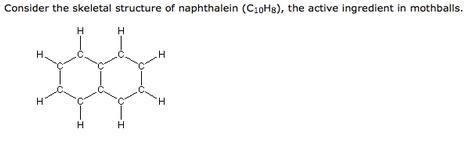
Consider the skeletal structure of naphthalein (C10H8), the active ingredient in mothballs. How many double bonds must be added
Greeley [361]

Answer:

four (4)

Explanation:

Naphthalein is an organic compound with formula C 10H 8. It is the simplest polycyclic aromatic hydrocarbon, and is a white crystalline solid with a characteristic odor that is detectable at concentrations as low as 0.08 ppm by mass. As an aromatic hydrocarbon, naphthalene's structure consists of a fused pair of benzene rings. It is best known as the main ingredient of traditional mothballs.

The molecule is planar, like benzene. Unlike benzene, the carbon–carbon bonds in naphthalene are not of the same length. The bonds C1−C2, C3−C4, C5−C6 and C7−C8 are about 1.37 Å (137 pm) in length, whereas the other carbon–carbon bonds are about 1.42 Å (142 pm) long. This difference, established by X-ray diffraction is consistent with the valence bond model in naphthalene and in particular, with the theorem of cross-conjugation. This theorem would describe naphthalene as an aromatic benzene unit bonded to a diene but not extensively conjugated to it (at least in the ground state), which is consistent with two of its three resonance structures.

Because of this resonance, the molecule has bilateral symmetry across the plane of the shared carbon pair, as well as across the plane that bisects bonds C2-C3 and C6-C7, and across the plane of the carbon atoms. Thus there are two sets of equivalent hydrogen atoms: the alpha positions, numbered 1, 4, 5, and 8, and the beta positions, 2, 3, 6, and 7. Two isomers are then possible for mono-substituted naphthalenes, corresponding to substitution at an alpha or beta position. Bicyclo[6.2.0]decapentaene is a structural isomer with a fused 4–8 ring system.

Therefore four (4) double bonds will be added to give each carbon atom an octet structure.

8 0
2 years ago
11. A sample contains 25% water and weighs 201 grams. Determine the grams of water in the
77julia77 [94]

Answer:

m_{water}=50.25g

Explanation:

Hello,

In this case, considering that the by-mass percent of water is:

\% m/m=\frac{m_{water}}{m_{sample}}*100\%

Given such percent and the mass of the sample, we can find the mass of water in grams in the sample by solving for it as shown below:

m_{water}=\frac{\%m/m*m_{sample}}{100\%}\\ \\m_{water}=\frac{25\%*201g}{100\%}\\ \\m_{water}=50.25g

Best regards.

5 0
2 years ago
Other questions:
  • Material A has a small latent heat of fusion. Material B has a large heat of fusion. Which of the following statements is true?
    7·2 answers
  • When you open a bottle of a soft drink and leave it open, the drink eventually goes flat. this happens because the equilibrium b
    6·1 answer
  • During this reaction, p4 + 5o2 → p4o10, 0.800 moles of product was made in 15.0 seconds. what is the rate of reaction? 56.8 g/mi
    12·1 answer
  • What is the mass of nickel(ii) nitrate (182.71 g/mol) dissolved in 25.0 ml of 0.100 m ni(no3)2 solution?
    13·2 answers
  • To neutralize 1.65g LiOH, how much .150 M HCl would be needed?
    6·1 answer
  • 1.35 Draw structures for all constitutional isomers with the following molecular formulas: (a) C6H14 (b) C2H5Cl (c) C2H4Cl2 (d )
    9·1 answer
  • How many L of carbon dioxide at 1.00 atm and 298.15 K are released from a car's engine upon consumption of a 60.0 L LIQUID tank
    10·1 answer
  • In recent years, assistive technologies have been developed to give people
    12·1 answer
  • How many mm are equal to 4.75 x 10⁻² m?
    11·1 answer
  • Calculate the mass of the zinc that reacts with 4.11 g of hydrochloric acid to form 9.1 g of zinc chloride and 3.97 g of hydroge
    6·1 answer
Add answer
Login
Not registered? Fast signup
Signup
Login Signup
Ask question!