answer.
Ask question
Login Signup
Ask question
All categories
  • English
  • Mathematics
  • Social Studies
  • Business
  • History
  • Health
  • Geography
  • Biology
  • Physics
  • Chemistry
  • Computers and Technology
  • Arts
  • World Languages
  • Spanish
  • French
  • German
  • Advanced Placement (AP)
  • SAT
  • Medicine
  • Law
  • Engineering
vlabodo [156]
2 years ago
6

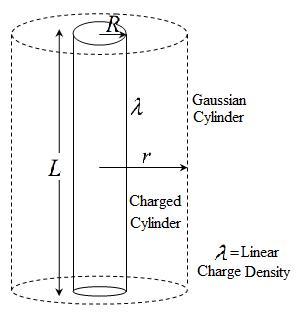
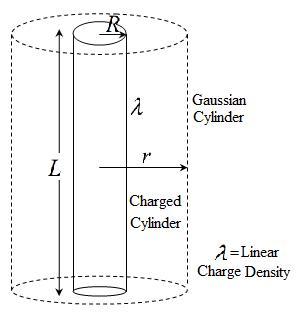
A very long, uniformly charged cylinder has radius R and linear charge density λ. Find the cylinder's electric field strength ou

tside the cylinder,
r≥R
. Give your answer as a multiple of
λ/
ε
0

Physics
2 answers:
Alborosie2 years ago
6 0

The electric field of cylinder at a distance r more than radius of cylinder is equal to \boxed{E=\dfrac{\lambda}{2\pi\epsilon_0r}}}.

Further Explanation:

Gauss law states that net electric flux through any closed surface is equal to \dfrac{1}{\epsilon_0} times the net electric charge within that closed surface. The hypothetical closed surface is name as Gaussian surface. The electric flux also defined as the total electric field lines, which passes through a surface area of any closed curve.

Given:

The linear charge density of cylinder is \lambda.

Concept:

Consider the length of the cylinder is L.

Charge on curved surface of cylinder is \lambda L.

For a Gaussian curve in the shape of a concentric cylinder (with a radius more than the radius of charged cylinder) we can write gauss law as:

\phi=\dfrac{q}{\epsilon_0}

Substitute \lambda L for q in above equation.

\phi=\dfrac{\lambda L}{\epsilon_0}                          …… (I)

Here, \phi is the Electric flux and \epsilon_0 is the permittivity of vacuum.

Since the electric field is constant for a given distance r from the axis of the cylinder we can write that:

\phi=E2\pi rL                                                            …… (II)

Here, E is the electric field of charge on cylinder, L is the height or length of curved surface and r is the radius of Gaussian cylindrical curve.

On equating the equation (I) and equation (II) and Rearranging it for E :

\boxed{E=\dfrac{\lambda}{2\pi\epsilon_0r}}}

Thus, the electric field of cylinder at a distance r more than radius of cylinder is equal to \boxed{E=\dfrac{\lambda}{2\pi\epsilon_0r}}}.

Learn more:

1. Threshold frequency of photoelectric surface: brainly.com/question/6953278

2. Find the odd one out for lever: brainly.com/question/1073452

3. Volume of gas after expansion: brainly.com/question/9979757

Answer Details:

Grade: College

Subject: Physics

Chapter: Electrostatics

Keywords:

Very long, uniformly charged cylinder, radius R, linear charge density λ, cylinder, electric field strength, gauss law, net electric charge and distance r from the axis of the cylinder.

mixer [17]2 years ago
5 0

The cylinder's electric field magnitude, at a distance <em>r</em> from the axis of the cylinder (greater than the cylinder's radius), is equal to E= \frac{\lambda}{2\pi \epsilon_0 \cdot r}

<h3>Further explanation</h3>

Matter is the building block of everything that we encounter in our lives. Matter is made of atoms, which are in turn made of tiny particles which are called electrons, protons, and neutrons. The ammount of these 3 elements, and their topological configuration in the atoms, is what determines what a certain element is (like Carbon, Hydrogen, Iron, etc).

In some cases, some elements may lose or gain some electrons. Regarded that this missing or extra electrons are not very high in number, the material doesn't lose any of its properties, however it will always try to get its number of electrons back to normal. This is when we say that an element has a <em>charge</em>, which is a measure of how much electrons a body needs to get back to normal. A body has positive charge if it lacks electrons, and has negative charge if it has extra electrons.

This charge causes the material to have an Electric field, which is a measure of how much does it attract or repel electrons. In the case of our problem, we need to compute exactly that, the Electric field. In our problem, we have an infinitely long cylinder with a linear charge density \lambda, this means that all parts of the cylinder have the same charge, and due to symmetry, the electric field is constant on the angular and longitudinal directions of the cylinder.

This makes easy to apply Gauss' Law, since for a Gaussian curve in the shape of a concentric cylinder (with a higher radius than that of our charged cylinder) we can write:

\Phi = \frac{\lambda \cdot L}{\epsilon_0}

Where \Phi is called the Electric flux. Since the electric field is constant for a given distance <em>r</em> from the axis of the cylinder we can write that:

\Phi = E \cdot 2\pi r \cdot L

Joining both our expressions we can get that:

E= \frac{\lambda}{2\pi \epsilon_0 \cdot r}

<h3 /><h3>Learn more</h3>
  • Description on Electric fields: brainly.com/question/8971780
  • Relation between electric fields and magnetism: brainly.com/question/2838625
  • How can we use electric charges: brainly.com/question/10427437
<h3>Keywords</h3>

Electrons, protons, electric field, cylinder, electric flux
You might be interested in
Consider a string of length 1.0 meter, fixed at both ends, with mass 100 grams and tension 100 newtons. part a give the number o
Bond [772]
To answer the problem we would be using this formula which isv = sqrt(T/(m/L)) 
v = sqrt(100 N / [(0.100 kg)/(1.0 m)]) 
v = 31.62 m/s 
v = fλ 
31.62 m/s = (95 Hz)(λ) 
λ = 0.333 m 
For every wavelength along a string there will be 2 antinodes. 
1.0 m / 0.333 m = 3 
3 * 2 = 6 antinodes 
6 + 1 = 7 nodes
4 0
2 years ago
Nanotechnology and microtechnology devices are both very tiny. However, one property of nanotechnology distinguishes it from mic
jek_recluse [69]
Nanotechnology displays particle quality
7 0
2 years ago
A bar of silicon is 4 cm long with a circular cross section. If the resistance of the bar is 270 ω at room temperature, what is
vova2212 [387]

solution:

consider the following data\\&#10;length of slicon bar with circular cross section is 4cm or 0.04m\\&#10;at room temperature resistance of the slicon bar is 270\Omega \\&#10;represent the resistance in mathematical from\\&#10;r=p\frac{1}{A}---1\\&#10;where r is resistance and l is the length \\&#10;A is cross sectional area\\&#10;it is clear that resistivity of the silicon meterial is 6.4\times^2 \Omega.m\\&#10;substitute 6.4\times10^2 for p,270\Omega for R and 0.04m for l i equation (1).\\270=(604\times10^2)\frac{0.04}{A}\\&#10;rewrite the equation\\&#10;a=(6.4\times10^2)\frac{(0.04)}{270}\\&#10;=0.9481m^2\\&#10;write the formula for the circular cross sectional area of silicon bar.\\&#10;A=\pi r^2\\&#10;substitute 0.9481 for A in the above equation\\&#10;\pi r^2=0.9481&#10;r^2=\frac{0.9481}{3.14},since \pi =3.14\\&#10;0.30194\\&#10;further simplified\\&#10;r^2=0.30194\\&#10;\sqrt{0.30194}\\&#10;\cong 0.1509m\\&#10;\cong 150.1mm

7 0
2 years ago
An electron moves through a uniform electric field vector E = (2.80î + 5.20ĵ) V/m and a uniform magnetic field vector B = 0.400k
alina1380 [7]

Answer:

1.758820×10^11(-2.5i-0.8j) m/s^2

Explanation:

From the question, the parameters given are; E=(2.80i+ 5.20j) v/m, a uniform magnetic field,B= 0.400K T, acceleration, a= ??? and velocity vector, v= 11.0i metre per seconds (m/s)...

We can solve this problem using the formula below;

Ma= q[E+V × B] ---------------(1).

Note: q is negative, m= mass of electron.

Making acceleration,a the subject of the formula and substituting the parameters into equation (1);

a= -e/m × (2.5i + 5.2j +11.0i × 0.400K)

a= -e/m × (2.5i+5.2j-4.4j)

a= e/m × (-2.5i - 0.8j)

e/m= 1.758820×10^11 c/kg

Therefore, slotting in the value of charge to mass(e/m) ratio;

a= 1.7588×10^11×(-2.5i-0.8j) m/s^2

7 0
2 years ago
If the light strikes the first mirror at an angle θ1, what is the reflected angle θ2? express your answer in terms of θ1.
Alexus [3.1K]

Answer:

θ₂ = 90° - θ₁

Explanation:

When the light falls on a mirror it bounces back. This is know as reflection. The incident angle is equal to the angle of reflection.

Here, the light strikes the mirror at an angle = θ₁

To find the angle of reflection we first need to understand angle of incidence. The angle of incidence is the angle made between the incident ray and normal. Normal is an imaginary line drawn perpendicular line on the boundary of the mirror.

Since the light strikes the mirror at angle of θ₁, which is the angle between light ray and the mirror.

Angle of incidence = 90° - θ₁.

Thus, angle of reflection, θ₂ = 90° - θ₁

3 0
2 years ago
Other questions:
  • Read the lab procedure for a controlled experiment that looks at the effect of heat on the circumference of bicycle tires.
    7·2 answers
  • A grasshopper jumps at a 65.0 degree angle at 5.42m/s. At what time does it reach its maximum height?
    9·2 answers
  • Which statement best describes what energy transfer diagrams show? Energy can change form, but the total amount of energy stays
    12·2 answers
  • A certain 100W light bulb has an efficiency of 95%. How much thermal energy will this light bulb add to the inside of a room in
    12·1 answer
  • A large container, 120 cm deep is filled with water. If a small hole is punched in its side 77.0 cm from the top, at what initia
    11·1 answer
  • A person wants to lose weight by "pumping iron". The person lifts an 80 kg weight 1 meter. How many times must this weight be li
    14·1 answer
  • A mechanic uses a hydraulic car jack to lift the front end of a car to change the oil. The jack used exerts 8,915 N of force fro
    6·1 answer
  • A transformer is to be designed to increase the 30 kV-rms output of a generator to the transmission-line voltage of 345 kV-rms.
    8·1 answer
  • A rocket exhausts fuel with a velocity of 1500m/s, relative to the rocket. It starts from rest in outer space with fuel comprisi
    15·2 answers
  • Fill in the terms that accurately complete the statements. The nucleus contains positively charged particles called and neutral
    11·2 answers
Add answer
Login
Not registered? Fast signup
Signup
Login Signup
Ask question!