answer.
Ask question
Login Signup
Ask question
All categories
  • English
  • Mathematics
  • Social Studies
  • Business
  • History
  • Health
  • Geography
  • Biology
  • Physics
  • Chemistry
  • Computers and Technology
  • Arts
  • World Languages
  • Spanish
  • French
  • German
  • Advanced Placement (AP)
  • SAT
  • Medicine
  • Law
  • Engineering
padilas [110]
2 years ago
6

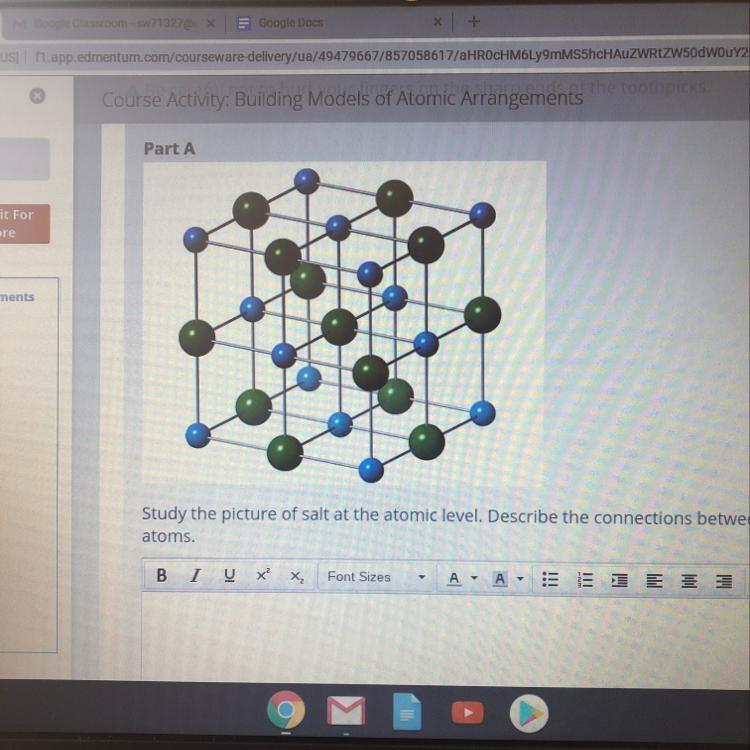
Study the picture of salt at the atomic level. Describe the connections between the sodium and chlorine atoms

Physics
2 answers:
Illusion [34]2 years ago
5 0

Answer:

Connection between the sodium and chlorine atoms are Ionic

Explanation:

Ionic bond is defined as the bond formed between two atoms by the complete transferring of electrons. It is type of chemical bond that generates two oppositely charged ions i.e Anion (-ve charge) and cation (+ve charge).

Metals that has 1, 2 or 3 electrons in its valence shell losses valence   electrons and become positively charged cation. These electron attracted by the non-metals to form bond and become negatively charged anion. In this way, ionic bond is generated between 2 atoms.

Sodium is a metal with 1 electron in its valence shell. Chlorine is a non-metal with 7 less electrons (need 1 more to complete its valence shell to stabilize) in its valence shell. When sodium comes in contact with chlorine, it losses its one valence electron and become cation with +1 charge. This electron is accepted by chlorine and become anion with -1 charge. In this way ionic bond is formed between sodium and chloride.

                Na⁺    +    Cl ⁻⇒  NaCl

Luba_88 [7]2 years ago
3 0

Explanation:

dude i littlerly am doing the same thing and i dont feel like thinking so i just copyed and pasted lol

You might be interested in
An object moving at a velocity of 32m/s slows to a stop in 4 seconds. What was its acceleration?
Romashka [77]

Answer:

8m/s

Explanation:

a=d/t

a=32/4

a=8 m/s

6 0
2 years ago
Read 2 more answers
If a train is 100 kilometers away, how much sooner would you hear the train coming by listening to the rails (iron) as opposed t
Whitepunk [10]
From tables, the speed of sound at 0°C is approximately
V₁ = 331 m/s (in air)
V₃ = 5130 m/s (in iron)

Distance traveled is
d = 100 km = 10⁵ m

Time required to travel in air is
t₁ = d/V₁ = 10⁵/331 = 302.12 s

Time required to travel in iron is
t₂ = d/V₂ = 10⁵/5130 = 19.49 s

The difference in time is
302.12 - 19.49 = 282.63 s

Answer:  283 s (nearest second)


6 0
2 years ago
Determine the specific volume of refrigerant-134a at 1 MPa and 50°C, using (a) the ideal-gas equation of state and (b) the gener
Andrej [43]

Answer:

( a ) The specific volume by ideal gas equation = 0.02632 \frac{m^{3} }{kg}

% Error =  20.75 %

(b) The value of specific volume From the generalized compressibility chart = 0.0142 \frac{m^{3} }{kg}

% Error =  - 34.85 %

Explanation:

Pressure = 1 M pa

Temperature = 50 °c = 323 K

Gas constant ( R ) for refrigerant = 81.49 \frac{J}{kg k}

(a). From ideal gas equation P V = m R T ---------- (1)

⇒ \frac{V}{m} = \frac{R T}{P}

⇒ Here \frac{V}{m} = Specific volume = v

⇒ v =  \frac{R T}{P}

Put all the values in the above formula we get

⇒ v = \frac{323}{10^{6} } ×81.49

⇒ v = 0.02632 \frac{m^{3} }{kg}

This is the specific volume by ideal gas equation.

Actual value = 0.021796 \frac{m^{3} }{kg}

Error =  0.02632 - 0.021796 =   0.004524 \frac{m^{3} }{kg}

% Error =  \frac{0.004524}{0.021796} × 100

% Error =  20.75 %

(b). From the generalized compressibility chart the value of specific volume

 \frac{V}{m} = v = 0.0142 \frac{m^{3} }{kg}

The actual value = 0.021796 \frac{m^{3} }{kg}

Error = 0.0142 - 0.021796 =  \frac{m^{3} }{kg}

% Error = \frac{- 0.0076}{0.021796} × 100

% Error =  - 34.85 %

3 0
2 years ago
The equilibrium fraction of lattice sites that are vacant in silver (Ag) at 600°C is 1 × 10⁻⁶. Calculate the number of vacancies
algol [13]

Answer :

The number of vacancies (per meter cube) = 5.778 × 10^22/m^3.

Explanation:

Given,

Atomic mass of silver = 107.87 g/mol

Density of silver = 10.35 g/cm^3

Converting to g/m^3,

= 10.35 g/cm^3 × 10^6cm^3/m^3

= 10.35 × 10^6 g/m^3

Avogadro's number = 6.022 × 10^23 atoms/mol

Fraction of lattice sites that are vacant in silver = 1 × 10^-6

Nag = (Na * Da)/Aag

Where,

Nag = Total number of lattice sites in Ag

Na = Avogadro's number

Da = Density of silver

Aag = Atomic weight of silver

= (6.022 × 10^23 × (10.35 × 10^6)/107.87

= 5.778 × 10^28 atoms/m^3

The number of vacancies (per meter cube) = 5.778 × 10^28 × 1 × 10^-6

= 5.778 × 10^22/m^3.

6 0
2 years ago
A 6.70 −μC particle moves through a region of space where an electric field of magnitude 1500 N/C points in the positive x direc
Alborosie

The given question is incomplete. The complete question is as follows.

A 6.70 −μC particle moves through a region of space where an electric field of magnitude 1500 N/C points in the positive x direction, and a magnetic field of magnitude 1.25 T points in the positive z direction.

A) If the net force acting on the particle is 6.21 \times 10^{-3} N in the positive x direction, find the components of the particle's velocity. Assume the particle's velocity is in the x-y plane.

Enter your answers numerically separated by commas.

Explanation:

The given data is as follows.

           Q = 6.50 \times 10^{-6} C

           E = 1300 N/C in the +x direction

           B = 1.02 T in the +z direction

and,    F_{net} = 6.25 \times 10^{-3} N in the +x direction

Also,       F_{net} = F_{E} - F_{b}

                         = qE - qvB

Now, we will calculate the value of v as follows.

             v = (\frac{1}{B}) \times (E - \frac{F_{net}}{q})

                 = (\frac{1}{1.02 T}) \times (1300 - \frac{6.25 \times 10^{-3}}{6.50 \times 10^{-6}})

                v = 458.507 m/s

Using the value for velocity, we need to know which direction it's going.

You know +x direction for E, +z direction for B and +x for F_{net}.

Using the right hand rule where:

your right thumb goes toward the F_{net}, then your index finger points to B (z direction) Then curl your middle, ring, and pink 90 angle. This shows where v is going which is -y direction.

Thus, we can conclude that v_{x}, v_{y}, v_{z} = 0, -(458.507), 0.

8 0
2 years ago
Other questions:
  • Calculate the volume of a liquid with a density of 5.45 g/ml and a mass of 65g
    6·1 answer
  • Iron(II) carbonate (FeCO3) has a solubility product constant of 3.13 x 10⁻¹¹ . Calculate the molar solubility of FeCO3 in water
    11·1 answer
  • Some hydrogen gas is enclosed within a chamber being held at 200∘c with a volume of 0.0250 m3. the chamber is fitted with a mova
    9·1 answer
  • An agriculturalist working with Australian pine trees wanted to investigate the relationship between the age and the height of t
    9·1 answer
  • In a fusion reaction, the nuclei of two atoms join to form a single atom of a different element. In such a reaction, a fraction
    5·1 answer
  • A calorimeter has a heat capacity of 1265 J/oC. A reaction causes the temperature of the calorimeter to change from 22.34oC to 2
    14·2 answers
  • In very cold weather, a significant mechanism for heat loss by the human body is energy expended in warming the air taken into t
    11·1 answer
  • Mo is on a baseball team and hears that a ball thrown at a 45 degree angle from the ground will travel the furthest distance. Ho
    13·1 answer
  • Suppose an isolated box of volume 2V is divided into two equal compartments. An ideal gas occupies half of the container and the
    14·1 answer
  • A particle is moving along the x-axis. Its position as a function of time is given as x=bt-ct^2a) What must be the units of the
    13·1 answer
Add answer
Login
Not registered? Fast signup
Signup
Login Signup
Ask question!