answer.
Ask question
Login Signup
Ask question
All categories
  • English
  • Mathematics
  • Social Studies
  • Business
  • History
  • Health
  • Geography
  • Biology
  • Physics
  • Chemistry
  • Computers and Technology
  • Arts
  • World Languages
  • Spanish
  • French
  • German
  • Advanced Placement (AP)
  • SAT
  • Medicine
  • Law
  • Engineering
Alex73 [517]
2 years ago
7

A 25.0 kg box of textbooks rests on a loading ramp that makes an angle α with the horizontal. The coefficient of kinetic frictio

n is 0.250, and the coefficient of static friction is 0.350. Part APart complete As α is increased, find the minimum angle at which the box starts to slip. Express your answer in degrees. αα = 19 ∘ Previous Answers Correct

Physics
1 answer:
Alekssandra [29.7K]2 years ago
8 0

Answer:

The minimum angle at which the box starts to slip (rounded to the next whole number) is α=19°

Explanation:

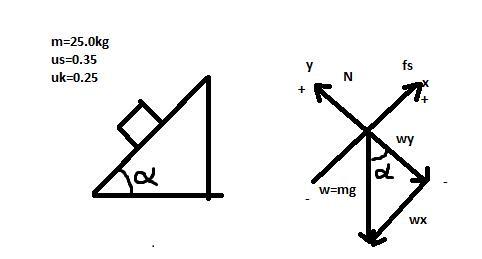
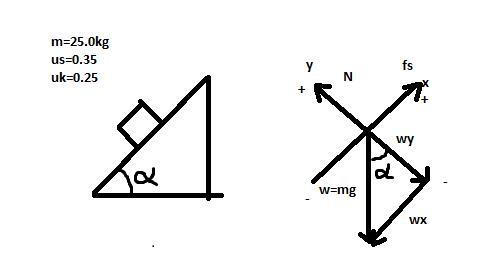
In order to solve this problem we must start by drawing a sketch of the problem and its corresponding fre body diagram (See picture attached).

So, when we are talking about friction, there are two types of friction coefficients. Static and kinetic. Static friction happens when the box is not moving no matter what force you apply to it. You get to a certain force that is greater than the static friction and the box starts moving, it is then when the kinetic friction comes into play (kinetic friction is generally smaller than static friction). So in order to solve this problem, we must find an angle such that the static friction is the same as the force applie by gravity on the box. For it to be easier to analyze, we must incline the axis of coordinates, just as shown on the picture attached.

After doing an analysis of the free-body diagram, we can build our set of equations by using Newton's thrid law:

\sum F_{x}=0

we can see there are only two forces in x, which are the weight on x and the static friction, so:

-W_{x}+f_{s}=0

when solving for the static friction we get:

f_{s}=W_{x}

We know the weight is found by multiplying the mass by the acceleration of gravity, so:

W=mg

and:

W_{x}=mg sin \alpha

we can substitute this on our sum of forces equation:

f_{s}=mg sin \alpha

the static friction will depend on the normal force applied by the plane on the box, static friction is found by using the following equation:

f_{s}=N\mu_{s}

so we can substitute this on our equation:

N\mu_{s}=mg sin \alpha

but we don't know what the normal force is, so we need to find it by doing a sum of forces in y.

\sum F_{y}=0

In the y direction we got two forces as well, the normal force and the force due to gravity, so we get:

N-W_{y}=0

when solving for N we get:

N=W_{y}

When seeing the free-body diagram we can determine that:

W_{y}=mg cos \alpha

so we can substitute that in the sum of y-forces equation, so we get:

N=mg cos \alpha

we can go ahead and substitute this equation in the sum of forces in x equation so we get:

mg cos \alpha \mu_{s}=mg sin \alpha

we can divide both sides of the equation into mg so we get:

cos \alpha \mu_{s}=sin \alpha

as you may see, the angle doesn't depend on the mass of the box, only on the static coefficient of friction. When solving for \mu_{s} we get:

\mu_{s}=\frac{sin \alpha}{cos \alpha}

when simplifying this we get that:

\mu_{s}=tan \alpha

now we can solve for the angle so we get:

\alpha= tan^{-1}(\mu_{s})

and we can substitute the given value so we get:

\alpha= tan^{-1}(0.350)

which yields:

α=19.29°

which rounds to:

α=19°
You might be interested in
A closed, rigid container holding 0.2 moles of a monatomic ideal gas is placed over a Bunsen burner and heated slowly, starting
Georgia [21]

Answer:

a) 2250 J

b) 0 J

c) 2250 J

Explanation:

a) Since, the process is isochoric

the change in internal energy

\Delta U = n C_v(T_f-T_i)

Here, n = 0.2 moles

Cv = 12.5 J/mole.K

We have to find T_f so we can use gas equation as

\frac{P_1V_1}{P_2V_2} =\frac{T_i}{T_f}\\Since, V_1=V_2    [isochoric/process]\\\Rightarrow \frac{P_{atm}}{4P_{atm}} = \frac{300}{T_f} \\\Rightarrow T_f = 1200 K

So,  \Delta U= 0.2\times12.5(1200-300)\\=2250 J

b) Since, the process is isochoric no work shall be done.

c) By first law of thermodynamics we have

\Delta U = Q-W\\Since, W = 0\\\Delta U = Q\\Therefore, Q = 2250 J

Since, Q is positive 2250 J of heat will flow into the system.

6 0
2 years ago
The chemical formula for water, H2O, means that each water molecule contains
Ainat [17]
The chemical formula for water, H2o means that each water molecule contains one oxygen atom and two hydrogen atoms. This is the formula for water which has a liquid form, a solid form as ice, and also a gaseous form as water vapor. 
5 0
2 years ago
Read 2 more answers
Gibbons, small Asian apes, move by brachiation, swinging below a handhold to move forward to the next handhold. A 9.4 kg gibbon
Katarina [22]

Answer:

upward force acting = 261.6 N

Explanation:

given,

mass of gibbon = 9.4 kg

arm length = 0.6 m

speed of the swing

net force must provide

F_{branch} + F_{gravity}=F_{centripetal}

force of gravity = - mg

F_{branch}=F_{centripetal}-F_{gravity}

                        = \dfrac{mv^2}{r} + mg

                        = m(\dfrac{3.4^2}{0.6} +9.8)

                        =9 x 29.067

                        = 261.6 N

upward force acting = 261.6 N

7 0
2 years ago
The maximum tension that a 0.80 m string can tolerate is 15 N. A 0.35-kg ball attached to this string is being whirled in a vert
zimovet [89]

Answer:

v=5.86 m/s

Explanation:

Given that,

Length of the string, l = 0.8 m

Maximum tension tolerated by the string, F = 15 N

Mass of the ball, m = 0.35 kg

We need to find the maximum speed the ball can have at the top of the circle. The ball is moving under the action of the centripetal force. The length of the string will be the radius of the circular path. The centripetal force is given by the relation as follows :

F=\dfrac{mv^2}{r}

v is the maximum speed

v=\sqrt{\dfrac{Fr}{m}} \\\\v=\sqrt{\dfrac{15\times 0.8}{0.35}} \\\\v=5.86\ m/s

Hence, the maximum speed of the ball is 5.86 m/s.

3 0
2 years ago
A box rests on the (horizontal) back of a truck. The coefficient of static friction between the box and the surface on which it
vredina [299]

Answer:

The distance is 11 m.

Explanation:

Given that,

Friction coefficient = 0.24

Time = 3.0 s

Initial velocity = 0

We need to calculate the acceleration

Using newton's second law

F = ma...(I)

Using formula of friction force

F= \mu m g....(II)

Put the value of F in the equation (II) from equation (I)

ma=\mu mg....(III)

a = \mu g

Put the value in the equation (III)

a=0.24\times9.8

a=2.352\ m/s^2

We need to calculate the distance,

Using equation of motion

s = ut+\dfrac{1}{2}at^2

s=0+\dfrac{1}{2}2.352\times(3.0)^2

s=10.584\ m\ approx\ 11\ m

Hence, The distance is 11 m.

3 0
2 years ago
Other questions:
  • Consider a 0.63-kg sample of metal at room temperature of 20
    15·1 answer
  • Explain how energy is conserved when nuclear fission or fusion occurs
    7·2 answers
  • Ba-11 when passing through a lock, which light means "approach the lock under full control?"
    9·2 answers
  • When a resistor with resistance R is connected to a 1.50-V flashlight battery, the resistor consumes 0.0625 W of electrical powe
    7·1 answer
  • A 32-kg child decides to make a raft out of empty 1.0-L soda bottles and duct tape. Neglecting the mass of the duct tape and pla
    15·1 answer
  • Wire A has the same length and twice the radius of wire B. Both wires are made of the same material and carry the same current.
    8·1 answer
  • A low-pressure sodium vapor lamp whose wavelength is 5.89 x 10⁻⁷ m passes through double-slits that are 6.7 x 10⁻⁴ m apart and p
    10·1 answer
  • What is the direction of the magnetic field b⃗ net at point a? Recall that the currents in the two wires have equal magnitudes.
    5·1 answer
  • An astronaut holds a rock 100m above the surface of Planet XX. The rock is then thrown upward with a speed of 15m/s, as shown in
    11·1 answer
  • Tech A says that some electric actuators are positioned by an A/C ECU which checks the air flow with sensors. Tech B says that e
    12·1 answer
Add answer
Login
Not registered? Fast signup
Signup
Login Signup
Ask question!