answer.
Ask question
Login Signup
Ask question
All categories
  • English
  • Mathematics
  • Social Studies
  • Business
  • History
  • Health
  • Geography
  • Biology
  • Physics
  • Chemistry
  • Computers and Technology
  • Arts
  • World Languages
  • Spanish
  • French
  • German
  • Advanced Placement (AP)
  • SAT
  • Medicine
  • Law
  • Engineering
Bas_tet [7]
2 years ago
4

In what way(s) is the compound formed of iron and oxygen (a compound called iron oxide) different from a mixture of

Chemistry
1 answer:
Nastasia [14]2 years ago
3 0

Explanation:

A compound of iron and oxygen is a ferrous oxide and it is totally different from the mixture if iron and oxygen. Compounds are made up of elements that are chemically combined together.

  • A compound of iron and oxygen has a different property from the original atoms that forms it.
  • To form the compound, iron and oxygen is chemically combined by the loss and gain of their valence electrons.
  • The mixture of oxygen and iron contains individual substances that still retains their original composition.
  • Mixtures are not chemically combined.
  • The mixture is made up of oxygen gas and iron which are different states of matter.

Learn more:

mixtures brainly.com/question/1446244

more about mixtures brainly.com/question/1832352

#learnwithBrainly

You might be interested in
How many pints of a 30% sugar solution must be added to a 5 pint of a 5% sugar solution to obtain a 20% sugar solution?
ser-zykov [4K]

You must add 7.5 pt of the 30 % sugar to the 5 % sugar to get a 20 % solution.

You can use a modified dilution formula to calculate the volume of 30 % sugar.

<em>V</em>_1×<em>C</em>_1 + <em>V</em>_2×<em>C</em>_2 = <em>V</em>_3×<em>C</em>_3

Let the volume of 30 % sugar = <em>x</em> pt. Then the volume of the final 20 % sugar = (5 + <em>x</em> ) pt

(<em>x</em> pt×30 % sugar) + (5 pt×5 % sugar) = (<em>x</em> + 5) pt × 20 % sugar

30<em>x</em> + 25 = 20x + 100

10<em>x</em> = 75

<em>x</em> = 75/10 = 7.5

5 0
2 years ago
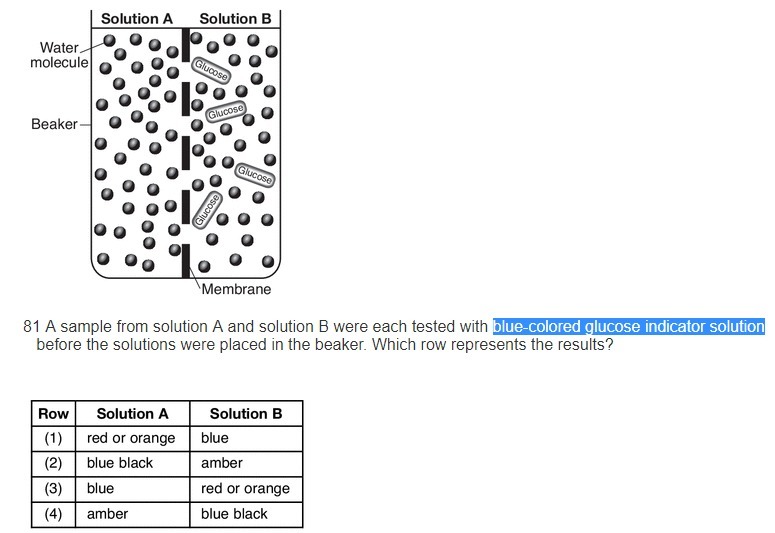
A sample from solution a and solution b were each tested with blue colored glucose indicator solution before the solutions were
vova2212 [387]
With the given problem you gave here, I can't answer the question because I need more details. Luckily, I found a similar problem that's provided with a diagram and a table shown in the attached picture.

This test is called the Benedict's test which is used as test for presence of sugars. If the solution contains sugar, like glucose, the solution would turn from blue to red. If not, it would stay blue. <em>Therefore, the correct results would be that in row 3.</em>

3 0
2 years ago
From the graph of Density vs. Concentration, created in Graph 1, what was the relationship between the concentration of the suga
USPshnik [31]

The graph is not given in the question, so, the required graph is attached below:

Answer:

According to the graph, the relationship between the density of the sugar solution and the concentration of the sugar solution is directly proportional to each other as they both are increasing exponentially.

The graph shows that, the density of sugar solution will increase with the increase in concentration of sugar in the solution.

8 0
2 years ago
Write down the dissolution equation for rubidium chromate dissolving in water. (Chromate is a polyatomic ion with the formula Cr
ycow [4]

Answer:

Four moles of the cation

Explanation:

2Rb2CrO4(s)<--------> 4Rb^+(aq) + 2CrO4^2-(aq)

Now looking at the reaction equation, it can be seen that one mole of rubidium chromate contains two moles of rubidium ions and one mole of chromate ions.

The dissolution of two moles of rubidium chromate should then yield four moles of rubidium ions and two moles of chromate ions since the ratio of ions present is 2:1.

This explains the reaction equation written above for the dissolution of two moles of rubidium chromate as shown.

5 0
2 years ago
8.03 Solutions Lab Report<br> Does anyone have a PDF or Document of FLVS 8.03 Solutions Lab
GarryVolchara [31]

8.03 solutions report is described below.

Explanation:

8.03 Solutions Lab Report

In this laboratory activity, you will investigate how temperature, agitation, particle size, and dilution affect the taste of a drink. Fill in each section of this lab report and submit it and your pre-lab answers to your instructor for grading.  

Pre-lab Questions:

In this lab, you will make fruit drinks with powdered drink mix. Complete the pre-lab questions to get the values you need for your drink solutions.  

Calculate the molar mass of powered fruit drink mix, made from sucrose (C12H22O11).

Using stoichiometry, determine the mass of powdered drink mix needed to make a 1.0 M solution of 100 mL.


7 0
2 years ago
Read 2 more answers
Other questions:
  • Which is an example of practical pursuit of alchemy
    14·2 answers
  • Which sentence correctly describes an aspect of the Antarctic treaty system
    7·2 answers
  • Exactly 1.0 mol N2O4 is placed in an empty 1.0-L container and allowed to reach equilibrium described by the equation N2O4(g) 2N
    8·1 answer
  • During a titration the following data were collected. A 10. mL portion of an unknown monoprotic acid solution was titrated with
    5·1 answer
  • A student weighs an empty flask and stopper and finds the mass to be 53.256 g. She then adds about 5 mL of an unknown liquid and
    9·1 answer
  • What is the difference between matter and non matter ?
    7·2 answers
  • In the same condition, what happens to the net force acting on the rope?
    7·1 answer
  • Daniel Harris has always enjoyed eating tuna fish. Unfortunately, a study of the mercury content of canned tuna in 2010 found th
    13·1 answer
  • Acetylenic fatty acids are found in many tropical plants. Compound B, C18H32O2, is one such compound; it absorbs 2 equivalents o
    9·1 answer
  • The mass of a container is determined to be 1.2 g. A sample of a compound is transferred to this container, and the mass of the
    10·1 answer
Add answer
Login
Not registered? Fast signup
Signup
Login Signup
Ask question!