answer.
Ask question
Login Signup
Ask question
All categories
  • English
  • Mathematics
  • Social Studies
  • Business
  • History
  • Health
  • Geography
  • Biology
  • Physics
  • Chemistry
  • Computers and Technology
  • Arts
  • World Languages
  • Spanish
  • French
  • German
  • Advanced Placement (AP)
  • SAT
  • Medicine
  • Law
  • Engineering
gogolik [260]
2 years ago
4

Two very thick equally-magnetized square plates of side 0.25 m and of mass 21 g, are hung by threads 22.0 cm long from a common

point. The plates repel and deflect from each other through a very small angle. Calculate the B field between the two plates, if the distance between them is 0.15 cm?

Physics
1 answer:
Lubov Fominskaja [6]2 years ago
8 0

Answer:

The magnetic field between the two plates is 2.39\times10^{-4}\ T

Explanation:

Given that,

Side of square plate = 0.25 m

Mass = 21 g

length = 22.0 cm

Distance between two plates = 0.15 cm

We need to calculate the angle

Using formula of angle

\cos\theta=\dfrac{\dfrac{r}{2}}{l}

Put the value into the formula

\cos\theta=\dfrac{0.25}{2\times22.0}

\cos\theta=0.0056

\theta=\cos^{-1}(0.0056)

\theta=89.6^{\circ}

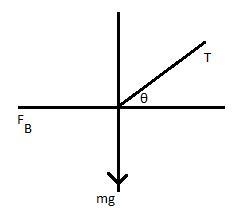
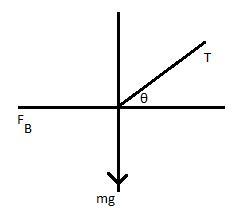
From the diagram

We need to calculate the tension

Using formula of tension

T\sin\theta=mg

Put the value into the formula

T=\dfrac{mg}{\sin\theta}

T=\dfrac{21\times10^{-3}\times9.8}{\sin89.6}

T=0.205\ N

We need to calculate the magnetic force

Using formula of force

F_{B}=T\cos\theta

Put the value into the formula

F_{B}=0.205\times\cos89.6

F_{B}=1.43\times10^{-3}\ N

We need to calculate the magnetic field

Using formula of magnetic field

F_{B}=\dfrac{B^2A}{2\mu}

B=\dfrac{F_{B}\times2\mu}{A}

Put the value into the formula

B=\sqrt{\dfrac{1.43\times10^{-3}\times2\times4\pi\times10^{-7}}{(0.25)^2}}

B=2.39\times10^{-4}\ T

Hence, The magnetic field between the two plates is 2.39\times10^{-4}\ T

You might be interested in
Someone plans to float a small, totally absorbing sphere 0.500 m above an isotropic point source of light,so that the upward rad
mote1985 [20]

Answer:

468449163762.0812 W

Explanation:

m = Mass = \rhoV

V = Volume =\dfrac{4}{3}\pi r^3

r = Distance of sphere from isotropic point source of light = 0.5 m

R = Radius of sphere = 2 mm

\rho = Density = 19 g/cm³

c = Speed of light = 3\times 10^8\ m/s

A = Area = \pi R^2

I = Intensity = \dfrac{P}{4\pi r^2}

g = Acceleration due to gravity = 9.81 m/s²

Force due to radiation is given by

F=\dfrac{IA}{c}\\\Rightarrow F=\dfrac{\dfrac{P}{4\pi r^2}{\pi R^2}}{c}\\\Rightarrow F=\dfrac{PR^2}{4r^2c}

According to the question

F=mg\\\Rightarrow \dfrac{PR^2}{4r^2c}=\rho \dfrac{4}{3}\pi R^3g\\\Rightarrow P=\dfrac{16r^2\rho c\pi Rg}{3}\\\Rightarrow P=\dfrac{16\times 0.002\times 19000\times \pi\times 0.5^2\times 9.81\times 3\times 10^8}{3}\\\Rightarrow P=468449163762.0812\ W

The power required of the light source is 468449163762.0812 W

4 0
2 years ago
The ends of a massless rope are attached to two stationary objects (e.g., two trees or two cars) so that the rope makes a straig
julia-pushkina [17]

Answer: They are all true

a. The tension in the rope is everywhere the same.

b. The magnitudes of the forces exerted on the two objects by the rope are the same.

c. The forces exerted on the two objects by the rope must be in opposite directions.

d. The forces exerted on the two objects by the rope must be in the direction of the rope.

Hope this helps, now you know the answer and how to do it. HAVE A BLESSED AND WONDERFUL DAY! As well as a great rest of Black History Month! :-)  

- Cutiepatutie ☺❀❤

5 0
2 years ago
To determine the height of a flagpole, Abby throws a ball straight up and times it. She sees that the ball goes by the top of th
Kryger [21]

Answer:

H = 10.05 m

Explanation:

If the stone will reach the top position of flag pole at t = 0.5 s and t = 4.1 s

so here the total time of the motion above the top point of pole is given as

\Delta t = 4.1 - 0.5 = 3.6 s

now we have

\Delta t = \frac{2v}{g}

3.6 = \frac{2v}{9.8}

v = 17.64 m/s

so this is the speed at the top of flag pole

now we have

v_f - v_i = at

17.64 - v_i = (-9.8)(0.5)

v_i = 22.5 m/s

now the height of flag pole is given as

H = \frac{v_f + v_i}{2}t

H = \frac{22.5 + 17.64}{2} (0.5)

H = 10.05 m

5 0
2 years ago
A quarterback throws a football at 40km/hr to a receiver 50yd away. How much time does it take the ball to reach the receiver
Akimi4 [234]

Given:

Distance = 50 yard = 45.72 meter

Speed = 40 km/hr = 11.11 m/s

To find:

Time required by ball to reach the receiver = ?

Formula used:

speed = \frac{distance}{time}

Solution:

The speed of the ball is given by,

speed = \frac{distance}{time}

Thus,

Time = \frac{distance}{speed}

Distance = 50 yard = 45.72 meter

Speed = 40 km/hr = 11.11 m/s

Time = 4.12 second

Hence, ball reaches the receiver in 4.12 second.

3 0
2 years ago
Which of the following expressions will have units of kg⋅m/s2? Select all that apply, where x is position, v is velocity, m is m
netineya [11]

Answer: m \frac{d}{dt}v_{(t)}

Explanation:

In the image  attached with this answer are shown the given options from which only one is correct.

The correct expression is:

m \frac{d}{dt}v_{(t)}

Because, if we derive velocity v_{t} with respect to time t we will have acceleration a, hence:

m \frac{d}{dt}v_{(t)}=m.a

Where m is the mass with units of kilograms (kg) and a with units of meter per square seconds \frac{m}{s}^{2}, having as a result kg\frac{m}{s}^{2}

The other expressions are incorrect, let’s prove it:

\frac{m}{2} \frac{d}{dx}{(v_{(x)})}^{2}=\frac{m}{2} 2v_{(x)}^{2-1}=mv_{(x)} This result has units of kg\frac{m}{s}

m\frac{d}{dt}a_{(t)}=ma_{(t)}^{1-1}=m This result has units of kg

m\int x_{(t)} dt= m \frac{{(x_{(t)})}^{1+1}}{1+1}+C=m\frac{{(x_{(t)})}^{2}}{2}+C This result has units of kgm^{2} and C is a constant

m\frac{d}{dt}x_{(t)}=mx_{(t)}^{1-1}=m This result has units of kg

m\frac{d}{dt}v_{(t)}=mv_{(t)}^{1-1}=m This result has units of kg

\frac{m}{2}\int {(v_{(t)})}^{2} dt= \frac{m}{2} \frac{{(v_{(t)})}^{2+1}}{2+1}+C=\frac{m}{6} {(v_{(t)})}^{3}+C This result has units of kg \frac{m^{3}}{s^{3}} and C is a constant

m\int a_{(t)} dt= \frac{m {a_{(t)}}^{2}}{2}+C This result has units of kg \frac{m^{2}}{s^{4}} and C is a constant

\frac{m}{2} \frac{d}{dt}{(v_{(x)})}^{2}=0 because v_{(x)} is a constant in this derivation respect to t

m\int v_{(t)} dt= \frac{m {v_{(t)}}^{2}}{2}+C This result has units of kg \frac{m^{2}}{s^{2}} and C is a constant

6 0
2 years ago
Other questions:
  • A 7.0-kilogram cart, A, and a 3.0-kilogram cart, B, are initially held together at rest on a horizontal, frictionless surface. W
    7·1 answer
  • A 2600-m-high mountain is located on the equator. how much faster does a climber on top of the mountain move than a surfer at a
    14·1 answer
  • A conducting rod (length = 80 cm) rotates at a constant angular rate of 15 revolutions per second about a pivot at one end. A un
    10·1 answer
  • A baseball hits a car, breaking its window and triggering its alarm which sounds at a frequency of 1210 Hz. What frequency (in H
    5·1 answer
  • You have been abducted by aliens and find yourself on a strange planet. Fortunately, you have a meter stick with you. You observ
    12·2 answers
  • You slide a coin across the floor, and observe that it slows down and eventually stops. A sensitive thermometer shows that its t
    12·1 answer
  • A dog of mass 10 kg sits on a skateboard of mass 2 kg that is initially traveling south at 2 m/s. The dog jumps off with a veloc
    9·1 answer
  • g A coil formed by wrapping 50 turns of wire in the shape of a square is positioned in a magnetic field so that the normal to th
    5·1 answer
  • A swimmer standing near the edge of a lake notices a cork bobbing in the water. While watching for one minute, she notices the c
    10·1 answer
  • 11. A tight guitar string has a frequency of 540 Hz as its third harmonic. What will be its fundamental frequency if it is finge
    8·1 answer
Add answer
Login
Not registered? Fast signup
Signup
Login Signup
Ask question!