answer.
Ask question
Login Signup
Ask question
All categories
  • English
  • Mathematics
  • Social Studies
  • Business
  • History
  • Health
  • Geography
  • Biology
  • Physics
  • Chemistry
  • Computers and Technology
  • Arts
  • World Languages
  • Spanish
  • French
  • German
  • Advanced Placement (AP)
  • SAT
  • Medicine
  • Law
  • Engineering
romanna [79]
2 years ago
11

Breathing air that contains 4.0% by volume CO2 over time causes rapid breathing, throbbing headache, and nausea, among other sym

ptoms. You may want to reference (Pages 539 - 541) Section 13.4 while completing this problem. Part A What is the concentration of CO2 in such air in terms of molarity, assuming 1 atm pressure and a body temperature of 37 ∘C? Express you
Chemistry
2 answers:
DiKsa [7]2 years ago
8 0

Answer:

1.6x10^{-4}M

Explanation:

Hello,

By volume percentage for this case is defined as:

v/v=\frac{V_{CO_2}}{V}*100

Since we've got a 4.0%by volume solution, it is related, for instance, with 4L of carbon dioxide per 100L of air, so the moles are computed via the ideal gas equation as:

n_{CO_2}=\frac{PV}{RT}=\frac{1atm*4L}{0.082\frac{atm*L}{mol*K}*310K}  \\n_{CO_2}=0.16molCO_2

Finally, applying the molarity formula we get:

M=\frac{n_{CO_2}}{V} =\frac{0.16mol}{100L}=1.6x10^{-4}M

Best regards.

Alecsey [184]2 years ago
8 0

<u>Answer:</u> The concentration of carbon dioxide in air is 1.57\times 10^{-3}M

<u>Explanation:</u>

We are given:

4.0 % carbon dioxide by volume

This means that 4.00 mL of carbon dioxide is present in 100 mL of solution

To calculate the amount of carbon dioxide, we use the equation given by ideal gas which follows:

PV=nRT

where,

P = pressure of the gas = 1 atm

V = Volume of the gas = 4.0 mL = 0.004 L

T = Temperature of the gas = 37^oC=[37+273]K=310K

R = Gas constant = 0.0821\text{ L atm }mol^{-1}K^{-1}

n = number of moles of carbon dioxide gas = ?

Putting values in above equation, we get:

1atm\times 0.004L=n\times 0.0821\text{ L. atm }mol^{-1}K^{-1}\times 310K\\\\n=\frac{1\times 0.004}{0.0821\times 310}=1.57\times 10^{-4}mol

To calculate the molarity of solution, we use the equation:

\text{Molarity}=\frac{\text{Number of moles}\times 1000}{\text{Volume of solution( in mL)}}

Moles of carbon dioxide gas = 1.57\times 10^{-4}mol

Volume of solution = 100 mL

Putting values in above equation, we get:

\text{Molarity of carbon dioxide}=\frac{1.57\times 10^{-4}\times 1000}{100}\\\\\text{Molarity of carbon dioxide}=1.57\times 10^{-3}M

Hence, the concentration of carbon dioxide in air is 1.57\times 10^{-3}M

You might be interested in
A gem has a mass of 4.50 g. When the gem is placed in a graduated cylinder 12.00 mL of water, the water level rises to 13.45 mL.
Mandarinka [93]
<span>Displaced volume :

</span>Final volume - <span>Initial volume

</span>13.45 mL - 12.00 mL => 1.45 mL

Mass =  4.50 g

Therefore:

density = mass / volume

D = 4.50 / 1.45

<span>D = 3.103 g/mL </span>
6 0
2 years ago
One molecule of a compound weighs 2.03x10⁻²² g. what is the molar mass of that compound?
stealth61 [152]
<span>The molar mass of the compound is 122 g. </span>
6 0
2 years ago
Read 2 more answers
Using the following data table and graph, calculate the average k from the data. Amount CO2 (mL) Amount of White Solid (g) y x 1
UkoKoshka [18]
The k is the proportionality constant of the reaction. Graphically, this is the slope of the graph. Since the graph is linear, then there is only 1 value of k. To calculate this, choose two random points in the line. Suppose we use (0.15,10) and (0.30,20), calculate for the slope.

Slope = k = (10 - 20)/(0.15 - 0.30) = 66.67 mL CO₂/g CaCO₃
8 0
2 years ago
Read 2 more answers
Old photographic flashbulbs burn magnesium metal in a reaction that causes a flash of brilliant white light. A photographer woul
OLga [1]

Answer is: A. Chemical energy to electromagnetic energy and thermal energy.  

Balanced chemical reaction: 2Mg(s) + O₂(g) → 2MgO(s) + energy.

This is chemical change (chemical reaction), because new substance (magnesium oxide MgO) is formed, the atoms are rearranged and the reaction is followed by an energy change (exothermic reaction because energy is released).

Chemical changes (chemical synthesis) is when a substance combines with another (in this example magnesium and oxygen) to form a new substance.


5 0
2 years ago
Read 2 more answers
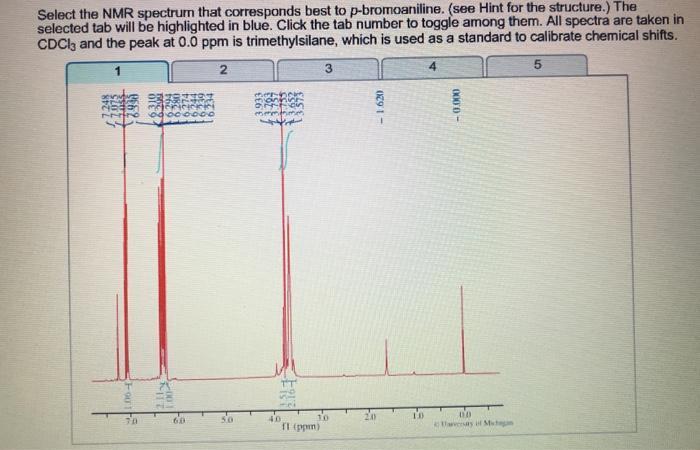
Select the NMR spectrum that corresponds best to p-bromoaniline. (see Hint for the structure.) The selected tab will be highligh
lana [24]

Answer:

The NMR spectrum that corresponds best to p-bromoaniline  is the one that is attached in the image below.

Explanation:

For the p-bromoaniline 3 types of hydrogen are observed. The first signal that appears at 3.7 ppm would be from the hydrogens of the NH2 group, the hydrogens in ortho position with respect to the NH2 group give a double at approximately 6.54 ppm, and finally the characteristic 7.21 ppm signal is observed for the hydrogens in meta position with with respect to the NH2 group.

7 0
2 years ago
Other questions:
  • How many equivalents are in 0.60 mole of Mg2+
    7·1 answer
  • The table below provides some information about an unidentified element. Based on this information, the unidentified element is
    6·1 answer
  • In any engineering design problem, the first step is to understand the problem and identify one or more possible solutions. In t
    12·1 answer
  • How will increasing the pressure on the system affect this equilibrium reaction? 2H2(g)+O2(g) -&gt; 2H2O(g)
    6·1 answer
  • A scientist is wondering why a certain region in the ocean doesn't have maximum phytoplankton growth, despite having plenty of n
    12·1 answer
  • A solution is prepared by adding 100 mL of 1.0 M HC2H3O2 (aq) to 100 mL of 1.0 M NaC2H3O2 (aq). The solution is stirred and its
    8·1 answer
  • Please help me double-check my answer: Calculate the molarity of an aqueous solution that contains 36.5g KMnO4 and has a total v
    5·2 answers
  • A chemist dissolves 0.9 g of an unknown monoprotic (one acidic H) acid in water. She finds that 14.6 mL of 0.426 M NaOH are requ
    15·1 answer
  • Question 5
    5·1 answer
  • The pH of an acidic solution is 2.11. What is [H⁺]
    5·2 answers
Add answer
Login
Not registered? Fast signup
Signup
Login Signup
Ask question!