answer.
Ask question
Login Signup
Ask question
All categories
  • English
  • Mathematics
  • Social Studies
  • Business
  • History
  • Health
  • Geography
  • Biology
  • Physics
  • Chemistry
  • Computers and Technology
  • Arts
  • World Languages
  • Spanish
  • French
  • German
  • Advanced Placement (AP)
  • SAT
  • Medicine
  • Law
  • Engineering
Iteru [2.4K]
2 years ago
3

It’s a snowy day and you’re pulling a friend along a level road on a sled. You’ve both been taking physics, so she asks what you

think the coefficient of friction between the sled and the snow is. You’ve been walking at a steady 1.5 m/s, and the rope pulls up on the sled at a 30 ° angle. You estimate that the mass of the sled, with your friend on it, is 60 kg and that you’re pulling with a force of 75 N. What answer will you give?

Physics
1 answer:
evablogger [386]2 years ago
3 0

Answer:

\mu_{k}=0.12

Explanation:

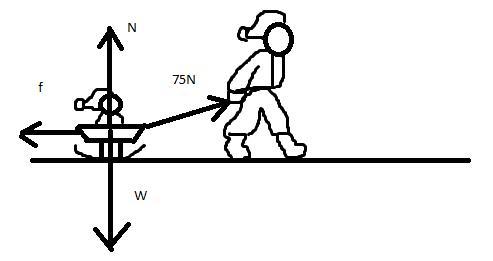
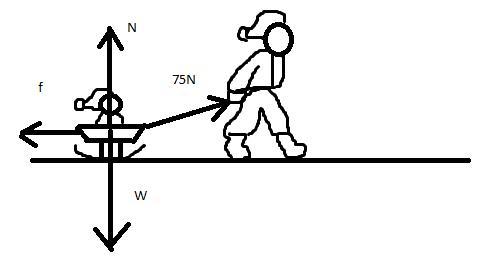
In order to solve this problem we must first start by drawing a diagram of the situation. (See attached picture).

So we can start solving this problem by doing a sum of the forces in the y-direction so we get:

\sum F_{y}=0

which yields:

N+F_{y}-W=0

which can be solved for N so we get:

N=W-F_{y}

we know that:

F_{y}=Fsin\theta

and that

W=mg

so we can substitute that into our original equation so we get:

N=mg-Fsin\theta

we can also substitute the provided data here so we get:

N=(60kg)(9.81m/s^{2})-75Nsin(30^{o})

which yields:

N=551.1N

Next we can do a sum of forces in the x-direction so we get:

\sum F_{x}=0

which gives us:

F_{x}-f=0

We know that the friction is given by the following formula:

f=N\mu_{k}

and that:

F_{x}=Fcos \theta

so we can substitute them into our sum of forces so we get:

Fcos \theta - N\mu_{k}=0

we can now solve this for \mu_{k}:

which yields:

\mu_{k}=\frac{Fcos \theta}{N}

now we can substitute the provided data so we get:

\mu_{k}=\frac{(75N)cos 30^{o}}{551.1N}=0.12

So the coefficient of kinetic friction between the sled and the snow is 0.12.
You might be interested in
a child hits a ball with a force of 350 N. (a) If the ball and bat are in contact for 0.12 is, what impulse does the ball receiv
Lina20 [59]

Explanation:

Given that,

Force with which a child hits a ball is 350 N

Time of contact is 0.12 s

We need to find the impulse received by the ball. The impulse delivered is given by :

J=F\times t\\\\J=350\times 0.12\\\\J=42\ N-m

So, the impulse is 42 N-m..

We know that he change in momentum is also equal to the impulse delivered.

So, impulse = 42 N-m and change in momentum =42 N-m.

7 0
2 years ago
Jaiden is writing a report about the structure of the atom. In her report, she says that the atom has three main parts and two s
USPshnik [31]
No because an atom consists of <u>two</u> main parts <em>and</em> <u>three</u> subatomic particles - protons, neutrons, electrons. Each one is smaller than an atom, therefore they are subatomic particles. An atom only requires protons and electrons to be an atom - e.g. Hydrogen has 1 proton and 1 electron. Neutrons do not affect the overall charge of the atom, and only increase the atomic mass.
7 0
2 years ago
Read 2 more answers
An electrical conductor is an element with __________ electrons in its outer orbit.
Setler [38]
An electric conductor is an element with free electrons in its outer orbit
5 0
2 years ago
Calculate the current through a 10.0-m long 22-gauge nichrome wire with a radius of 0.321 mm if it is connected across a 12.0-V
Kipish [7]

Answer:

Therefore,

Current through Nichrome wire is 0.3879 Ampere.

Explanation:

Given:

Length = l = 10 meter

Radius = r = 0.321\ mm =0.321\times 10^{-3}\ meter

Resistivity=\rho=1.00\times 10^{-6}\ ohm\ meter

V = 12 Volt

To Find:

Current, I =?

Solution:

Resistance for 0.0-m long 22-gauge nichrome wire with a radius of 0.321 mm if it is connected across a 12.0-V battery given as

R=\dfrac{\rho\times l}{A}

Where,

R = Resistance

l = length

A = Area of cross section = πr²

\rho=Resistivity=1.00\times 10^{-6}\ ohm\ meter

Substituting the values we get

R=\dfrac{1\times 10^{-6}\times 10}{3.14\times (0.321\times 10^{-3})^{2}}

R=\dfrac{1\times 10^{-5}}{3.23\times 10^{-7}}

R=\dfrac{1\times 10^{2}}{3.23}

R=30.95\ ohm

Now by Ohm's Law,

V= I\times R

Substituting the values we get

I=\dfrac{V}{R}=\dfrac{12}{30.95}=0.3876\ Ampere

Therefore,

Current through Nichrome wire is 0.3879 Ampere.

4 0
2 years ago
A large container, 120 cm deep is filled with water. If a small hole is punched in its side 77.0 cm from the top, at what initia
prisoha [69]

Answer:

The water will flow at a speed of 3,884 m/s

Explanation:

Torricelli's equation

v = \sqrt{2gh}

*v = liquid velocity at the exit of the hole

g = gravity acceleration

h = distance from the surface of the liquid to the center of the hole.

v = \sqrt{2*9,8m/s^2*0,77m} = 3,884 m/s

6 0
2 years ago
Other questions:
  • A race car exerts 19,454 n while the car travels at a constant speed of 201 mph, 91.36 m/s.what is the mass of the car?
    12·2 answers
  • A rocket moves through outer space a 12,000 m/s. At this time, how much time would be required to travel the distance from Earth
    6·2 answers
  • An object is falling from a height of 7.5 meters. At what height will its velocity be 7 meters/second?
    5·1 answer
  • Alex, who has a mass of 100kg, is skateboarding at 9.0m/s when he smacks into a brick wall and comes to a dead stop in 0.2 s. sh
    5·1 answer
  • The electric field at a point 2.8 cm from a small object points toward the object with a strength of 180,000 N/C. What is the ob
    8·1 answer
  • Just after a motorcycle rides off the end of a ramp and launches into the air, its engine is turning counterclockwise at 8325 re
    8·2 answers
  • A 45.0-kg person steps on a scale in an elevator. The scale reads 460 n. What is the magnitude of the acceleration of the elevat
    11·1 answer
  • The angle between the axes of two polarizing filters is 45.0^\circ45.0 ​∘ ​​ . By how much does the second filter reduce the int
    10·1 answer
  • A box is sliding with a speed of 4.50 m/s on a horizontal surface when, at point P, it encounters a rough section. The coefficie
    7·2 answers
  • A container contains 200g of water at initial temperature of 30°C. An iron nail of mass 200g at temperature of 50°C is immersed
    14·1 answer
Add answer
Login
Not registered? Fast signup
Signup
Login Signup
Ask question!