answer.
Ask question
Login Signup
Ask question
All categories
  • English
  • Mathematics
  • Social Studies
  • Business
  • History
  • Health
  • Geography
  • Biology
  • Physics
  • Chemistry
  • Computers and Technology
  • Arts
  • World Languages
  • Spanish
  • French
  • German
  • Advanced Placement (AP)
  • SAT
  • Medicine
  • Law
  • Engineering
Alekssandra [29.7K]
2 years ago
9

Identify the blocks and groups of elements in the periodic table​

Chemistry
1 answer:
djyliett [7]2 years ago
3 0

Explanation:

The periodic table is a table that arranges elements based on their atomic numbers into groups and periods.

The groups are the vertical arrangement of elements. All elements in a group share similar chemical properties because they have the same number of elements in their valence shell. The periodic table groups are:

               Group                             Other names

              1A or 1                               Alkali metals

              IIA or 2                              Alkaline earth metals

             IIIA or 3                            Boron family

             VIA or 6                             Chalcogens

            VIIA or 17                            Halogens

             O-18                                  Inert elements

             IIIB-IIB                              Transition elements

There are 18 vertical columns divided into 8 tall groups or main groups which are 1A to O. The short groups or subgroups are from numerals 1B to VIII.

The periodic table can be divided into four blocks based on the type of sublevels their valence electrons occupy.

  • Group IA and IIA constitute the s-block
  • Group IIIA to O constitute the p-block
  • The transition elements makes up the d-block
  • The lanthanides and actinides makes up the f-block

Learn more:

Periodic table brainly.com/question/2014634

#learnwithBrainly

You might be interested in
A laboratory manual gave precise instructions for carrying out the reaction described by the chemical equation, C2H6O + O2 C2H4O
Alexxandr [17]
C2H6O + O2 ---> C2H4O2 + H2O

using the molar masses:-
24+ 6 + 16 g of C2H6O  produces 24 + 4 + 32 g C2H4O2    (theoretical)
 46 g produces 60g 

60 g C2H4O2 is produced from 46g C2H6O
1g      .     .................................46/60 g 
 700g     .................................    (46/60) * 700  Theoretically

But as the yield is only 7.5% 

the required amount is    ((46/60) * 700 ) / 0.075 =  7155.56 g 

=  7.156 kg to nearest gram.  Answer


8 0
2 years ago
A 5.0 g sample of calcium nitrate (Ca(NO3)2, M = 164) contaminated with silica (SiO2, M = 60.1) is found to contain 1.0 g calciu
zhenek [66]

Answer:

= 82%

Explanation:

Percentage purity is calculated by the formula;

% purity = (mass of pure chemical/total mass of sample) × 100

In this case;

1 mole of Ca(NO3)2 = 164 g

but; 164 g of Ca(NO3)2 = 40 g Ca

Therefore; mass of Ca(NO3)2 = 164 /40

                                                  = 4.1 g

Thus;

% purity of Ca(NO3)2 = (Mass of Ca(NO3)2/ mass of the sample)× 100

                                    = (4.1 g/ 5 g) × 100

                                    = 82%

4 0
2 years ago
Assume the weight of an average adult is 70. kg, and that 420. kJ of heat are evolved per mole of oxygen consumed as a result of
seraphim [82]

Answer:

The temperature difference of the body after 3 hours = 5.16 K

Explanation:

we know that the number of moles of O₂ inhaled are 0.02 mole/min⁻¹

                                   or, 1.2 mole.h⁻¹

The average heat evolved by the oxidation of foodstuffs is then:

⇒          Q avg =\frac{1.2 X 420 X 10^{3} }{70} = 7.2 kj.h⁻¹.Kg⁻¹

the heat produced after 3 h would be:

                 =    7.2 kj. h⁻¹.Kg⁻¹ x 3 h

                 = 21.6 kj. kg⁻¹

                 = 21.6 x 10³ j kg⁻¹

We know Qp = Cp x ΔT

Assume the heat capacity of the body is 4.18 J g⁻¹K⁻¹

⇒ ΔT = \frac{Qp}{Cp}

⇒ ΔT = \frac{(21.6 X 10^{3} j.kg^{-1} ) }{(4.18 j k^{-1}g^{-1})   X (1000g.kg^{-1} )}

⇒ ΔT = 5.16 K

6 0
2 years ago
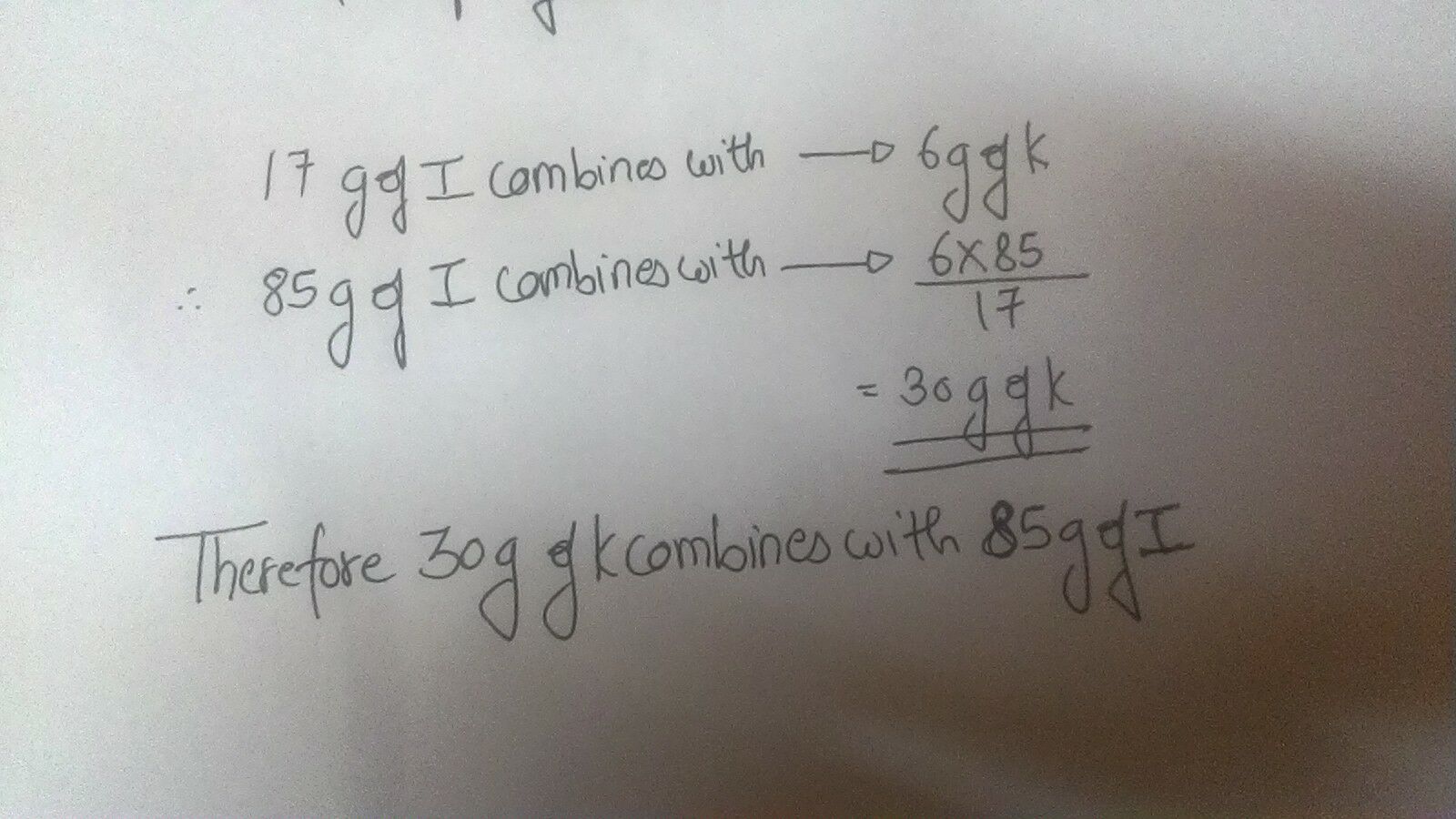
If 6 g of element k combine with 17 g of element l, how many grams of element k combine with 85 g of element l?
Ede4ka [16]
Hope this helps you.

5 0
2 years ago
For the reaction below, Kp 5 1.16 at 800.8C. CaCO3(s) 34 CaO(s) 1 CO2(g) If a 20.0-g sample of CaCO3 is put into a 10.0-L contai
Elena L [17]

Answer:

The mass percentage of calcium carbonated reacted is 2.5%.

Explanation:

The reaction is:

CaCO_{3}(s)--->CaO(s)+CO_{2}(g)

Thus the Kp of the equilibrium will be:

Kp = partial pressure of carbon dioxide [as the other are solid]

Moles of calcium carbonate initially present = \frac{mass}{molarmass}=\frac{20}{100}=0.2

Let us apply ICE table to the equilibrium given:

                        CaCO_{3}(s)--->CaO(s)+CO_{2}(g)

Initial                       0.2                       0          0

Change                 -x                            +x        +x

Equilibrium           0.2-x                         x          x

Kp = partial pressure of carbon dioxide

Kp = Kc(RT)ⁿ

where n = difference in the number of moles of gaseous products and reactants

for given reaction n = 1

R = gas constant = 8.314 J /mol K

T = temperature = 800 ⁰C = 1073 K

Putting values

Kc =\frac{Kp}{RT}=\frac{1.16}{8.314X1073}=1.3X10^{-4}

Kc = \frac{[CO_{2}][CaO]}{[CaCO_{3}]}= \frac{x^{2} }{(0.2-x)}=1.3X10^{-4}

1.3X10^{-4}(0.2-x)=x^{2}

x^{2} = 0.26X10^{-4}-1.3X10^{-4}x

On calculating

x =  0.005

where x = the moles of calcium carbonate dissociated or reacted.

Percentage of the moles or mass reacted = \frac{molesreacted X100}{initialmoles}=\frac{0.005X100}{0.2}=2.5%

7 0
2 years ago
Other questions:
  • If 200.0 g of copper(II) sulfate react with an excess of zinc metal, what is the theoretical yield of copper? 1.253 g 50.72 g 79
    11·1 answer
  • Each of the following substances is a liquid at –50°C. Place these liquids in order of increasing vapor pressure: dimethyl ether
    9·1 answer
  • How many L of carbon dioxide at 1.00 atm and 298.15 K are released from a car's engine upon consumption of a 60.0 L LIQUID tank
    10·1 answer
  • Dibutyl phthalate is a plasticizer added to make brittle polymers softer and more flexible. Dibutyl phthalate can be prepared by
    11·1 answer
  • In a voltaic cell made of a Ag strip and an Al strip immersed in 1.0 M aqueous AgNO_3 and Al(NO_3)_3 solutions, respectively, wi
    6·1 answer
  • If for a particular process, ΔH=308 kJmol and ΔS=439 Jmol K, in what temperature range will the process be spontaneous?
    10·1 answer
  • In what way would one dozen elephants and one dozen doughnuts be different?
    8·1 answer
  • How are oxygen and<br> water molecules different<br> from argon and neon<br> molecules?
    10·1 answer
  • This is the chemical formula for acetic acid (the chemical that gives the sharp taste to vinegar): An analytical chemist has det
    15·1 answer
  • A rod, X has a positive charge of 8. An otherwise identical rod, Y has a negative charge of 4. The rods are touched together, an
    7·1 answer
Add answer
Login
Not registered? Fast signup
Signup
Login Signup
Ask question!