answer.
Ask question
Login Signup
Ask question
All categories
  • English
  • Mathematics
  • Social Studies
  • Business
  • History
  • Health
  • Geography
  • Biology
  • Physics
  • Chemistry
  • Computers and Technology
  • Arts
  • World Languages
  • Spanish
  • French
  • German
  • Advanced Placement (AP)
  • SAT
  • Medicine
  • Law
  • Engineering
Leokris [45]
2 years ago
13

Which of the following reactions is a redox reaction? (a) K2CrO4 + BaCl2 → BaCrO4 + 2KCl (b) Pb2+ + 2Br- → PbBr2 (c) Cu + S → Cu

S Which of the following reactions is a redox reaction? (a) K2CrO4 + BaCl2 BaCrO4 + 2KCl (b) Pb2+ + 2Br- PbBr2 (c) Cu + S CuS (a) only (b) only (c) only (a) and (c) (b) and (c)
Chemistry
1 answer:
natima [27]2 years ago
7 0

(c) Cu + S → CuS is a redox reaction

Explanation:

We have the following chemical reactions:

(a) K₂CrO₄ + BaCl₂ → BaCrO₄ + 2 KCl

(b) Pb²⁺ + 2 Br⁻ → PbBr₂

(c) Cu + S → CuS

There is a redox reaction where the elements are changing the oxidation state. The reaction (c) is such a case.

Cu + S → CuS

Cu in elemental state have a oxidation number of 0 and in CuS (copper sulfide) have a oxidation number of +2.

S in elemental state have a oxidation number of 0 and in CuS (copper sulfide) have a oxidation number of -2.

Learn more about:

redox reactions

brainly.com/question/1161855

brainly.com/question/7484802

#learnwithBrainly

You might be interested in
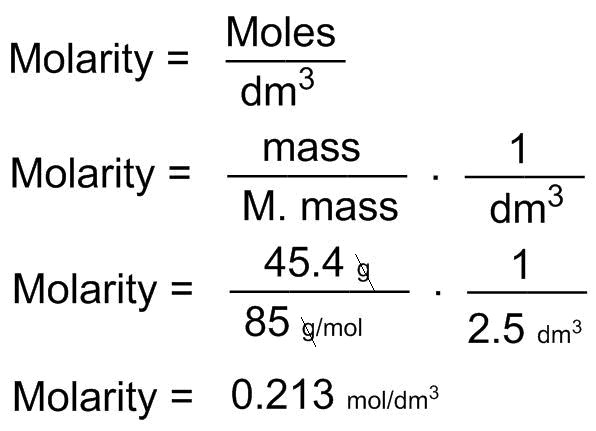
Calculate the molarity of a solution made by adding 45.4 g of nano3 to a flask and dissolving it with water to create a total vo
aleksandr82 [10.1K]
Solutions are made up of two non reacting species called solute and solvent. The amount of solute in solvent is known as concentration of that solute. Concentration is often measured in Molarity. Molarity is the amount of solute dissolved in 1 dm3 of solution. Answer to your question is as follow;

3 0
2 years ago
Read 2 more answers
If a certain gas occupies a volume of 13 L when the applied pressure is 6.5 atm , find the pressure when the gas occupies a volu
Sav [38]
We should apply Boyle's Law here given initial pressure, initial volume and final volume.

P1V1= P2V2
(6.5 atm) (13 L) = P2 (3.3 L)

Solve for P2 on your calculator and that should get you to the answer.


5 0
2 years ago
Read 2 more answers
A mass of 5.4 grams of aluminum (al) reacts with an excess of copper (ii) chloride (cucl2) in solution, as shown below. 3cucl2 2
horrorfan [7]

Answer:

Mass of copper produced is 19.07g

Explanation:

Let's bring out the chemical equation;

3CuCl2 + 2Al → 2AlCl3 + 3Cu

3           :   2       :   2       : 3

Upon confirming that the reaction is indeed balanced, we can proceed.

The questions asks to calculate mass of Cu formed when a mass of 5.4g of Al is being used.

From the equation, what is the relationship between Al and Cu?

2 mol of Al would react to form 3 mol of Cu

Expressing this in terms of mass, we have;

mass = no. of moles * molar mass

Mass of Aluminium = 2 * 26.98 = 53.98 g

Mass of Copper = 3 * 63.546 = 190.638g

This means;

53.98 g of Al would react to form 190.638g of Cu

So how much Cu would form from 5.4 g of Al?

This leads us to;

53.98 = 190.638

5.4 = x

Upon cross multiplication, we are left with;

x = (190.638 * 5.4) / 53.98

x = 19.07 g

Mass of copper produced is 19.07g

8 0
2 years ago
How many moles are equal to 5.82 x 10^23 atoms of tungsten (w)
fiasKO [112]

Answer:

0.97 mole

Explanation:

1 mole will give 6.02×10^23 atoms

Xmole of tungsten will give 5.82×10^23 atom of tungsten

X= 5.82×10^23/ 6.02×10^23

X = 0.97 moles of tungsten

6 0
2 years ago
Read 2 more answers
____are both centrally located in an atom's nucleus, while ______ electrons surround the nucleus in designated shells (which are
masya89 [10]
<span>Protons and neutrons are both centrally located in an atom's nucleus, while negative electrons surround the nucleus in designated shells (which are commonly thought of as "orbits" as labeled in the PhET simulation).
Nucleus of an atom has positive charge, electrons are negative and atom has neutral net charge.</span>
4 0
2 years ago
Read 2 more answers
Other questions:
  • Use bond energies to determine δhrxn for the reaction between ethane and chlorine. ch3ch3(g)+cl2(g)→ch3ch2cl(g)+hcl(g)
    9·2 answers
  • Instrumental methods need only a microscopic sample to return an accurate result. Why is this so?
    7·1 answer
  • Which statement must be mentioned in explaining why amphipathic molecules line up at a water surface?Which statement must be men
    5·2 answers
  • let 4 moles of methanol (liquid) combust in 3 moles of gaseous oxygen to form gaseous carbon dioxide and water vapor. Suppose th
    12·1 answer
  • Consider the following reaction: A2 + B2 → 2AB ΔH = –321 kJ Bond energy (A2) = 1/2AB Bond energy (B2) =393 kJ/mol. What is the n
    7·1 answer
  • A solution that contains 55.0 g of ascorbic acid (vitamin C) in 250.0 g of water freezes at –2.34°C.
    7·1 answer
  • Sample (3.585g) contains 1.388g of C, 0.345g of H, 1.850g of O and its molar mass is 62g. What is the molecular formula of this
    5·1 answer
  • During a laboratory experiment, 36.12 grams of Al2O3 was formed when O2 reacted with aluminum metal at 280.0 K and 1.4 atm. What
    11·1 answer
  • It is 762 miles from here to Chicago. An obese physics teacher jogs at a rate of 5.0 miles every 20.0 minutes. How long would it
    10·1 answer
  • Empirical Formula of P3O4H2?
    14·1 answer
Add answer
Login
Not registered? Fast signup
Signup
Login Signup
Ask question!