answer.
Ask question
Login Signup
Ask question
All categories
  • English
  • Mathematics
  • Social Studies
  • Business
  • History
  • Health
  • Geography
  • Biology
  • Physics
  • Chemistry
  • Computers and Technology
  • Arts
  • World Languages
  • Spanish
  • French
  • German
  • Advanced Placement (AP)
  • SAT
  • Medicine
  • Law
  • Engineering
morpeh [17]
2 years ago
9

In Part B the given conditions were 1.00 mol of argon in a 0.500-L container at 18.0°C. You identified that the ideal pressure (

P ) was 47.8 atm, and the real pressure (Prral) was 45.7 atm under these conditions. Complete the sentences to analyze this difference Match the words and compounds in the left column to the appropriate blanks in the sentences on the right. Make certain each sentence is complete before submitting your answer. View Available Hint(s) Reset Help strong intermolecular forces The percent difference between the ideal and real gas is decrease This difference is considered significant, and is best explained because argon atoms have relatively small molecular volumes If the volume of the container were increased to 2.00 L, you would expect the percent difference between the ideal and real gas to 4.38% 4.48% 4.58% increase weak intermolecular forces large molecular volumes
Chemistry
1 answer:
Natasha2012 [34]2 years ago
5 0

Answer:

4,38%

small molecular volumes

Decrease

Explanation:

The percent difference between the ideal and real gas is:

(47,8atm - 45,7 atm) / 47,8 atm × 100 = 4,39% ≈ <em>4,38%</em>

This difference is considered significant, and is best explained because argon atoms have relatively <em>small molecular volumes. </em>That produce an increasing in intermolecular forces deviating the system of ideal gas behavior.

Therefore, an increasing in volume will produce an ideal gas behavior. Thus:

If the volume of the container were increased to 2.00 L, you would expect the percent difference between the ideal and real gas to <em>decrease</em>

<em />

I hope it helps!

You might be interested in
Suppose that 2.5 mmol n2 (g) occupies 42 cm3 at 300 k and expands isothermally to 600 cm3. calculate δgm in kj/mol for the proc
andriy [413]

<u>Given:</u>

MilliMoles of N2 = 2.5 mmol = 0.0025 moles

Initial volume V1 = 42 cm3

Final volume V2 = 600 cm3

Temperature T = 300 K

<u>To determine:</u>

The change in Gibbs free energy, ΔG

<u>Explanation:</u>

The change in Gibbs free energy is related to the ration of the volumes:

ΔG = -nRTln(V2)/(V1)

      = -0.0025*8.314*300*ln(600/42) = -16.582 J/mol

Ans: The Gibbs free energy for the process is 0.0166 kJ/mol


8 0
2 years ago
A student is trying to classify an unidentified, solid gray material as a metal or a nonmetal. Which question will best help the
vekshin1

Answer:

A - Is the material malleable or ductile?

Explanation:

3 0
2 years ago
What element has the electron configuration 1s22s22p63s23p64s23d104p65s24d105p66s24f145d106p2?
Marina CMI [18]
<span>6s²4f¹⁴5d¹⁰6p²
6 shows that the element is in the 6 period,
6p² shows that the element is in the 14th group. (1 and 2 groups have s -electrons as last ones, 13 group has s²p¹, and 14 group has s²p²)
The element is Pb.

</span>
3 0
2 years ago
Read 2 more answers
In your body, carbon dioxide, CO2, dissolves in the blood to form carbonic acid, H2CO3 as follows:
Lubov Fominskaja [6]

Answer:

STOP USING THIS SIGHT STOP

Explanation:

not good for ua quart of stain covers 100 square ft how many quarts should you buy to stain the ramp assume you dont have to stain the bottem its lenth is 7 ft 1 side is 35ft the other 35 1/6 ft and the hight is 35 ft


a quart of stain covers 100 square ft how many quarts should you buy to stain the ramp assume you dont have to stain the bottem its lenth is 7 ft 1 side is 35ft the other 35 1/6 ft and the hight is 35 ft
a quart of stain covers 100 square ft how many quarts should you buy to stain the ramp assume you dont have to stain the bottem its lenth is 7 ft 1 side is 35ft the other 35 1/6 ft and the hight is 35 ft

a quart of stain covers 100 square ft how many quarts should you buy to stain the ramp assume you dont have to stain the bottem its lenth is 7 ft 1 side is 35ft the other 35 1/6 ft and the hight is 35 ft

a quart of stain covers 100 square ft how many quarts should you buy to stain the ramp assume you dont have to stain the bottem its lenth is 7 ft 1 side is 35ft the other 35 1/6 ft and the hight is 35 ft

a quart of stain covers 100 square ft how many quarts should you buy to stain the ramp assume you dont have to stain the bottem its lenth is 7 ft 1 side is 35ft the other 35 1/6 ft and the hight is 35 ft

a quart of stain covers 100 square ft how many quarts should you buy to stain the ramp assume you dont have to stain the bottem its lenth is 7 ft 1 side is 35ft the other 35 1/6 ft and the hight is 35 ft

a quart of stain covers 100 square ft how many quarts should you buy to stain the ramp assume you dont have to stain the bottem its lenth is 7 ft 1 side is 35ft the other 35 1/6 ft and the hight is 35 ft

a quart of stain covers 100 square ft how many quarts should you buy to stain the ramp assume you dont have to stain the bottem its lenth is 7 ft 1 side is 35ft the other 35 1/6 ft and the hight is 35 ft

a quart of stain covers 100 square ft how many quarts should you buy to stain the ramp assume you dont have to stain the bottem its lenth is 7 ft 1 side is 35ft the other 35 1/6 ft and the hight is 35 ft

a quart of stain covers 100 square ft how many quarts should you buy to stain the ramp assume you dont have to stain the bottem its lenth is 7 ft 1 side is 35ft the other 35 1/6 ft and the hight is 35 ft

3 0
2 years ago
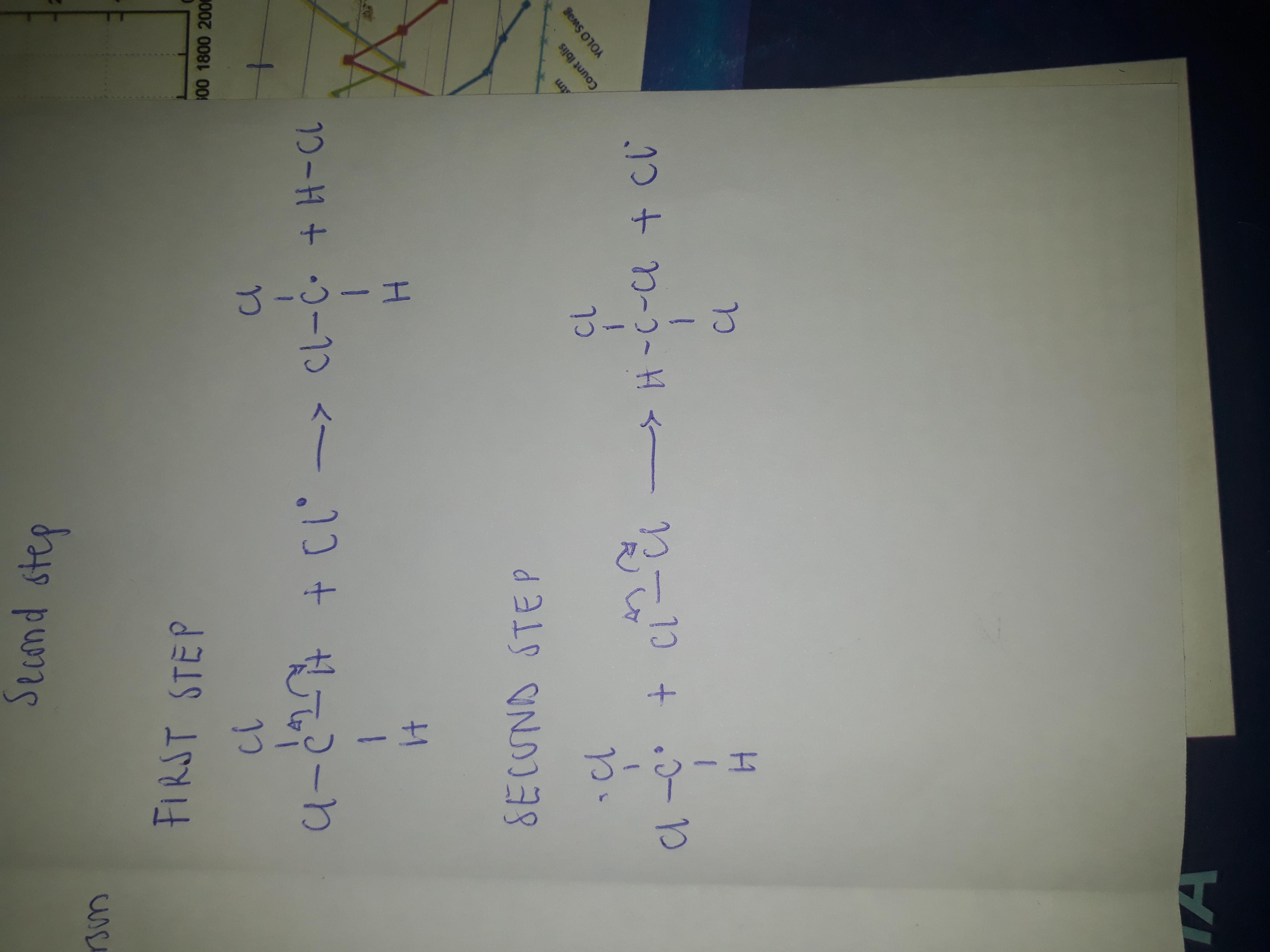
Which of the following represents a propagation step in the monochlorination of methylene chloride (CH2Cl2)?a. CHCl3 + Cl. Right
svetlana [45]

Answer:

B = CHCl2 + Cl2 --> CHCl3 + Cl

Explanation:

Free radical halogenation is a chlorination reaction on Alkane hydrocarbons. This involves the splitting of molecules into radicals/ unstable molecules in the presence of sunlight/ U.V light which ensures bonding of the molecules.

Free radical chlorination is divided into 3 steps which are:

The initiation step

The propagation step

The termination step

So in reference to the question, propagation step involves two steps.

The first step is where the molecule in this case the methylene chloride(CH2Cl2) loses a hydrogen atom and then bond with a chlorine atom radical to give a nethylwnw chloride radical and HCl.

The second step involves the reaction of this methylene chloride got in the first step with chlorine molecule to form trichloride methane and a chlorine radical.

You would find in the attachment the 2 step mechanism.

3 0
2 years ago
Other questions:
  • How many moles are in 8.30x10^23 molecules of H2o
    7·2 answers
  • (a) The bonding with electrostatic attraction between oppositely charged ions is called . The bonding with electron sharing betw
    5·1 answer
  • A 1.800-g sample of solid phenol (C6H5OH(s)) was burned in a bomb calorimeter, which has a total heat capacity of 11.66 kJ/∘C. T
    10·1 answer
  • According to the following reaction, how many moles of Fe(OH)2 can form from 175.0 mL of 0.227 M LiOH solution? Assume that ther
    10·1 answer
  • A magnesium ion, Mg2+, with a charge of 3.2×10⁻¹⁹C and an oxide ion, O2−, with a charge of −3.2×10⁻¹⁹C, are separated by a dista
    6·1 answer
  • What is the pressure of a 3.00 L gas vessel that has 18.0 grams of helium at 25°C? (R= 0.0821 L atm/ mol K)
    7·1 answer
  • What is the concentration of FeCl3 in a solution prepared by dissolving 10.0 g of FeCl3 in enough water to make 275 mL of soluti
    15·1 answer
  • Write a hypothesis about the pH level of common household solutions based on what you know about their physical and chemical pro
    8·2 answers
  • The stock concentration of dye is 3.4E-5M. The stock concentration of bleach is 0.36M. Assuming that the reaction goes to comple
    5·1 answer
  • A bird on a long migration flies 63 kilometers per hour for 2900 kilometers. How long does he fly?
    11·1 answer
Add answer
Login
Not registered? Fast signup
Signup
Login Signup
Ask question!