answer.
Ask question
Login Signup
Ask question
All categories
  • English
  • Mathematics
  • Social Studies
  • Business
  • History
  • Health
  • Geography
  • Biology
  • Physics
  • Chemistry
  • Computers and Technology
  • Arts
  • World Languages
  • Spanish
  • French
  • German
  • Advanced Placement (AP)
  • SAT
  • Medicine
  • Law
  • Engineering
sveticcg [70]
2 years ago
4

An egg is thrown nearly vertically upward from a point near the cornice of a tall building. It just misses the cornice on the wa

y down and passes a point a distance 39.0 m below its starting point at a time 5.00 s after it leaves the thrower's hand. Air resistance may be ignored.
What is the initial speed of the egg? v=?m/s

How high does it rise above its starting point h=?m

What is the magnitude of its velocity at the highest point? v=?m/s

What is the magnitude of its acceleration at the highest point? a=?m/s^2

Physics
1 answer:
KATRIN_1 [288]2 years ago
8 0

Answer:

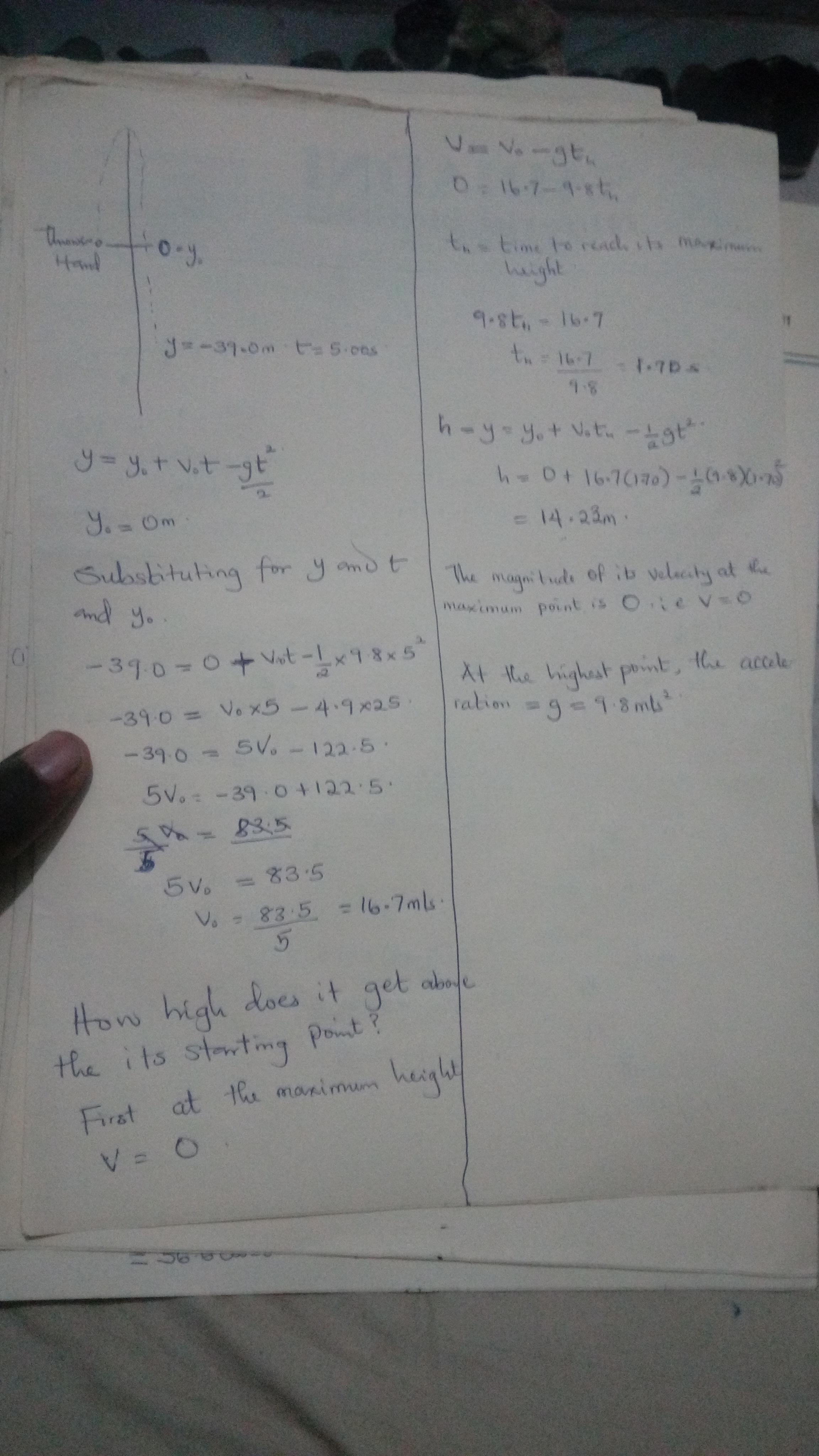
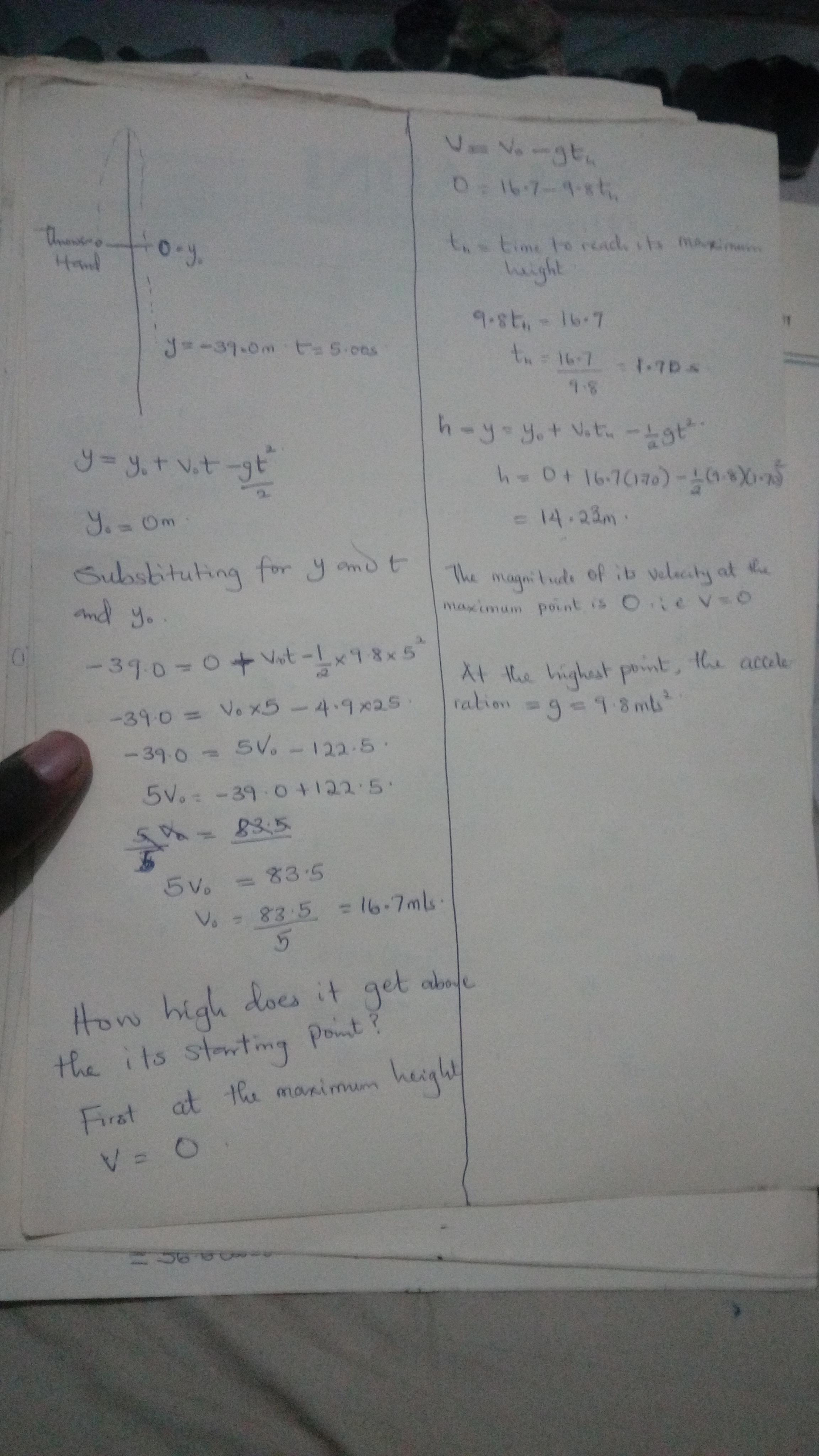
The initial speed of the egg is Vo = 16.7m/s

The highest point the egg gets to above the starting point is 14.2m

The magnitude of the veloc

Explanation:

The initial speed of the egg was computed by first setting the initial positionbof the egg to be y0 = 0 and then using the equivalent

y = y0 + Vo *t -1/2 * gt²

and solving for Vo

The highest point was calculated by first composure the time it took the egg to get the maximum height using the fact that when the egg gets to the highest point above the starting point it will temporarily be stationary having a zero velocity (v = 0). Taking advantage of this and setting v = to zero in the equation

V = Vo - gt

Where g is the acceleration due to gravity

Then using this equation again

Detailed solution can be found below in the attachment.

The acceleration of the egg is still the same as the acceleration due to gravity because no other force is acting on it and as a result it accelerates in the direction of gravity downloads. This answer is backed by Newton's second law of motion .

Thank you very much and I hope this is helpful to you.
You might be interested in
A vertical spring of constant k = 400 N/m hangs at rest. When a 2 kg mass is attached to it, and it is released, the spring exte
Viefleur [7K]

Answer:

4.9 cm

Explanation:

From Hook's Law,

F = ke......................... Equation 1

Where F= force, e = extension, k = spring constant.

Note: the Force acting on the the spring is the weight of the mass.

W = mg.

F = mg.................... Equation 2

Where m = mass, g = acceleration due to gravity

Substitute equation 2 into equation 1

mg = ke

make e the subject of the equation

e = mg/k............... Equation 3.

Given: m = 2 kg, g = 9.8 m/s², k = 400 N/m

e = (2×9.8)/400

e = 19.6/400

e = 0.049 m

e = 4.9 cm

3 0
2 years ago
The average mass of an automobile in the United States is about 1.440x10^6 g express this mass in kilograms
-BARSIC- [3]
From the problem statement, this is a conversion problem. We are asked to convert from units of grams to units of kilograms. To do this, we need a conversion factor which would relate the different units involved. We either multiply or divide this certain value to the original measurement depending on what is asked. From literature, we will find that 1000 grams is equal to 1 kilogram. We use this as follows:

<span> 1.440x10^6 g ( 1 kg / 1000 g ) = 1440 kg</span><span>
</span>
8 0
2 years ago
Calculate the current through a 10.0-m long 22-gauge nichrome wire with a radius of 0.321 mm if it is connected across a 12.0-V
Kipish [7]

Answer:

Therefore,

Current through Nichrome wire is 0.3879 Ampere.

Explanation:

Given:

Length = l = 10 meter

Radius = r = 0.321\ mm =0.321\times 10^{-3}\ meter

Resistivity=\rho=1.00\times 10^{-6}\ ohm\ meter

V = 12 Volt

To Find:

Current, I =?

Solution:

Resistance for 0.0-m long 22-gauge nichrome wire with a radius of 0.321 mm if it is connected across a 12.0-V battery given as

R=\dfrac{\rho\times l}{A}

Where,

R = Resistance

l = length

A = Area of cross section = πr²

\rho=Resistivity=1.00\times 10^{-6}\ ohm\ meter

Substituting the values we get

R=\dfrac{1\times 10^{-6}\times 10}{3.14\times (0.321\times 10^{-3})^{2}}

R=\dfrac{1\times 10^{-5}}{3.23\times 10^{-7}}

R=\dfrac{1\times 10^{2}}{3.23}

R=30.95\ ohm

Now by Ohm's Law,

V= I\times R

Substituting the values we get

I=\dfrac{V}{R}=\dfrac{12}{30.95}=0.3876\ Ampere

Therefore,

Current through Nichrome wire is 0.3879 Ampere.

4 0
2 years ago
Last year a baseball player made 63 errors. This year he made 42. What percent decrease was there in the number of errors commit
Crank

Answer:

33.33 %

Explanation:

given,

error last year = 63

error this year = 42

percent decrease in the error = ?

to find the percentage difference in the error formula used is

   = \dfrac{difference}{original}\times 100

   = \dfrac{63-42}{63}\times 100

   = \dfrac{21}{63}\times 100

   = 33.33 %

Percentage decrease in the number of error is equal to 33.33%.

7 0
2 years ago
Two strings are respectively 1.00 m and 2.00 m long. Which of the following wavelengths, in meters, could represent harmonics pr
MrRissso [65]

Answer:

5) 4.00, 2.00, 1.0

Explanation:

wave equation is given as;

F₀ = V / λ

Where;

F₀ is the fundamental frequency = first harmonic

Length of the string for first harmonic is given as;

L₀ = (¹/₂) λ  

λ  = 2 L₀

when L₀ = 1

λ  = 2 x 1 = 2m

when L₀ = 2m

λ  = 2 x 2 = 4m

For First harmonic, the wavelength is 2m, 4m

For second harmonic;

L₁ = (²/₂)λ  

L₁ = λ

When L₁ = 1

λ  = 1 m

when L₁ = 2

λ  = 2 m

For second harmonic, the wavelength is 1m, 2m

Thus, the wavelength that could represent harmonics present on both strings is 4m, 2m, 1 m

6 0
2 years ago
Other questions:
  • Assume that a cloud consists of tiny water droplets suspended (uniformly distributed,
    13·1 answer
  • An electron starts from rest 3.00 cm from the center of a uniformly charged sphere of radius 2.00 cm. if the sphere carries a to
    11·1 answer
  • A child wants to pump up a bicycle tire so that its pressure is 1.2 × 10⁵ pa above that of atmospheric pressure. if the child us
    11·2 answers
  • Which of the following is probably not a reason why society might initially reject a new scientific theory
    14·1 answer
  • A crate is placed on an adjustable, incline board. the coefficient of static friction between the crate and the board is 0.29.
    11·1 answer
  • A 38 kg crate rests on a floor. A horizontal pulling force of 170 N is needed to start the crate
    15·1 answer
  • A coworker did not clean his work area before going home this could cause an accident so you quickly clean up the next day you s
    10·2 answers
  • .Find the uncertainty in a calculated electrical potential difference from the measurements of current and resistance. Electric
    8·1 answer
  • a 2.0 kg hoop rolls without slipping on a horizontal surface so that its center proceeds to the right with a constant linear spe
    7·1 answer
  • Benjamin Franklin has convinced his hapless assistant Mike Piepan to participate in an experiment on electiricty. Ben has set up
    9·1 answer
Add answer
Login
Not registered? Fast signup
Signup
Login Signup
Ask question!