answer.
Ask question
Login Signup
Ask question
All categories
  • English
  • Mathematics
  • Social Studies
  • Business
  • History
  • Health
  • Geography
  • Biology
  • Physics
  • Chemistry
  • Computers and Technology
  • Arts
  • World Languages
  • Spanish
  • French
  • German
  • Advanced Placement (AP)
  • SAT
  • Medicine
  • Law
  • Engineering
stellarik [79]
2 years ago
11

You are at a train station, standing next to the train at the front of the first car. The train starts moving with constant acce

leration, and 5.0 s later the back of the first car passes you.
How long does it take after the train starts moving until the back of the seventh car passes you? All cars are the same length.

Express your answer with the appropriate units.

The solution HAS to include the Kinematic equations with constant acceleration

Please include a graph.

Physics
1 answer:
Aleksandr [31]2 years ago
8 0

The time needed for the 7th car to pass is 13.2 s

Explanation:

The motion of the train is a uniformly accelerated motion, therefore we can use suvat equations.

We start by analzying the motion of the first car, by using the equation:

s=ut+\frac{1}{2}at^2

where

s is the distance covered by the first car in a time t, which corresponds to the length of one car

u = 0 is the initial velocity

a is the acceleration

t = 5.0 s is the time

The equation can be rewritten as

a=\frac{2s}{t^2}=\frac{2L}{(5.0)^2}=0.08L[m/s^2]

where L is the length of one car.

The same equation can be written considering the first 7 cars:

7L = ut+\frac{1}{2}at'^2

where

7L is the distance covered by the 7 cars

t' is the time needed

We still have

u = 0

And the acceleration is constant so it is

a=0.08L

Substituting into the equation, we can find t':

7L = \frac{1}{2}(0.08L)t'^2\\7=0.04t'^2\\t'=\sqrt{\frac{7}{0.04}}=13.2 s

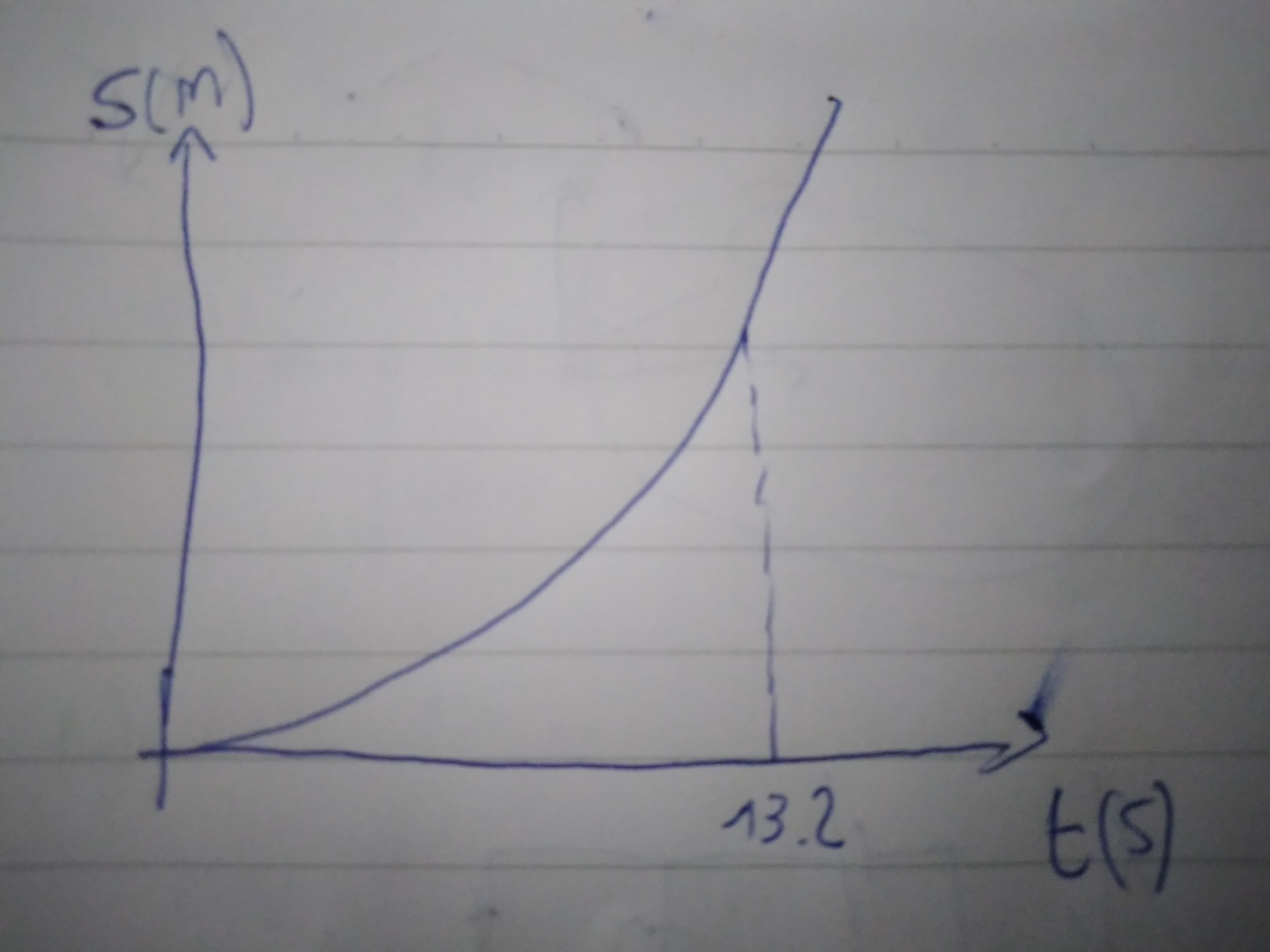
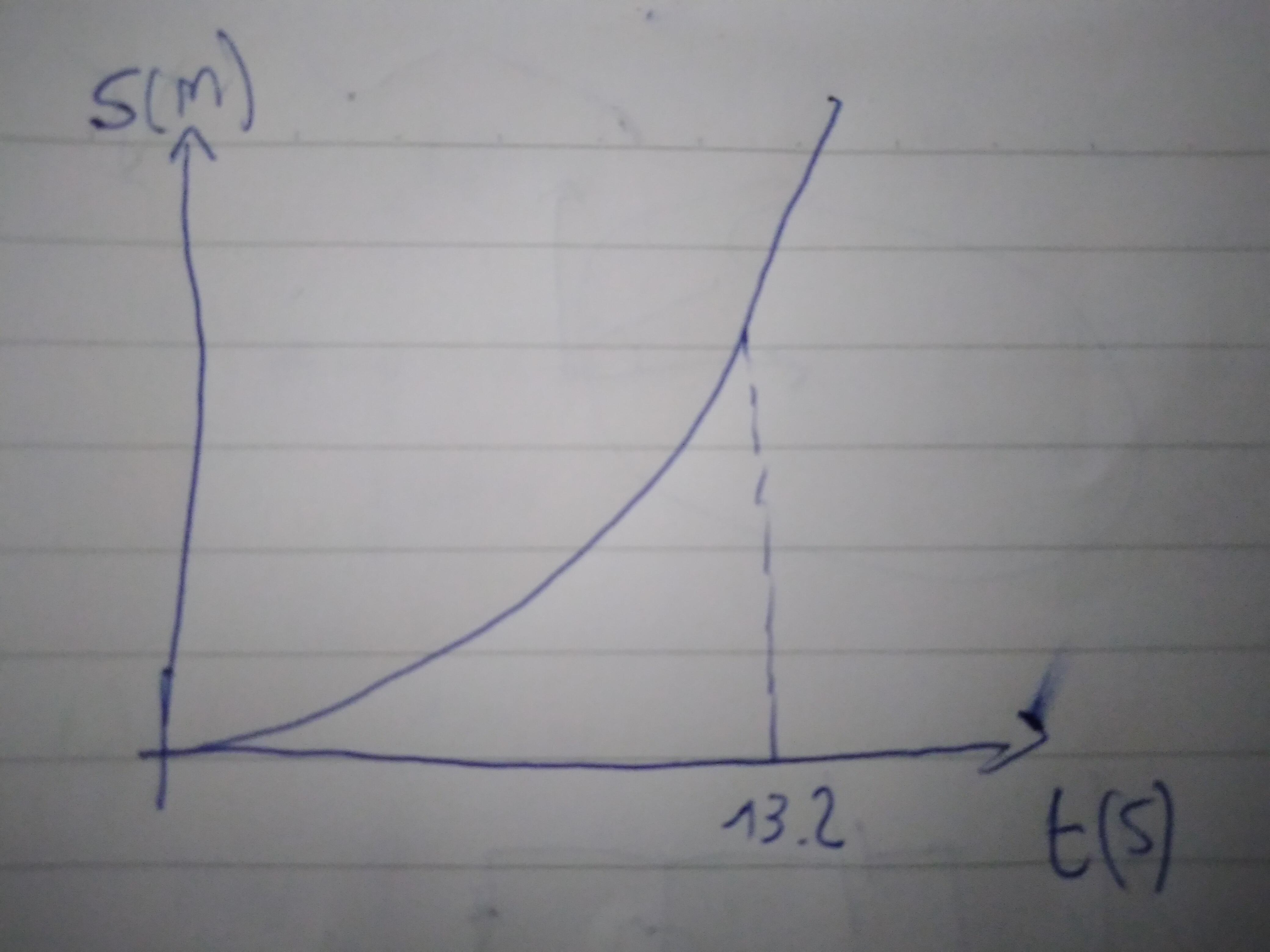
In attachment the graph of the distance covered versus the time taken: since the motion is uniformly accelerated, the relationship between the two variables is quadratical.

Learn more about accelerated motion:

brainly.com/question/9527152

brainly.com/question/11181826

brainly.com/question/2506873

brainly.com/question/2562700

#LearnwithBrainly
You might be interested in
An object is located 25.0 cm from a convex mirror. The image distance is -50.0 cm. What is the magnification?
Lynna [10]

Answer:

\boxed{\sf Magnification \ (m) = 2}

Given:

Object distance (u) = 25.0 cm

Image distance (v) = -50.0 cm

To Find:

Magnification (m)

Explanation:

\boxed{\bold{\sf Magnification  \: (m) = - \frac{Image  \: distance  \: (v)}{Object  \: distance  \: (u)}}}

Substituting values of Image distance(v) & Object distance (u) in the equation:

\sf \implies m =  -  \frac{( - 50)}{25}

-(-50) = 50:

\sf \implies m =  \frac{50}{25}

\sf \implies m =  \frac{2 \times  \cancel{25}}{ \cancel{25}}

\sf \implies m = 2

4 0
2 years ago
Suppose astronomers discover a new planet farther away from the Sun than Earth. How would the day and year of this planet compar
posledela
I think the answer would be C. because the orbit around the sun compared to the Earth's (Identifies the seasons change and the year) would be longer, but the day is unknown because that is where it would come down to the total mass of the planet and other important factors about the planets properties.
6 0
2 years ago
Read 2 more answers
A steel cable lifting a heavy box stretches by ΔL . In order for the cable to stretch by only half of ΔL , by about what factor
il63 [147K]

Answer:

2.0

Explanation:

because I'm a geek and ik

6 0
2 years ago
What voltage is required to move 6A through 20?<br><br>​
Marina CMI [18]

Answer:

120V

Explanation:

Given parameters:

Current  = 6A

Resistance  = 20Ω

Unknown:

Voltage = ?

Solution:

According to ohms law;

           V = IR

Where V is the voltage

            I is the current

            R is the resistance

Now, insert the parameters and solve;

    V  = 6 x 20  = 120V

7 0
2 years ago
Multiplying or dividing vectors by scalars results in a. vectors. b. scalars. c. vectors if multiplied or scalars if divided. d.
klemol [59]
Let A = i+j+k be a vector and B = 3 be any scalar, 
Multiplying A and B, 
AB = (i+j+k)3 = 3i+3j+3k 

Which is a new vector whose direction is same as the old but it's 3 times greater in length  than the old vector(i+j+k).

Now, dividing A and B,
A/B = (i+j+k)/3 = \frac{1}{3}i +  \frac{1}{3}j + \frac{1}{3}k

Which is again a new vector whose direction is same as the old but now it's 1/3 times small in length than the old vector. 

Direction is same because we multiplied by positive scalar. If we multiply A by suppose -1, -4, -1000000 or any negative number, it's direction will reverse. 

Thus, if we multiply a vector with scalar, it's length increases. If we divide, it shrinks. 
8 0
2 years ago
Read 2 more answers
Other questions:
  • Water is projected from two rubber pipes at the same speed from one at an angle of 30°and from the other at 60°.why are the rang
    6·1 answer
  • If you were trying to build a soundproof room, which of the following materials would you choose in order to absorb the most sou
    5·2 answers
  • Match each label to the boundary it describes. convergent boundary new crust forms transform boundary crust submerges into the m
    5·2 answers
  • Two loudspeakers in a plane, 5.0m apart, are playing the same frequency. If you stand 14.0m in front of the plane of the speaker
    14·1 answer
  • A 26 foot ladder is lowered down a vertical wall at a rate of 3 feet per minute. The base of the ladder is sliding away from the
    10·1 answer
  • A 10. g cube of copper at a temperature T1 is placed in an insulated cup containing 10. g of water at a temperature T2. If T1 &g
    12·1 answer
  • How much heat is required to convert 18.0 g of ice at -10.0C to steam at 100.0C? Express your answer in joules, calories, and Bt
    6·1 answer
  • a cylinder has a radius of 2.1cm and a length of 8.8cm .total charge 6.1 x 10^-7C is distributed uniformly throughout. the volum
    14·1 answer
  • Calculate the true mass (in vacuum) of a piece of aluminum whose apparent mass is 4.5000 kgkg when weighed in air. The density o
    5·1 answer
  • The cantilever beam AB has a rectangular cross section of 150 × 200 mm. Knowing that the tension in the cable BD is 10.8 kN and
    8·1 answer
Add answer
Login
Not registered? Fast signup
Signup
Login Signup
Ask question!