answer.
Ask question
Login Signup
Ask question
All categories
  • English
  • Mathematics
  • Social Studies
  • Business
  • History
  • Health
  • Geography
  • Biology
  • Physics
  • Chemistry
  • Computers and Technology
  • Arts
  • World Languages
  • Spanish
  • French
  • German
  • Advanced Placement (AP)
  • SAT
  • Medicine
  • Law
  • Engineering
vovikov84 [41]
2 years ago
11

Finding the center of Gravity:

Physics
2 answers:
ValentinkaMS [17]2 years ago
6 0

The answer is:

xA = 0

XB = 0

XC = 10.0.

The explanation:

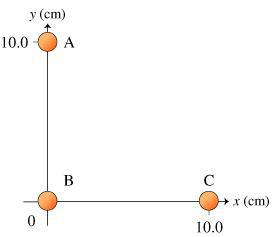
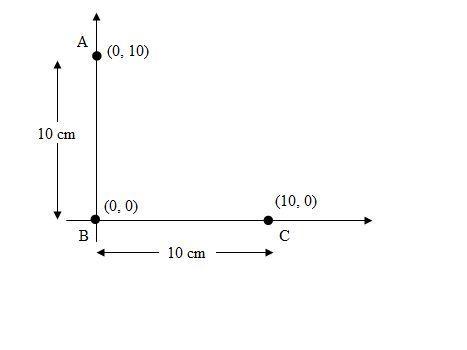
1) From the given figure we can see that the coin B lies at the origin with coordinates (0,0).

2) and the coins A, B and C  on the corners of a square.

3) The length of all sides in a square are equal. The distance between B and C form a side of a square.

4) So distance from B to C is 10 cm. Likewise, distance from B to A is also 10 cm.

5) and when B is located at point (0,0) and C is 10 units right of B, so coordinates of C will be (10,0).

6) A is located 10 units above B, so coordinates of A will be (0, 10).  

7) Therefore, the x-coordinates of A, B and C are 0,0 and 10 respectively.


Leokris [45]2 years ago
6 0

The X-coordinate of the coin A is \boxed{0\,{\text{cm}}}, coin B is \boxed{0\,{\text{cm}}} and coin C is \boxed{10\,{\text{cm}}}.

Further Explanation:

The three coins A, B , C are placed in the XY plane and they are placed along the X and Y axes. The X-coordinate of the coin is the value on X-axis at which they are placed.

The coin A is placed at the 10\,{\text{cm}} mark on the Y- axis and if we carefully look at its position along the X axis, then it will cross the X axis at the point x = 0\,{\text{cm}}. Therefore, the X-coordinate for the coin A is  \boxed{{X_A} = 0\,{\text{cm}}}.

Now, the coin B is placed as the intersection of the X and the Y axis. The point of intersection of the two axis in a 2-D plane is termed as the origin. It means that from this point, the plane starts. At origin the X as well as Y coordinates are zero.

Therefore, the X-coordinate for the coin is \boxed{{X_B}=0\,{\text{cm}}}.

The coin is placed at a distance of 10 cm from the coin B and it is placed along the X-axis. The X-coordinate of any point along the X-axis is the distance of the point from the origin. Therefore, the X-coordinate of the coin C is \boxed{{X_C}=10\,{\text{cm}}}.

Thus, the X-coordinate of the coin A is \boxed{0\,{\text{cm}}}, coin B is \boxed{0\,{\text{cm}}} and coin C is \boxed{10\,{\text{cm}}}.

Learn More:

1. What type of mirror do dentist use brainly.com/question/997618

2. What is ax, the x-component of the object's acceleration brainly.com/question/7114558

3. The amount of kinetic energy an object has depends on its brainly.com/question/137098

Answer Details:

Grade: High School

Subject: Physics

Chapter: Units and Measurements

Keywords:  Three identical coins, A, Band C, three corners of a square, 10cm on a side, X-coordinates, origin, distance from the origin, X-axis, Y-axis.
You might be interested in
Think about it: suppose a meteorite collided head-on with mars and becomes buried under mars's surface. what would be the elasti
Ket [755]

Answer:

Perfectly inelastic collision

Explanation:

There are two types of collision.

1. Elastic collision : When the momentum of the system and the kinetic energy of the system is conserved, the collision is said to be elastic. For example, the collision of two atoms or molecules are considered to be elastic collision.

2. Inelastic collision: When the momentum  the system is conserved but the kinetic energy is not conserved, the collision is said to be inelastic. For example, collision of a ball with the mud.

For a perfectly elastic collision, the two bodies stick together after collision.

Here, the meteorite collide with the Mars and buried inside it, the collision is said to be perfectly inelastic. here the kinetic energy of a body lost completely during the collision.

4 0
2 years ago
When a pendulum is pulled back from its equilibrium position by 10∘, the restoring force is 1.0 N. When it is pulled back to 30∘
jarptica [38.1K]

Answer: B

Explanation: I said B because if you pull something back what is going to be more of a force pulling back or letting it go for a rubier band yes it will have more force if you let it go

5 0
2 years ago
Read 2 more answers
A student states that 203.9 g of table sugar will form a saturated solution in 100 g of water.
riadik2000 [5.3K]

The temperature and the solubility of sugar at that temperature

Explanation:

The amount of substance which can be dissolved in the solvent depends on the temperature.

As the temperature increases, more substance can be dissolved.

A solution is  saturated if any more of the solute cannot be dissolved in the solution at the given temperature

Hence we need to know the temperature  and also the amount of substance which can be dissolved(solubility) at the same temperature

a) the statement given in option A is correct

b) molar mass has no correlation with the substance's solubility and hence option b is not correct

c) The percent by volume of the solution is not needed to find if the solution is saturated and hence option c is not correct

3 0
2 years ago
The driver of a car slams on the brakes when he sees a tree blocking the road. The car slows uniformly with acceleration of −5.2
sergejj [24]

Answer:

The car strikes the tree with a final speed of 4.165 m/s

The acceleration need to be of -5.19 m/seg2 to avoid collision by 0.5m

Explanation:

First we need to calculate the initial speed V_{0}

x=V_{0} *t+\frac{1}{2} *a*(t^{2} )\\62.5m=V_{0} *4.15s+\frac{1}{2} *-5.25\frac{m}{s^{2} } *(4.15^{2} )\\V_{0}=25.953\frac{m}{s}

Once we have the initial speed, we can isolate the final speed from following equation:

V_{f} =V_{0} +a*t  V_{f}= 4.165 \frac{m}{s}  

Then we can calculate the aceleration where the car stops 0.5 m before striking the tree.

To do that, we replace 62 m in the first formula, as follows:

x=V_{0} *t+\frac{1}{2} *a*(t^{2} )\\62m=25.953\frac{m}{s}*4.15s+\frac{1}{2} *-a\frac{m}{s^{2} } *(4.15^{2} )\\a=-5.19\frac{m}{s^{2} }

3 0
2 years ago
Read 2 more answers
Ingrid is moving a box from the ground into the back of a truck. She uses 20 N of force to move the box 5 meters. If she uses an
Oduvanchick [21]

Answer:

C

Explanation:

4 0
2 years ago
Other questions:
  • A projectile follows a straight-line path instead of a parabolic trajectory. Which could be the launch angle? would it be 90 or
    9·2 answers
  • It's a cloudy and rainy day. The air pressure is most likely _____.
    9·1 answer
  • Dylan has two cubes of iron. The larger cube has twice the mass of the smaller cube. He measures the smaller cube. Its mass is 2
    15·2 answers
  • Two identical carts travel at the same speed toward each other, and then a collision occurs. The graphs show the momentum of eac
    14·1 answer
  • A 1.50 cm high diamond ring is placed 20.0 cm from a concave mirror with radius of curvature 30.00 cm. The magnification is ____
    14·1 answer
  • A cyclist moving towards right with an acceleration of 4m/s² at t = 0 he has travelled 5 m moving towards the right at 15 m/s wh
    7·1 answer
  • A square loop of wire surrounds a solenoid. The side of the square is 0.1 m, while the radius of the solenoid is 0.025 m. The sq
    9·2 answers
  • Gibbons, small Asian apes, move by brachiation, swinging below a handhold to move forward to the next handhold. A 9.4 kg gibbon
    15·1 answer
  • The U.S. Department of Energy had plans for a 1500-kg automobile to be powered completely by the rotational kinetic energy of a
    15·1 answer
  • Suppose that the coefficient of kinetic friction between Zak's feet and the floor, while wearing socks, is 0.250. Knowing this,
    11·1 answer
Add answer
Login
Not registered? Fast signup
Signup
Login Signup
Ask question!
