answer.
Ask question
Login Signup
Ask question
All categories
  • English
  • Mathematics
  • Social Studies
  • Business
  • History
  • Health
  • Geography
  • Biology
  • Physics
  • Chemistry
  • Computers and Technology
  • Arts
  • World Languages
  • Spanish
  • French
  • German
  • Advanced Placement (AP)
  • SAT
  • Medicine
  • Law
  • Engineering
Margaret [11]
2 years ago
13

Mohr's salt is a pale green crystalline solid which is soluble in water. It is a 'double sulfate' which contains two cations, on

e of which is Fe2+.The identity of the second cation was determined by heating solid mohr's salt with solid sodium hydroxide and a colourless gas was evolved. The gas readily dissolved in watdr giving an alkaline solution. A grey green solid residue was also formed which wasd insoluble in water. Whate are the identities of the gas and solid residue? A. Gas: H2 Residue: FeSO4 B.NH3 Na2SO4 C. NH3 Fe(OH)2 D. SO2 Fe(OH)2
Chemistry
1 answer:
Veronika [31]2 years ago
3 0
The gas is NH₃.
H₂ doesn't dissolve readily in water, SO₂ gives an acidic solution in water.

The solid residue is Fe(OH)₂.
FeSO₄ and Na₂SO₄ are soluble in water.

The answer is C.
You might be interested in
Which of the compounds above are strong enough acids to react almost completely with a hydroxide ion (pka of h2o = 15.74) or wit
luda_lava [24]

The compounds can react with OH⁻ and HCO₃⁻ only C₅H₆N pyridinium

<h3><em>Further explanation </em></h3>

In an acid-base reaction, it can be determined whether or not a reaction occurs by knowing the value of pKa or Ka from acid and conjugate acid (acid from the reaction)

Acids and bases according to Bronsted-Lowry

Acid = donor (donor) proton (H + ion)

Base = proton (receiver) acceptor (H + ion)

If the acid gives (H +), then the remaining acid is a conjugate base because it accepts protons. Conversely, if a base receives (H +), then the base formed can release protons and is called the conjugate acid from the original base.

From this, it can be seen whether the acid in the product can give its proton to a base (or acid which has a lower Ka value) so that the reaction can go to the right to produce the product.

The step that needs to be done is to know the pKa value of the two acids (one on the left side and one on the right side of the arrow), then just determine the value of the equilibrium constant

Can be formulated:

K acid-base reaction = Ka acid on the left : K acid on the right.

or:

pK = acid pKa on the left - pKa acid on the right

K = equilibrium constant for acid-base reactions

pK = -log K;

K~=~10^{-pK}

K value> 1 indicates the reaction can take place, or the position of equilibrium to the right.

There is some data that we need to complete from the problem above, which is the pKa value of some compounds that will react, namely:

pyridinium pKa = 5.25

acetone pKa = 19.3

butan-2-one pKa = 19

Let's look at the K value of each possible reaction:

pka H₂O = 15.74, pka of H₂CO₃ = 6.37)

  • 1. C₅H₆N pyridinium

* with OH⁻

C₅H₆N + OH- ---> C₅H₅N- + H₂O

pK = pKa pyridinium - pKa H₂O

pK = 5.25 - 15.74

pK = -10.49

K~=~10^{4.9}

K values> 1 indicate the reaction can take place

* with HCO3⁻

C₅H₆N + HCO₃⁻-- ---> C₅H₅N⁻ + H₂CO₃

pK = 5.25 - 6.37

pK = -1.12

K`=~10^{1.12]

Reaction can take place

  • 2. Acetone C₃H₆O

* with OH-

C₃H₆O + OH⁻ ---> C₃H₅O- + H₂O

pK = 19.3 - 15.74

pK = 3.56

K~=~10^{ -3.56}

Reaction does not happen

* with HCO₃-

C₃H₆O + HCO₃⁻ ----> C₃H₅O⁻ + H₂CO₃

pK = 19.3 - 6.37

pK = 12.93

K`=~10 ^{-12.93}

Reaction does not happen

  • 3. butan-2-one C₄H₇O

* with OH-

C₄H₇O + OH- ---> C₄H₆O- + H₂O

pK = 19 - 15.74

pK = 3.26

K~=~10^{-3.26}

Reaction does not happen

* with HCO₃⁻

C₄H₇O + HCO₃⁻ ---> C₄H₆O⁻ + H₂CO₃

pK = 19 - 6.37

pK = 12.63

K~=~ 10^{-12.63}

Reaction does not happen

So that can react with OH⁻ and HCO₃⁻ only C₅H₆N pyridinium

<h3><em>Learn more </em></h3>

the lowest ph

brainly.com/question/9875355

the concentrations at equilibrium.

brainly.com/question/8918040

the ph of a solution

brainly.com/question/9560687

Keywords : acid base reaction, the equilibrium constant

5 0
2 years ago
Read 2 more answers
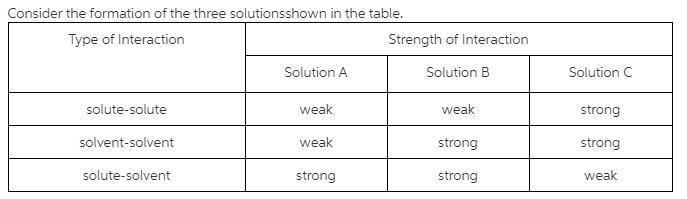
Rank the formation of the solutions A, B, and C from the most exothermic to the most endothermic. Rank the enthalpy of solution
Elodia [21]

This is an incomplete question, the table is attached below.

Answer : The correct ranking of the solution from most exothermic to most endothermic will be: A, B and C.

Explanation :

As we know that the intermolecular force of attraction play an important role in the interaction of solute-solute, solute-solvent and solvent solvent solution.

In the solution A, the solute-solute and solvent-solvent interactions are weak. So, their solute-solvent interaction will be strong. That means, the solution will be more exothermic.

In the solution C, the solute-solute and solvent-solvent interactions are strong. So, their solute-solvent interaction will be weak. That means, the solution will be more endothermic.

Thus, the correct ranking of the solution from most exothermic to most endothermic will be: A, B and C.

4 0
2 years ago
If 455-ml of 6.0 M HNO3 is used to make 2.5 L dilution, what is the molarity of the dilution
Anna11 [10]
Hi there

Formula
M1V1=M2V2
(455*6)/2500
Answer
1.092 M
5 0
2 years ago
Which runner has greater kinetic energy: a 46-kilogram runner moving at a speed of 8 meters per second or a 92-kilogram runner m
Lena [83]
Runner a has a greater kinetic energy
8 0
2 years ago
During a combustion reaction, 9.00 grams of oxygen reacted with 3.00 grams of CH4.
Monica [59]

Answer:

0.74 grams of methane

Explanation:

The balanced equation of the combustion reaction of methane with oxygen is:

  • CH₄ + 2 O₂ → CO₂ + 2 H₂O

it is clear that 1 mol of CH₄ reacts with 2 mol of O₂.

firstly, we need to calculate the number of moles of both

for CH₄:

number of moles = mass / molar mass = (3.00 g) /  (16.00 g/mol) = 0.1875 mol.

for O₂:

number of moles = mass / molar mass = (9.00 g) /  (32.00 g/mol) = 0.2812 mol.

  • it is clear that O₂ is the limiting reactant and methane will leftover.

using cross multiplication

1 mol of  CH₄ needs → 2 mol of O₂

???  mol of  CH₄  needs → 0.2812 mol of O₂

∴ the number of mol of CH₄ needed = (0.2812 * 1) / 2 = 0.1406 mol

so 0.14 mol will react and the remaining CH₄

mol of CH₄ left over = 0.1875 -0.1406 = 0.0469 mol

now we convert moles into grams

mass of CH₄ left over = no. of mol of CH₄ left over *  molar mass

                                    = 0.0469 mol * 16 g/mol = 0.7504 g

So, the right choice is 0.74 grams of methane

3 0
2 years ago
Other questions:
  • in collecting the precipitate, why would it be inappropriate to heat the reacted mixture and evaporate off the water?
    6·1 answer
  • Impure benzoic acid was dissolved in hot water. the container of solution was placed in an ice-water bath instead of being allow
    14·1 answer
  • Solid aluminum metal and diatomic chlorine gas react spontaneously to form a solid product. Give the balanced chemical equation
    14·1 answer
  • Consider the reaction below. 2H2O 2H2 + O2 How many moles of hydrogen are produced when 6.28 mol of oxygen form?
    7·1 answer
  • Which statement must be mentioned in explaining why amphipathic molecules line up at a water surface?Which statement must be men
    5·2 answers
  • How much maleic anhydride would you need to react 178 mg of anthracene? Assume 1:1 ratio from maleic anhydride to anthracene.
    14·1 answer
  • A 60.0 mL sample of 0.250 M NaOH is added to a beaker containing 125 mL of 0.120 M HOCl. Ka for HOCl is 3.5 x 10⁻⁸ at 25o C. Fin
    6·1 answer
  • 1g of a white solid is placed into a beaker of a green-colored liquid. The color of the liquid does not change, but a gas begins
    11·1 answer
  • Fill in the blanks with the word that best completes each statement. Scientists develop knowledge by making ------------about th
    7·1 answer
  • What happens when carbon dioxide is cooled to 780C?<br>Where is carbon dioxide found in nature?​
    9·1 answer
Add answer
Login
Not registered? Fast signup
Signup
Login Signup
Ask question!