answer.
Ask question
Login Signup
Ask question
All categories
  • English
  • Mathematics
  • Social Studies
  • Business
  • History
  • Health
  • Geography
  • Biology
  • Physics
  • Chemistry
  • Computers and Technology
  • Arts
  • World Languages
  • Spanish
  • French
  • German
  • Advanced Placement (AP)
  • SAT
  • Medicine
  • Law
  • Engineering
makkiz [27]
2 years ago
5

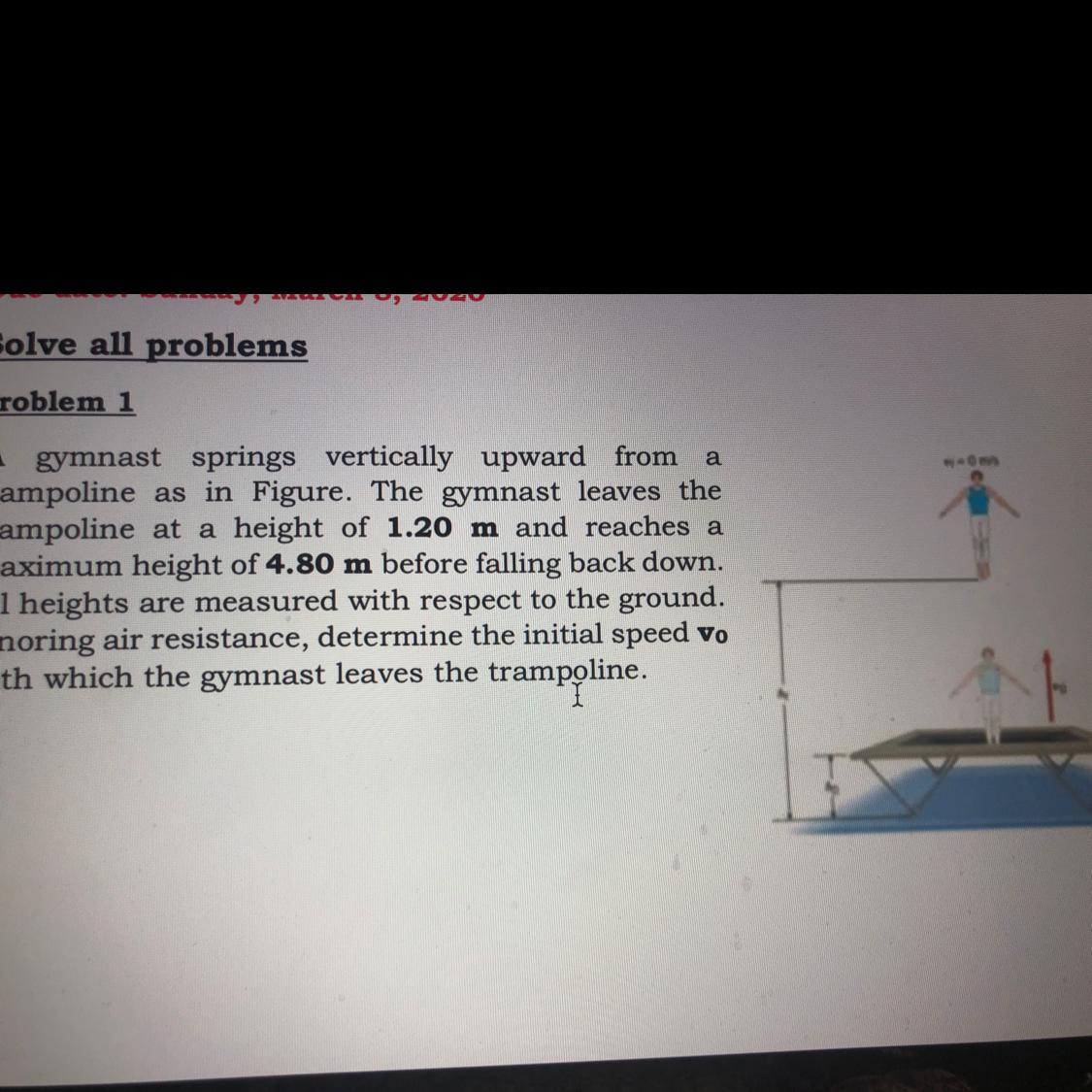
A gymnast spring vertical upward from a trampoline as in figure. The gymnast leaves the trampoline at height of 1.20m and reache

s a maximum height of 4.80m before falling back down. all heights are all measured with respect to the ground. Ignoring air resistance, determine the initial speed “vo” with witch the gymnast leaves the trampoline.

Physics
1 answer:
vaieri [72.5K]2 years ago
4 0

Answer:

The initial velocity of the gymnast is 8.5 m/s.

Explanation:

We can use the kinematic equation

v_f^2= v_o^2+2ad

to figure out the initial velocity v_o of the gymnast.

Now, when the gymnast reaches the maximum height,  the distance he has traveled is d = 4.8m- 1.2m = 3.6 m, and his velocity is zero; therefore v_f =0.

Thus, we have

0 = v_0^2+2(-10m/s^2)(3.6m)

v_0^2=72m^2/s^2

\boxed{v_0= 8.5m/s}

You might be interested in
A friend throws a heavy ball toward you while you are standing on smooth ice. You can either catch the ball or deflect it back t
baherus [9]

Answer:

Explanation:

My speed after the interaction will depend upon the impulse the ball will make on me . Now impulse can be expressed as follows

Impulse = change in momentum

change in momentum in the ball will be maximum when the ball bounces back with the same velocity which can be shown as follows

change in momentum = mv - ( - mv ) = 2mv

So when ball is bounced back with same velocity , it suffers greatest impulse from my hand . In return ,  it reacts with the same impulse on my hand pushing me with greatest impulse according to third law of motion. this maximizes my speed after the interaction.

6 0
2 years ago
An amusement park ride raises people high into the air, suspends them for a moment, and then drops them at a rate of free-fall a
blsea [12.9K]

Answer: apparent weighlessness.


Explanation:


1) Balance of forces on a person falling:


i) To answer this question we will deal with the assumption of non-drag force (abscence of air).


ii) When a person is dropped, and there is not air resistance, the only force acting on the person's body is the Earth's gravitational attraction (downward), which is the responsible for the gravitational acceleration (around 9.8 m/s²).


iii) Under that sceneraio, there is not normal force acting on the person (the normal force is the force that the floor or a chair exerts on a body to balance the gravitational force when the body is on it).


2) This is, the person does not feel a pressure upward, which is he/she does not feel the weight: freefalling is a situation of apparent weigthlessness.


3) True weightlessness is when the object is in a place where there exists not grativational acceleration: for example a point between two planes where the grativational forces are equal in magnitude but opposing in direction and so they cancel each other.


Therefore, you conclude that, assuming no air resistance, a person in this ride experiencing apparent weightlessness.

3 0
2 years ago
Read 2 more answers
In certain cases, using both the momentum principle and energy principle to analyze a system is useful, as they each can reveal
SpyIntel [72]

Answer:

A) F_g = 26284.48 N

B) v = 7404.18 m/s

C) E = 19.19 × 10^(10) J

Explanation:

We are given;

Mass of satellite; m = 3500 kg

Mass of the earth; M = 6 x 10²⁴ Kg

Earth circular orbit radius; R = 7.3 x 10⁶ m

A) Formula for the gravitational force is;

F_g = GmM/r²

Where G is gravitational constant = 6.67 × 10^(-11) N.m²/kg²

Plugging in the relevant values, we have;

F_g = (6.67 × 10^(-11) × 3500 × 6 x 10²⁴)/(7.3 x 10⁶)²

F_g = 26284.48 N

B) From the momentum principle, we have that the gravitational force is equal to the centripetal force.

Thus;

GmM/r² = mv²/r

Making v th subject, we have;

v = √(GM/r)

Plugging in the relevant values;

v = √(6.67 × 10^(-11) × 6 x 10²⁴)/(7.3 x 10⁶))

v = 7404.18 m/s

C) From the energy principle, the minimum amount of work is given by;

E = (GmM/r) - ½mv²

Plugging in the relevant values;

E = [(6.67 × 10^(-11) × 3500 × 6 × 10²⁴)/(7.3 x 10⁶)] - (½ × 3500 × 7404.18)

E = 19.19 × 10^(10) J
5 0
2 years ago
You slip a wrench over a bolt. Taking the origin at the bolt, the other end of the wrench is at x=18cm, y=5.5cm. You apply a for
mart [117]

Answer:

The torque on the wrench is 4.188 Nm

Explanation:

Let r = xi + yj where is the distance of the applied force to the origin.

Since x = 18 cm = 0.18 cm and y = 5.5 cm = 0.055 cm,

r = 0.18i + 0.055j

The applied force f = 88i - 23j

The torque τ = r × F

So, τ = r × F = (0.18i + 0.055j) × (88i - 23j) = 0.18i × 88i + 0.18i × -23j + 0.055j × 88i + 0.055j × -23j

= (0.18 × 88)i × i + (0.18 × -23)i × j + (0.055 × 88)j × i + (0.055 × -22)j × j  

= (0.18 × 88) × 0 + (0.18 × -23) × k + (0.055 × 88) × (-k) + (0.055 × -22) × 0   since i × i = 0, j × j = 0, i × j = k and j × i = -k

= 0 - 4.14k + 0.0484(-k) + 0

= -4.14k - 0.0484k

= -4.1884k Nm

≅ -4.188k Nm

So, the torque on the wrench is 4.188 Nm

8 0
2 years ago
A wire of 1mm diameter and 1m long fixed at one end is stretched by 0.01mm when a lend of 10 kg is attached to its free end.calc
Otrada [13]

Answer:

E = 1.25×10¹³ N/m²

Explanation:

Young's modulus is defined as:

E = stress / strain

E = (F / A) / (dL / L)

E = (F L) / (A dL)

Given:

F = 10 kg × 9.8 m/s² = 98 N

L = 1 m

dL = 10⁻⁵ m

A = π/4 (0.001 m)² = 7.85×10⁻⁷ m²

Solve:

E = (98 N × 1 m) / (7.85×10⁻⁷ m² × 10⁻⁵ m)

E = 1.25×10¹³ N/m²

Round as needed.

5 0
2 years ago
Other questions:
  • How much heat must be absorbed by 375 grams of water to raise its temperature by 25°c
    8·2 answers
  • Describing the motion of an object can be difficult to do and using graphs help make motion easier to understand. Motion is a ch
    15·2 answers
  • The drag force, fd, imposed by the surrounding air on a vehicle moving with velocity v is given by fd = cdaρv 2/2 where cd is a
    7·1 answer
  • Suppose that a rectangular toroid has 2,000 windings and a self-inductance of 0.060 H. If the height of the rectangular toroid i
    13·1 answer
  • A straight, nonconducting plastic wire 9.50 cm long carries a charge density of 130 nC/m distributed uniformly along its length.
    5·1 answer
  • A transformer is to be used to provide power for a computer drive. The number of turns in the primary is 1000, and it delivers a
    10·1 answer
  • ou purchase a rectangular piece of metal that has dimen- sions 5.0 * 15.0 * 30.0 mm and mass 0.0158 kg. The seller tells you tha
    11·1 answer
  • The period of an ocean wave is 5 seconds. What is the wave's frequency?
    15·1 answer
  • A typical machine tests the tensile strength of a sheet of material cut into a standard size of 5.00 centimeters wide by 10.0 ce
    12·1 answer
  • A gold puck has a mass of 12 kg and a velocity of 5i – 4j m/s prior to a collision with a stationary blue puck whose mass is 18
    13·1 answer
Add answer
Login
Not registered? Fast signup
Signup
Login Signup
Ask question!
