answer.
Ask question
Login Signup
Ask question
All categories
  • English
  • Mathematics
  • Social Studies
  • Business
  • History
  • Health
  • Geography
  • Biology
  • Physics
  • Chemistry
  • Computers and Technology
  • Arts
  • World Languages
  • Spanish
  • French
  • German
  • Advanced Placement (AP)
  • SAT
  • Medicine
  • Law
  • Engineering
Reika [66]
2 years ago
6

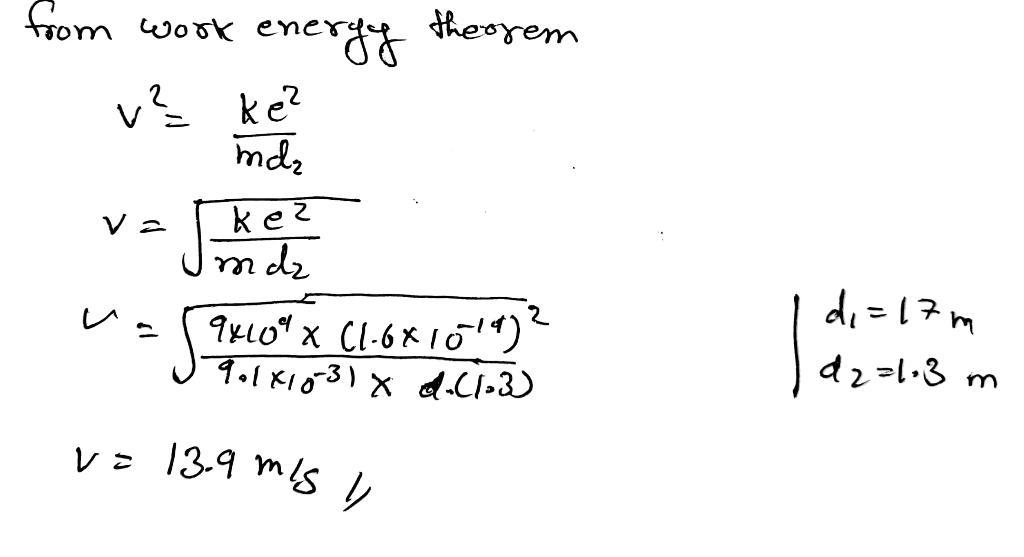
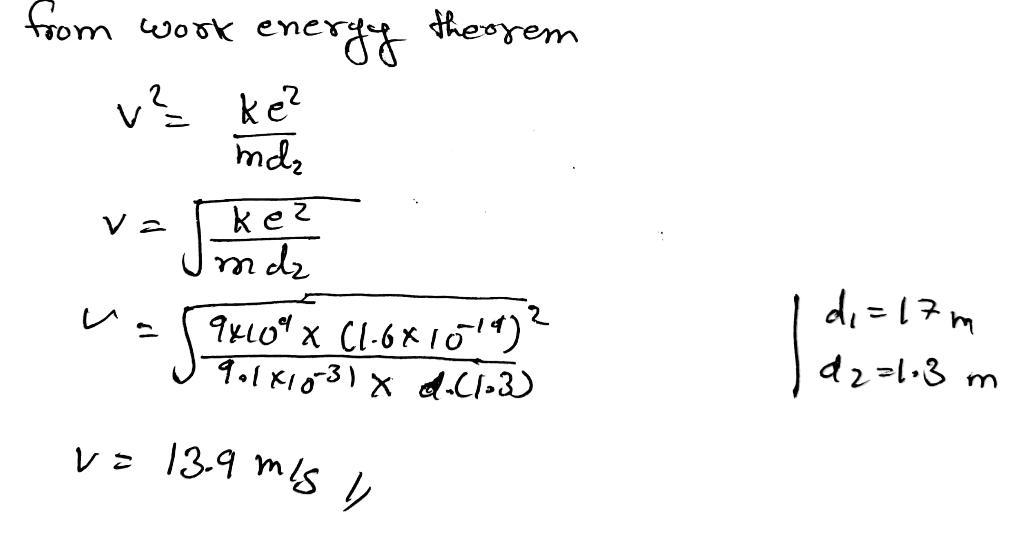
An electron and a positron are located 17 m away from each other and held fixed by some mechanism. The positron has the same mas

s and the same magnitude of charge as those of the electron, but its charge is positive. The electron and the positron are released at the same time by the mechanism. The electron and the positron begin to speed up towards each other. What velocities should they have when they are 1.3 m away from each other?

Physics
1 answer:
mariarad [96]2 years ago
6 0

Answer:

Velocity will be 13.9 m/s when they are 1.3 m away from each other.

Explanation:

Detailed steps are attached below.

You might be interested in
From the edge of a roof you throw a snowball downward that strikes the ground with 100J of kinetic energy. then you throw a seco
Vanyuwa [196]

Answer:

The second snowball hits the ground with a kinetic energy of 100 Joules

Explanation:

Given that,

From the edge of a roof you throw a snowball downward that strikes the ground with 100 J of kinetic energy. It is a case of conservation of energy.

At the highest point,

mgh+\dfrac{1}{2}mu^2=mgh'+0          

100=mgh'

At lowest point,

mgh'=K

From above two equation, we get :

Kinetic energy, K = 100 J

So, the second snowball hits the ground with a kinetic energy of 100 Joules. So, the correct option is (A).                                                                        

7 0
2 years ago
The thrust of a certain boat’s engine generates a power of 10kW as the boat moves at constant speed 10ms through the water of a
Lunna [17]

Answer:

The change in power is 4400 W.

Explanation:

Given that,

Power = 10 kW

Speed = 10 m/s

Increases speed = 12 m/s

Given equation is,

F=kv

We know that,

The power is,

P=Fv

Put the value of F into the formula

P=(kv)v

P=kv^2

P\propto v^2

We need to calculate the new power

Using formula for power

\dfrac{P}{P'}=\dfrac{v^2}{v'^2}

Put the value into the formula

\dfrac{10}{P'}=(\dfrac{10}{12})^2

P'=(\dfrac{12}{10})^2\times10

P'=14.4\ kW

We need to calculate the change in power

Using formula of change in power

\Delta P=P'-P

Put the value into the formula

\Delta P=14.4-10

\Delta P=4.4\ kW

\Delta P=4.4\times1000

\Delta P=4400\ W

Hence, The change in power is 4400 W.

6 0
3 years ago
In the middle of the night you are standing a horizontal distance of 14.0 m from the high fence that surrounds the estate of you
olchik [2.2K]

PART A)

horizontal distance that will be moved = 14 m

Height of the fence = 5.0 m

height from which it is thrown = 1.60 m

angle of projection = 54 degree

So here we can say that stone will travel vertically up by distance

\Delta y = 5 - 1.6 = 3.40 m

now we will have displacement in horizontal direction

\Delta x = 14 m

now we know that

v_x = vcos54

v_y = vsin54

now we will have

\Delta x = v_x t

14 = (vcos54)t

also for y direction

\Delta y = v_y t + \frac{1}{2}at^2

3.40 = (vsin54)t - \frac{1}{2}(9.8) t^2

now from the two equations we will have

3.40 = (vsin54)(\frac{14}{vcos54}) - 4.9 t^2

3.40 = 14 tan54 - 4.9 t^2

3.40 = 19.3 - 4.9 t^2

t = 1.8 s

now from above equations

14 = vcos54 (1.8)

v = 13.2 m/s

So the minimum speed will be 13.2 m/s

Part B)

Total time of the motion after which it will land on the ground will be "t"

so its vertical displacement will be

\Delta y = -1.60 m

now we will have

-1.60 = v_y t + \frac{1}{2}at^2

-1.60 = (13.2sin54)t - \frac{1}{2}(9.8)t^2

4.9 t^2 - 10.7t - 1.60 = 0

t = 2.3 s

Now the time after which it will reach the fence will be t1 = 1.8 s

so total time after which it will fall on other side of fence

t_2 = t - t_1

t_2 = 2.3 - 1.8 = 0.5 s

now the displacement on the other side is given as

\Delta x = (vcos54) t_2

\Delta x = (13.2 cos54)(0.5)

\Delta x = 3.88 m

4 0
2 years ago
A fisherman is fishing from a bridge and is using a "44.0-N test line." In other words, the line will sustain a maximum force of
vitfil [10]

Answer:

a) 4.485 kg b) 3.94 kg

Explanation:

since the maximum tension the line can stand is 44 N and for question a the speed is constant (acceleration must be zero since the velocity or speed is not changing), F(tension) = mass * acceleration due to gravity (g) .

44 = m * 9.81m/s^2

m = 44/9.81 = 4.485kg

b) F(tension) = ma + mg ( where a is the acceleration of the body and g is the acceleration of the gravity)

44 = m (a +g)

44 = m (1.37 + 9.81)

44/11.18 = m

m = 3.94 kg
3 0
2 years ago
As a descending elevator approaches the correct floor, it slows to a stop with a constant acceleration of magnitude 1m/s*2. The
Nookie1986 [14]

Answer:

C

Explanation:

4 0
2 years ago
Other questions:
  • Identify the arrows that show input force
    14·2 answers
  • Suppose a police officer is 1/2 mile south of an intersection, driving north towards the intersection at 30 mph. at the same tim
    13·2 answers
  • A baseball bat is 32 inches (81.3 cm) long and has a mass of 0.96 kg. Its center of mass is 22 inches (55.9 cm) from the handle
    11·1 answer
  • If 1.00 mol of argon is placed in a 0.500-L container at 28.0 ∘C , what is the difference between the ideal pressure (as predict
    7·1 answer
  • A pendulum is made of a small sphere of mass 0.250 kg attached to a lightweight string 1.20 m in length. As the pendulum swings
    14·1 answer
  • A brass lid screws tightly onto a glass jar at 20 degrees C. To help open the jar, it can be placed into a bath of hot water. Af
    9·1 answer
  • Two small diameter, 10gm dielectric balls can slide freely on a vertical channel each carry a negative charge of 1microcoulomb.
    12·1 answer
  • the container is filled with liquid. the depth of liquid is 60 cm. if it is exerting the pressure of 2000pa. calculate the densi
    11·1 answer
  • Nuclear waste disposal is one of the largest issues with nuclear power. Cesium-137 is one of the high level waste products in an
    7·1 answer
  • What is the magnitude of the force between a 25μC charge exerts on a -10μC charge 8.5cm away?
    12·1 answer
Add answer
Login
Not registered? Fast signup
Signup
Login Signup
Ask question!