answer.
Ask question
Login Signup
Ask question
All categories
  • English
  • Mathematics
  • Social Studies
  • Business
  • History
  • Health
  • Geography
  • Biology
  • Physics
  • Chemistry
  • Computers and Technology
  • Arts
  • World Languages
  • Spanish
  • French
  • German
  • Advanced Placement (AP)
  • SAT
  • Medicine
  • Law
  • Engineering
yKpoI14uk [10]
2 years ago
10

A hydraulic lift is made by sealing an ideal fluid inside a container with an input piston of cross- sectional area 0.004 m2, an

d an output piston of cross-sectional area 2 m2. The pistons can slide up or down without friction while keeping the fluid sealed inside. What is the maximum weight that can be lifted when a force of 50 N is applied to the input piston?

Physics
2 answers:
Readme [11.4K]2 years ago
7 0

Answer:

2500N

Explanation:

Like the law of conservation of energy( analogous to it ), Input pressure and output pressure will be equal, pressure is defined as force per unit area. here in this scenario

input pressure is equal to output pressure, writing this out in mathematics.

$\frac{50N}{0.004m^2} =\frac{Force-out}{2m^2} $

by solving above equation we get

Force-out = 25000N, 500 times greater than input force.

Marrrta [24]2 years ago
3 0

Answer:

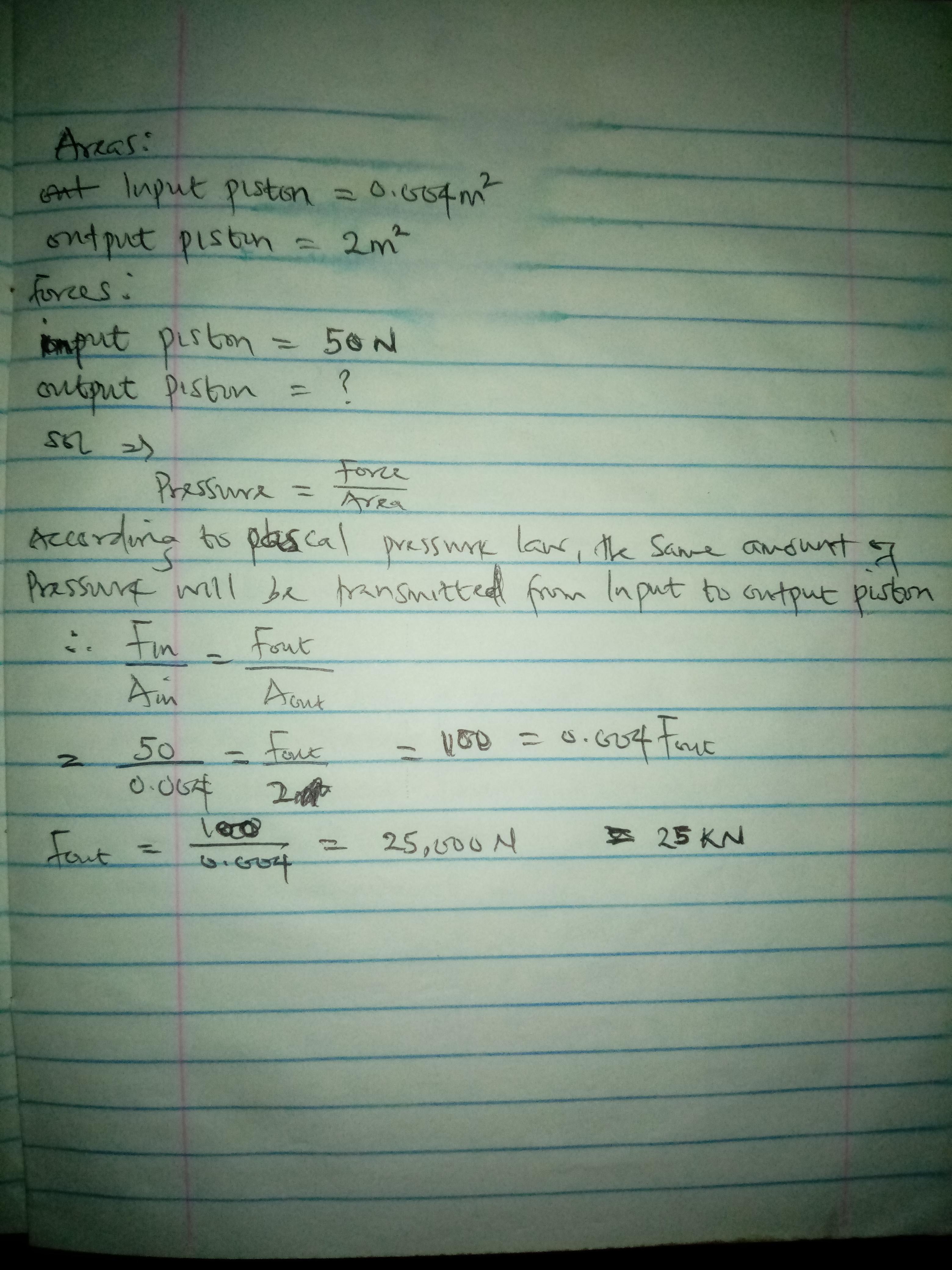
25,000N of force will be ouputed

Explanation:

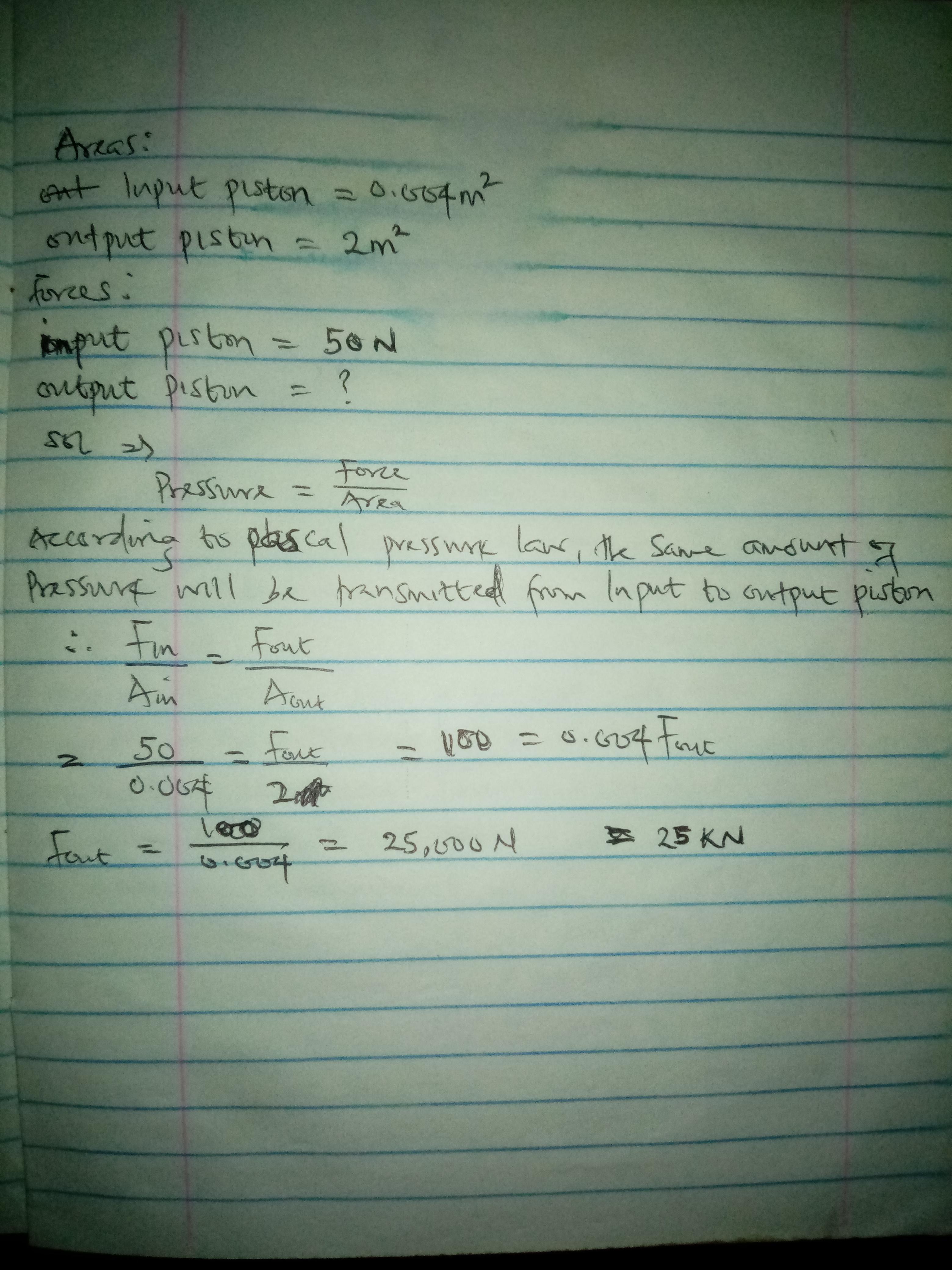
Detailed explanation and calculation is shown in the image below

You might be interested in
Lilli suggests that they explore the simulation starting with varying only a single parameter in order to understand the role of
mrs_skeptik [129]

Answer:

B.

Explanation:

One of the ways to address this issue is through the options given by the statement. The concepts related to the continuity equation and the Bernoulli equation.

Through these two equations it is possible to observe the behavior of the fluid, specifically the velocity at a constant height.

By definition the equation of continuity is,

A_1V_1=A_2V_2

In the problem A_2 is 2A_1, then

A_1V_1=2A_1V_2

V_2 = \frac{V_1}{2}

<em>Here we can conclude that by means of the continuity when increasing the Area, a decrease will be obtained - in the diminished times in the area - in the speed.</em>

For the particular case of Bernoulli we have to

P_1 + \frac{1}{2}\rho V_1^2 = P_2 +\frac{1}{2}\rho V_2^2

P_2-P_1 = \frac{1}{2} \rho (V_1^2-V_2^2)

For the previous definition we can now replace,

P_2-P_1 = \frac{1}{2} \rho (V_1^2-(\frac{V_1}{2})^2)

\Delta P =  \frac{3}{8} \rho V_1^2

<em>Expressed from Bernoulli's equation we can identify that the greater the change that exists in pressure, fluid velocity will tend to decrease</em>

The correct answer is B: "If we increase A2 then by the continuity equation the speed of the fluid should decrease. Bernoulli's equation then shows that if the velocity of the fluid decreases (at constant height conditions) then the pressure of the fluid should increase"

4 0
2 years ago
A 6.0-ohm resistor that obeys Ohm’s Law is connected to a source of variable potential difference. When the applied voltage is d
leva [86]

Is halved. A 6Ω resistor connected to a voltage source which voltage is decreased from 12V to 6V the current passing through the resistor is halved.

The key to solve this problem is applying Ohm's Law V = R I, clearing I from the equation, we obtain I = V/R. Then, the current is directly proportional to the voltage and inversely proportional to the resistance.

V = 12V and R = 6Ω

I = 12V/6Ω = 2A

V = 6V and R = 6Ω

V = 6V/6Ω = 1A

As we can see the current is halved if the voltage descreased from 12V to 6V

5 0
2 years ago
Arwan finds a piece of quartz while hiking in the mountains. When he returns to school, he takes it to his science teacher. She
bekas [8.4K]

it's 303.4 cm3. i just took the test

8 0
2 years ago
Read 2 more answers
A professor designing a class demonstration connects a parallel-plate capacitor to a battery, so that the potential difference b
Lesechka [4]

Answer:

a)  Q = 397.57 pC , Q = 3.18 104 pC , b) C = 1.157 10⁻¹⁰ F ,  V = 3.4375 V ,

c)  U = 54.7 nJ ,  d) ΔU = 54 nJ,

Explanation:

a) The capacity of a capacitor is defined

        C = Q / V

        Q = C V


can also be calculated using geometry consideration

        C = e or A / d


we reduce to the SI system

       A = 25.0 cm² (1 m / 10² cm) 2 = 25.0 10⁻⁴ m²

       d = 1.53 cm = 1.53 10⁻² m

we substitute

         Q = eo A / d V

         Q = 8.85 10⁻¹² 25 10⁻⁴ / 1.53 10⁻² 275

         Q = 3.9757 10⁻¹⁰ C


let's reduce to pC

         Q = 3.9757 10⁻¹⁰ C (10¹² pC / 1 C)

          Q = 397.57 pC

when the capacitor is introduced into the water the dielectric constant is different

           Q = k Q₀

           Q = 80 397.57

           Q = 3.18 104 pC

b) Find capacitance and voltage after submerged in water

           C = k C₀

           C = 80 8.85 10⁻¹² 25 10⁻⁴ / 1.53 10⁻²

           C = 1.157 10⁻¹⁰ F

           V = Vo / k

            V = 275/80

            V = 3.4375 V

c) The stored energy is

             U = ½ C V²

              U = ½, 85 10⁻¹² 25 10⁻⁴ / 1.53 10⁻²     275²

             U = 5.47 10⁻⁸ J

let's reduce to nJ

              109 nJ = 1 J

               U = 54.7 nJ

d) energy after submerging

             U = ½ (kCo) (Vo / k) 2

             U = ½ Co Vo2 / k

             U = U₀ / k

             U = 54.7 / 80 nJ

              U = 0.68375 nJ

the energy change is

         ΔU = U₀ -U

          ΔU = 54.7 - 0.687375
           

6 0
2 years ago
Consider a 2100-kg car cruising at constant speed of 70 km/h. Now the car starts to pass another car by accelerating to 110 km/h
Liula [17]

Answer: 51841.5 Watts

Explanation: Using the kinematic equation for the final velocity for a constant acceleration we have:

Vf=Vi+a*t

replacing the values the results is

a=(Vf-Vi)/t= (30.55 m/s-19.44 m/s)/5s= 2.22 m/s^2

Remenber that to convert the speed in Km/h to m/s we have to multiplier by the factor 0.277.

Finally to calculate the increment of power get the final velocity we have to use Neton second law to determine the Force applied to the car.

F=m* a=2100 Kg* 2.22 m/s^2= 4666.2 N

Then increment  power to accelerate is given by:

ΔPower= Force* Δ velocity= 4666.2 N* 11,11 m/s= 51841.5 Watts

6 0
2 years ago
Other questions:
  • If one of the satellites is at a distance of 20,000 km from you, what percent accuracy in the distance is required if we desire
    12·1 answer
  • If there is a potential difference v between the metal and the detector, what is the minimum energy emin that an electron must h
    11·1 answer
  • Ba-11 when passing through a lock, which light means "approach the lock under full control?"
    9·2 answers
  • A student holds one end of a thread, which is wrapped around a cylindrical spool, as shown above. The student then drops the spo
    8·1 answer
  • a satellite is orbiting Earth at a distance of 35 kilometers. The satellite has a mass of 500 kilograms. what is the force betwe
    7·2 answers
  • If you calculate the thermal power radiated by typical objects at room temperature, you will find surprisingly large values, sev
    8·1 answer
  • A girl is sledding down a slope that is inclined at 30º with respect to the horizontal. The wind is aiding the motion by providi
    8·1 answer
  • To a cyclist riding due west with a speed of 4 m/s a wind appears to
    9·1 answer
  • In a football game, running back is at the 10-yard line and running up the field towards the 50 yard
    5·1 answer
  • An owl has a mass of 4.00 kg. It dives to catch a mouse, losing 800.00 J of its GPE. What was the starting height of the owl, in
    10·1 answer
Add answer
Login
Not registered? Fast signup
Signup
Login Signup
Ask question!