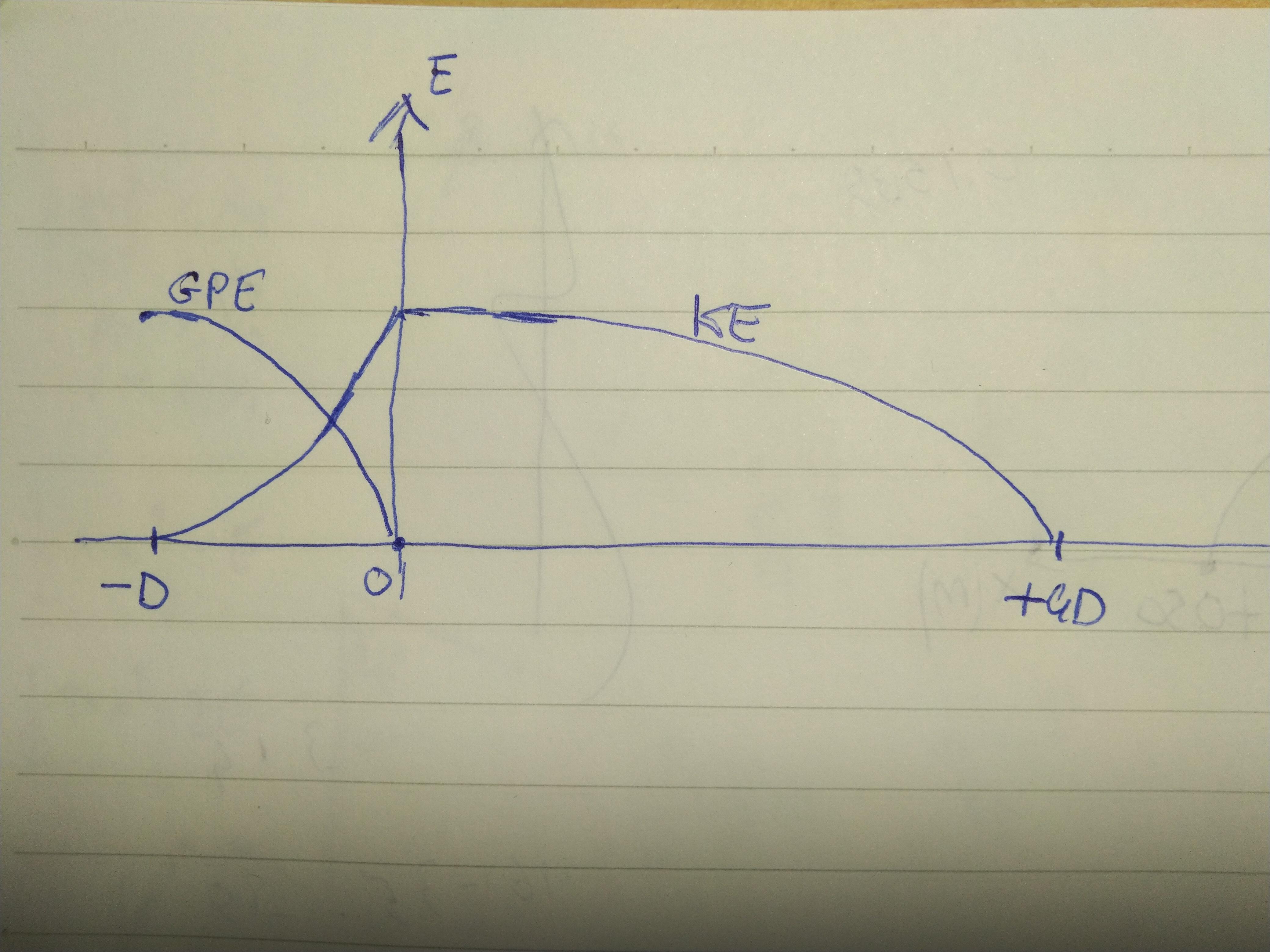
a) i) See graph in attachment
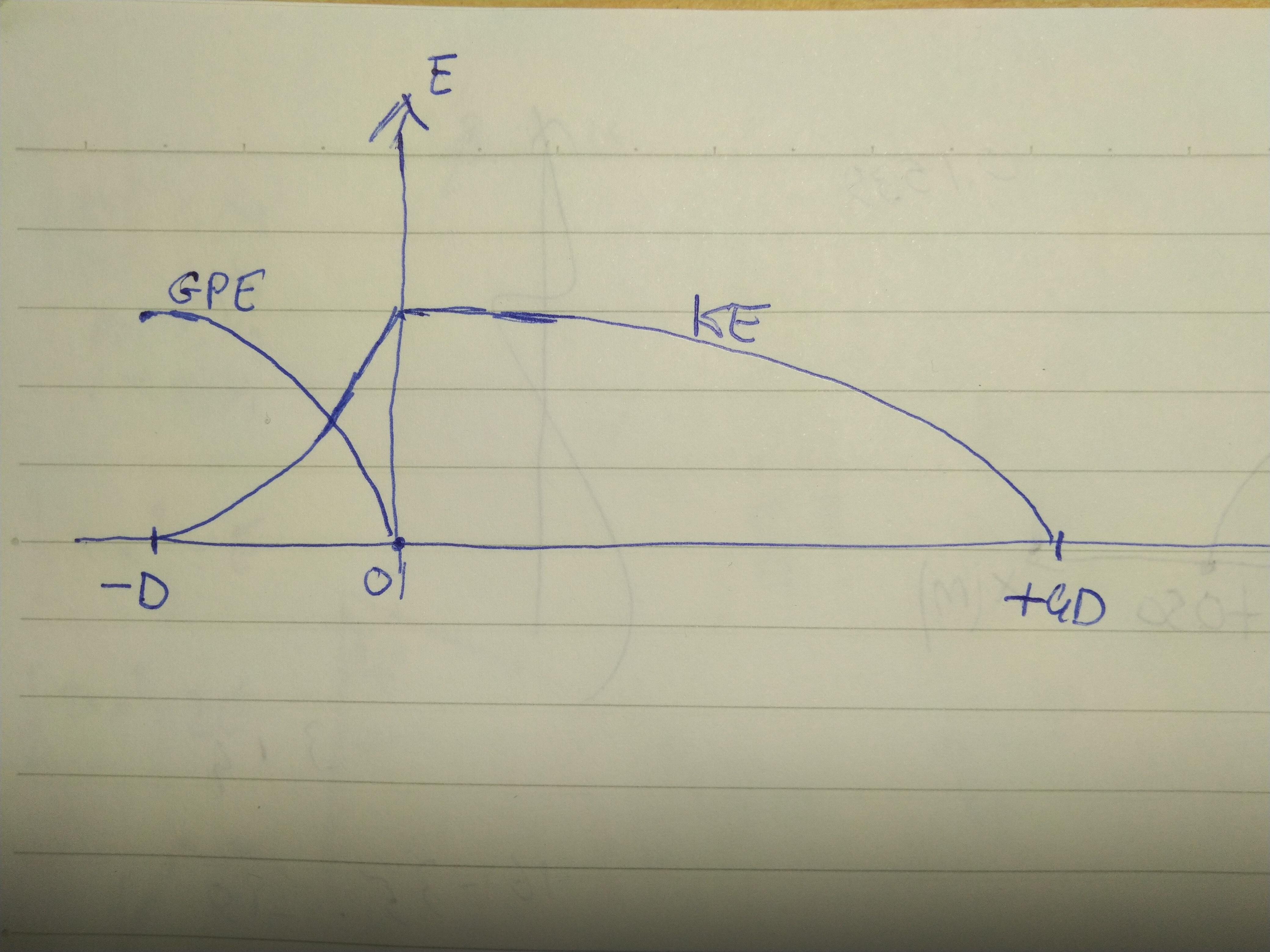
ii) See graph in attachment.
b) i) All of them
ii) none
c) 
d) See explanation below
Explanation:
a)
Find in attachment the graph showing the kinetic energy and the potential energy versus the position, x.
i)
Between x = -D and x = 0, the block is sliding down along the ramp. The kinetic energy of the block at any time is given by:

where
m is the mass of the block
v is its speed
At the beginning, the block's kinetic energy is zero, because the speed is initially zero: since v = 0, KE = 0.
As the block slides down, the kinetic energy increases, because the speed of the block increases; at x = 0 (end of the ramp), all the initial energy has been converted into kinetic energy, which is now maximum.
Then, the block slides along the flat, rough surface; as friction does (negative) work on the block, the speed of the block decreases, and so also its kinetic energy decreases, becoming zero when x = +4D (when the block comes to a stop).
ii)
The potential energy of the block is given by:

where
m is the mass of the block
g is the acceleration due to gravity
h is the height of the block above the ground
At the beginning (x = -D) the potential energy is maximum since the block is at maximum height.
When the block slides down (between -D and 0), the height h decreases, therefore the potential energy decreases as well, until reaching 0 when x = 0 (end of the ramp).
After x = 0, the block slides along the rough surface; however, its potential energy here no longer changes, as the height h dors not change (the surface is horizontal).
b)
Here, the block is released from the top of a new ramp, which has a base length of 2D (instead of D) but same angle as before: therefore, the initial height of the ramp is twice that in part a). This also means that the initial (potential) energy of the block in this case is twice the GPE of part a):

As a result, when the block reaches the end of the ramp at x = 0, it will have twice the kinetic energy it had before:

The stopping distance of an object moving with accelerated motion is proportional to its initial kinetic energy:

Therefore, this means that here the stopping distance of the block will be twice that of part a (which was 4D), so the block will stop at x = +8D.
So, all aspects of the student's reasoning are correct.
c)
Let's call  the initial total energy of the block at the top of the ramp.
In situation a), the initial total energy is

where  is the height of the ramp.
And so the kinetic energy at the bottom of the ramp is

We can rewrite the kinetic energy so that

For an accelerated motion, the stopping distance can be found using the equation

where
 is the final speed of the block
 is the acceleration due to friction
So we find
 (1)
(1)
In situation b), the initial height of the block is

So the final stopping distance becomes (1)
d)
We can see that the formula derived in part c) depends only on:
- The initial height of the ramp, which is  in part a) and
  in part b)
- The coefficient of friction in the rough part, 
- The angle of the ramp, which remains the same in the two cases
Therefore, all the correct aspects identified by the student in his reasoning are found in the fact that the final stopping distance is proportional to the initial energy of the block, which is proportional to initial height of the block, and since this is twice in part b) compared to part a), therefore the stopping distance is also twice in part b).