answer.
Ask question
Login Signup
Ask question
All categories
  • English
  • Mathematics
  • Social Studies
  • Business
  • History
  • Health
  • Geography
  • Biology
  • Physics
  • Chemistry
  • Computers and Technology
  • Arts
  • World Languages
  • Spanish
  • French
  • German
  • Advanced Placement (AP)
  • SAT
  • Medicine
  • Law
  • Engineering
Mila [183]
2 years ago
13

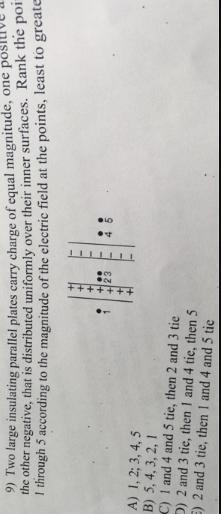
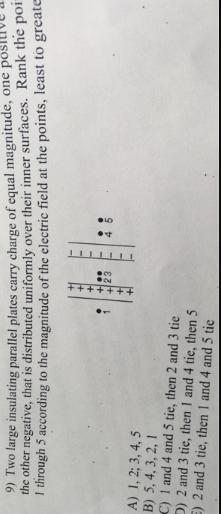
Two large insulating parallel plates carry charge of equal magnitude, one positive and the other negative, that is distributed u

niformly over their inner surfaces. Rank the points 1 through 5 according to the magnitude of the electric field at the points, least to greatest.
A. 1, 2, 3, 4, 5
B. 2, then 1, 3, and 4 tied, then 5
C. 1, 4, and 5 tie, then 2 and 3 tie
D. 2 and 3 tie, then 1 and 4 tie, then 5
E. 2 and 3 tie, then 1, 4, and 5 tie

Physics
1 answer:
noname [10]2 years ago
7 0

Answer:

The correct answer is C 1, 4, and 5 tie, then 2 and 3 tie

Explanation:

Solution

The electric field due to sheets E₁ positive =б/2E₀

E₂ is negative = б/2E₀

Now,

At the point 1, 4, 5 the electric field due to the sheets are in the opposite direction

At the point 1, the net field = -E₁ + E₂ =0

At the point A, the net field = -E₁ - E₂ = 0

Now,

At nay point inside between them, the electric field is seen to be at the same direction.

At the 2, 3 points the field is seen at the right

Thus,

E net = E₁ + E₂

= б/2E₀ + σ/2E₀

=б/E₀

Note: Kindly find an attached copy of the complete question to the solution

You might be interested in
Two blocks, with masses m and 3m, are attached to the ends of a string with negligible mass that passes over a pulley, as shown
olasank [31]

Answer:

a)  v = √ g x , b)  W = 2 m g d , c)    a = ½ g

Explanation:

a) For this exercise we use Newton's second law, suppose that the block of mass m moves up

            T-W₁ = m a

            W₃ - T = M a

            w₃ - w₁ = (m + M) a

            a = (3m - m) / (m + 3m) g

            a = 2/4 g

            a = ½ g

the speed of the blocks is

          v² = v₀² + 2 ½ g x

          v = √ g x

b) Work is a scalar, therefore an additive quantity

light block s

           W₁ = -W d = - mg d

3m heavy block


            W₂ = W d = 3m g d

the total work is

             W = W₁ + W₂

             W = 2 m g d

c) in the center of mass all external forces are applied, they relate it is

                      a = ½ g

8 0
2 years ago
Read 2 more answers
Two separate but nearby coils are mounted along the same axis. A power supply controls the flow of current in the first coil, an
gulaghasi [49]

Complete Question

The complete question is shown on the first uploaded image

Answer:

  The correct answer is option c

Explanation:

Faraday states that when there is a change in magnetic field of a coil of a wire, it means that there exist an emf in the circuit which in induced due to the change in the magnetic flux

From the question  two separate but nearby coils are mounted along the axis. First coil is connected to the power supply and the current flow is controlled by the supply.When the current alternates, it would produce magnetic field ,also the second coil is connected to an ammeter which indicates the current that is flowing in it when current in the first coil changes

This magnetic field that is produce would cause a change flux which would induce current in the second coil so the ammeter would indicate current flow in the second coil

a is incorrect because the current in fir coil is not change hence flux won't change therefore current is is not induced in second coil

This is the same reason b is incorrect

d is incorrect due to the fact that when the second coil is connected to a power supply by rewiring it to be in series with first coil the law of electromagnetism would no longer hold so he ammeter would show no reading  

6 0
2 years ago
A solenoid with 3,000.0 turns is 70.0 cm long. If its self-inductance is 25.0 mH, what is its radius? (The value of μ0 is 4π x 1
nevsk [136]

Answer:

A. 2.2*10^-2m

Explanation:

Using

Area = length x L/ uo xN²

So A = 0.7m * 25 x 10^-3H /( 4π x10^-7*

3000²)

A = 17.5*10^-3/ 1.13*10^-5

= 15.5*10^-2m²

Area= π r ²

15.5E-2/3.142 = r²

2.2*10^2m

Explanation:

5 0
2 years ago
ASK YOUR TEACHER A 2.0-kg mass swings at the end of a light string with the length of 3.0 m. Its speed at the lowest point on it
Nadya [2.5K]

Answer:

  K_b = 78 J

Explanation:

For this exercise we can use the conservation of energy relations

starting point. Lowest of the trajectory

        Em₀ = K = ½ mv²

final point. When it is at tea = 50º

        Em_f = K + U

        Em_f = ½ m v_b² + m g h

where h is the height from the lowest point

        h = L - L cos 50

        Em_f = ½ m v_b² + mg L (1 - cos50)

energy be conserve

        Em₀ = Em_f

         ½ mv² = ½ m v_b² + mg L (1 - cos50)

         K_b = ½ m v_b² + mg L (1 - cos50)

let's calculate

          K_b = ½ 2.0 6.0² + 2.0 9.8 6.0 (1 - cos50)

          K_b = 36 +42.0

          K_b = 78 J

4 0
2 years ago
Two stunt drivers drive directly toward each other. At time t=0 the two cars are a distance D apart, car 1 is at rest, and car 2
lesantik [10]

Answer: Hello there!

We know this:

The distance between the cars at t= 0 is D.

car 2 has an initial velocity of v0 and no acceleration.

car 1 has no initial velocity and a acceleration of ax that starts at  t = 0

then we could obtain the acceleration of the car 1 by integrating the acceleration over the time; this is v(t) = ax*t where there is not a constant of integration because the car 1 has no initial velocity.

Because the cars are moving against each other, we want to se at what time t they meet, this is equivalent to see:  

position of car 1 + position of car 2 = D

and in this way we could ignore constants of integration :D

for the position of each car we integrate again:  

P1(t) = (1/2)ax*t^2 and P2(t) = v0t

v0t + (1/2)ax*t^2 = D

v0t + (1/2)ax*t^2  - D = 0

now we can solve it for t using the Bhaskara equation.

t = \frac{-v0 +\sqrt{v0^{2} + 4*(1/2)ax*D } }{2(1/2)ax} =\frac{-v0 +\sqrt{v0^{2} + 2ax*D } }{ax}

that we cant solve witout knowing the values for v0, D and ax. But you could replace them in that equation and obtain the time, where you must remember that you need to choose the positive solution (because this quadratic equation has two solutions).

Now we want to know the velocity of car 1 just before the impact, this can be calculated by valuating the time in the as the time that we just found in the velocity equation for the car 1, this is:

v(\frac{-v0 +\sqrt{v0^{2} + 2ax*D } }{ax}) = ax*\frac{-v0 +\sqrt{v0^{2} + 2ax*D } }{ax} = {-v0 +\sqrt{v0^{2} + 2ax*D }

where again, you need to replace the values of v0, D and ax.
7 0
2 years ago
Other questions:
  • An object is thrown horizontally off a cliff with an initial velocity of 5.0 meters per second. the object strikes the ground 3
    9·2 answers
  • A metal ball with diameter of a half a centimeter and hanging from an insulating thread is charged up with 1010 excess electrons
    10·1 answer
  • Consider a box sitting in the back of a pickup. The pickup accelerates to the right, and because the bed of the pickup is sticky
    8·2 answers
  • You have a pumpkin of mass m and radius r. the pumpkin has the shape of a sphere, but it is not uniform inside so you do not kno
    8·1 answer
  • The voltage across the terminals of a 9.0 v battery is 8.5 v when the battery is connected to a 60 ω load. part a what is the ba
    11·2 answers
  • If 500 J of energy were added to 1 kg of each of these samples, which would experience the LEAST temperature increase? aluminum,
    6·2 answers
  • (Another tomato/skyscraper problem.) You are looking out your window in a skyscraper, and again your window is at a height of 45
    6·1 answer
  • Which situation would create a field like the one shown here? A. an interaction between two magnetic south poles B. an interacti
    5·2 answers
  • A11) A solenoid of length 18 cm consists of closely spaced coils of wire wrapped tightly around a wooden core. The magnetic fiel
    5·1 answer
  • In an adiabatic process oxygen gas in a container is compressed along a path that can be described by the following pressure p,
    9·1 answer
Add answer
Login
Not registered? Fast signup
Signup
Login Signup
Ask question!