answer.
Ask question
Login Signup
Ask question
All categories
  • English
  • Mathematics
  • Social Studies
  • Business
  • History
  • Health
  • Geography
  • Biology
  • Physics
  • Chemistry
  • Computers and Technology
  • Arts
  • World Languages
  • Spanish
  • French
  • German
  • Advanced Placement (AP)
  • SAT
  • Medicine
  • Law
  • Engineering
guajiro [1.7K]
2 years ago
3

An athlete needs to get across a river. She must reach from point A on one bank to point B, which is directly across from point

A on the opposite bank. If she wishes to minimize the total time T it would take to do so, at what angle upstreams (measured from the line AB) should she swim? Let her swimming/rowing speed relative to the water be 2.0 mi/h, and her running speed along the bank be 5 mi/h. The river flows downstream at 1.5 mi/h. (The rule of the competition stipulates that the athletes must swim first from point A, then run to reach point B.)

Physics
1 answer:
Amanda [17]2 years ago
3 0

Answer:

θ = 90°

Explanation:

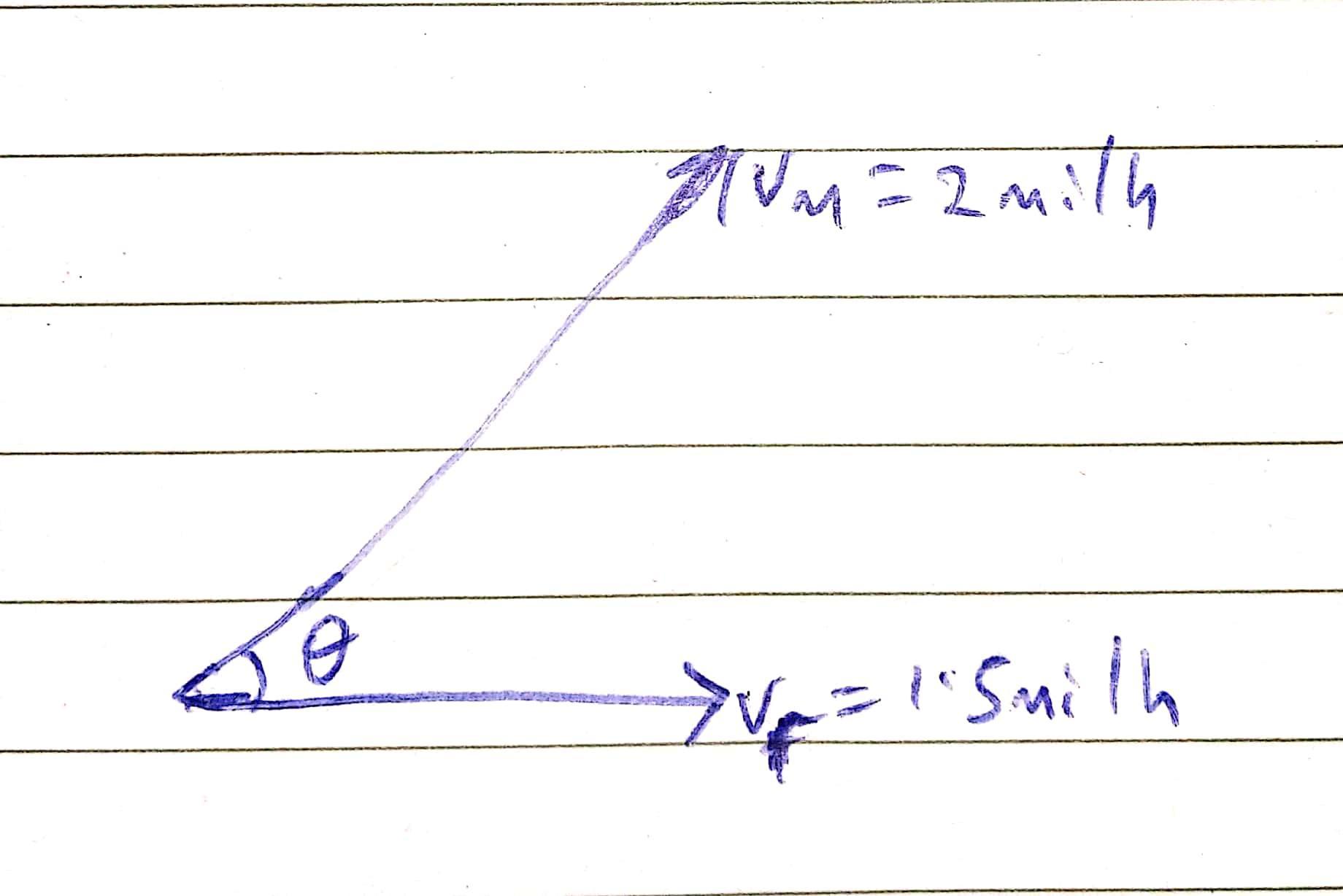
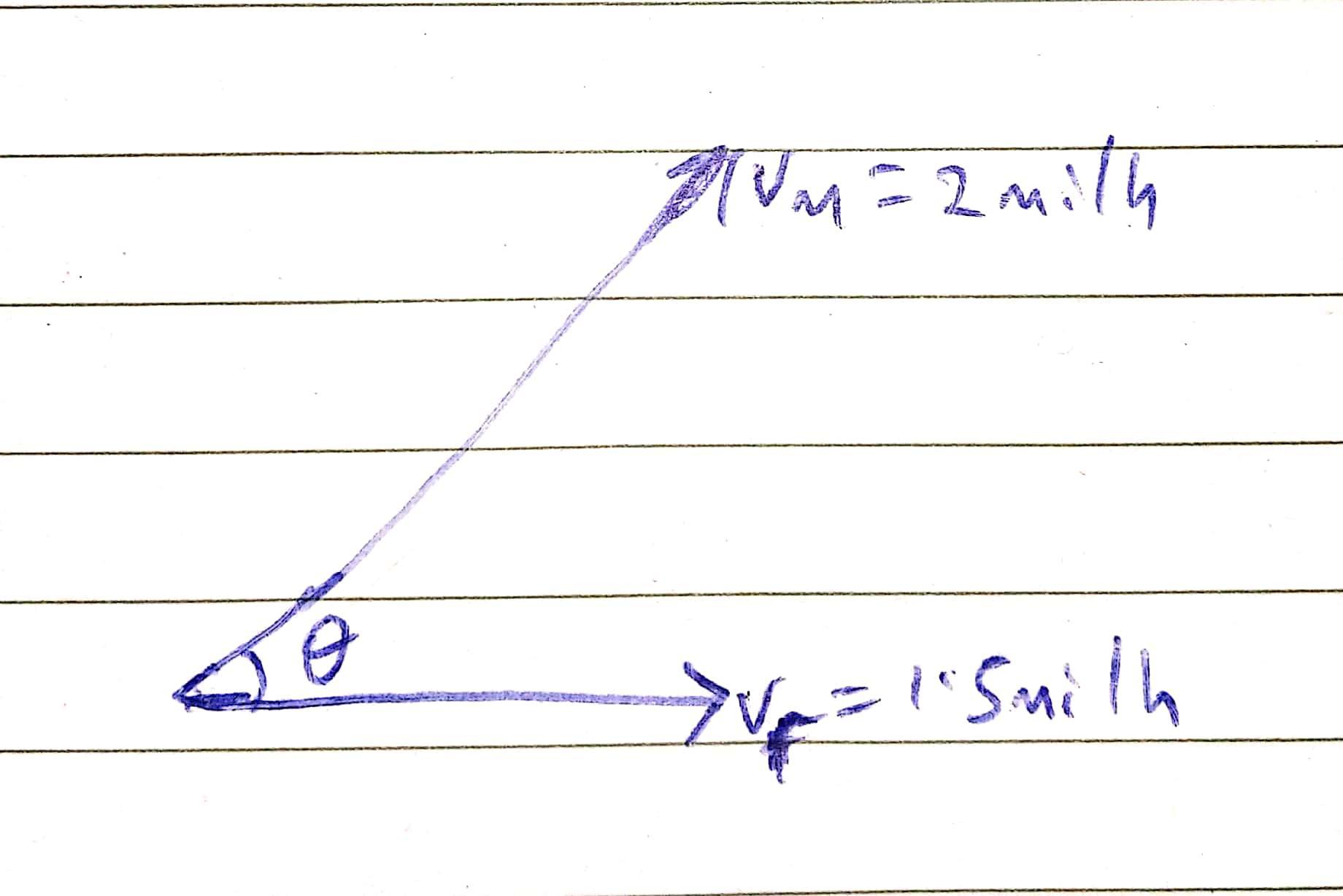
Speed at which she can swim in stationary water; v_m = 2 mi/h

Speed at which the river is flowing downstream; v_r = 1.5 mi/h

This can be illustrated in a form of triangle as attached. Where θ is the angle to the x-axis.

With respect to the bank of the river, the total speed of the girl is;

V_R = v_r + v_m

Now the horizontal component is;

V_R = v_r + v_m(cos θ)

While the vertical component is;

V_R = v_m(sin θ)

Now, the total time taken to get across the river is;

T = width of river/vertical component of total speed

Let's denote width of river as d.

Thus;

T = d/(v_m(sin θ))

Now, we are told she wishes o minimize the total time(T) .

Since the width(d) of the river is constant, and v_m is fixed, then it means the only variable we have is the angle θ.

Now, for the total time to be minimized, the denominator has to be at maximum.

Since angle θ is the only one that is variable, we have to find the value of angle θ that will make sin θ to be at a maximum value.

Now, for sin θ to be maximum, it means it has to be equal to 1.

Thus, θ = sin^(-1) 1

θ = 90°

You might be interested in
A baseball catcher puts on an exhibition by catching a 0.15-kg ball dropped from a helicopter at a height of 101 m. What is the
yaroslaw [1]

Answer:

The speed of the ball 1.0 m above the ground is 44 m/s (Answer A).

Explanation:

Hi there!

To solve this problem, let´s use the law of conservation of energy. Since there is no air resistance, the only energies that we should consider is the gravitational potential energy and the kinetic energy. Because of the conservation of energy, the loss of potential energy of the ball must be compensated by a gain in kinetic energy.

In this case, the potential energy is being converted into kinetic energy as the ball falls (this is only true when there are no dissipative forces, like air resistance, acting on the ball). Then, the loss of potential energy (PE) is equal to the increase in kinetic energy (KE):

We can express this mathematically as follows:

-ΔPE = ΔKE

-(final PE - initial PE) = final KE - initial KE

The equation of potential energy is the following:

PE = m · g · h

Where:

PE = potential energy.

m = mass of the ball.

g = acceleration due to gravity.

h = height.

The equation of kinetic energy is the following:

KE = 1/2 · m · v²

Where:

KE = kinetic energy.

m = mass of the ball.

v = velocity.

Then:

-(final PE - initial PE) = final KE - initial KE          

-(m · g · hf - m · g · hi) = 1/2 · m · v² - 0     (initial KE = 0 because the ball starts from rest)  (hf = final height, hi = initial height)

- m · g (hf - hi) = 1/2 · m · v²

2g (hi - hf) = v²

√(2g (hi - hf)) = v

Replacing with the given data:

√(2 · 9.8 m/s²(101 m - 1.0 m)) = v

v = 44 m/s

The speed of the ball 1.0 m above the ground is 44 m/s.
3 0
2 years ago
(PLEASE HELP) Identify the following as electromagnetic (E) or mechanical (M) waves.
fomenos
Sound waves (m)

water waves (m)

radio waves (e)

ultraviolet (e)

waves in a wheat field (m)
3 0
2 years ago
Read 2 more answers
As shown in the figure below, Justin walks from the house to his truck on a windy day. He walks 20 m toward
juin [17]

Complete Question

The complete question is shown on the first uploaded image

Answer:

The velocity is   v =0.333 \  m/s in positive x -direction

The speed is s = 0.733 \ m/s

Explanation:

From the question we are told that

The distance from the house to truck is  D =  20 m

  The distance traveled back to retrieve  wind-blown hat is  d =  15

  The distance from the wind-blown hat position too the truck is  k =  20  m

  The total time taken is  t  =  75 s

Generally when calculating the displacement the Justin's backward movement to collect his wind - blown hat is taken as negative

Generally Justin's displacement is mathematically represented as

      L  =  20 - 15 + 20

=>    L  =  25 \ m

Generally the average velocity is mathematically represented as

          v  =  \frac{L}{t}

=>      v = \frac{25}{75}

=>      v =0.333 \  m/s

Generally the distance covered by Justin is mathematically represented as  

         R =  D+ d + k

=>      R =  20 + 15 +20

=>     R =  55 \  m

Generally Justin's average speed over a 75 s period is mathematically represented as

            s = \frac{R}{ t}

=>         s = \frac{55}{ 75}

=>        s = 0.733 \ m/s

8 0
2 years ago
If a scale on Earth reads 650 N, what is your mass?
OlgaM077 [116]
If the scale reads 650N, then the mass of whoever it is standing on the scale is

         (weight) / (gravity)  =  (650N) / (9.8 m/s²)  =  66.3 kilograms  .

It's not MY mass, even if I'm the one standing on the scale. 
If I stand on a scale and it reads 650 N, the scale is broken.
4 0
2 years ago
You place a 500 g block of an unknown substance in an insulated container filled 2 kg of water. The block has an initial tempera
Nina [5.8K]

Answer:

3349J/kgC

Explanation:

Questions like these are properly handled having this fact in mind;

  • Heat loss = Heat gained

Quantity of heat = mcΔ∅

m = mass of subatance

c = specific heat capacity

Δ∅ = change in temperature

m₁c₁(∅₂-∅₁) = m₂c₂(∅₁-∅₃)

m₁ = mass of block = 500g = 0.5kg

c₁  = specific heat capacity of unknown substance

∅₂ = block initial temperature = 50oC

∅₁ = equilibrium temperature of block and water after mix= 25oC

m₂= mass of water = 2kg

c₂ = specific heat capacity of water = 4186J/kg C

∅₃ = intial temperature of water = 20oC

0.5c₁(50-25) = 2 x 4186(25-20)

And we can find c₁ which is the unknown specific heat capacity

c₁ = \frac{2*4186*5}{0.5*25}= 3348.8J/kg C≅ 3349J/kg C

4 0
2 years ago
Other questions:
  • In the Atwood machine shown below, m1 = 2.00 kg and m2 = 6.05 kg. The masses of the pulley and string are negligible by comparis
    6·1 answer
  • Select all that apply. Greenhouse gases _____. absorb solar energy absorb carbon dioxide release carbon dioxide are released dur
    7·1 answer
  • If the 80 ohm resistor fails, will the 50 ohm and 100 ohm resistor continue to operate? Why or why not?
    5·1 answer
  • The Bernoulli equation is valid for steady, inviscid, incompressible flows with a constant acceleration of gravity. Consider flo
    10·1 answer
  • A 2200 kg truck has put its front bumper against the rear bumper of a 2400 kg SUV to give it a push. With the engine at full pow
    6·1 answer
  • Seat belts and air bags save lives by reducing the forces exerted on the driver and passengers in an automobile collision. Cars
    14·1 answer
  • The wheel having a mass of 100 kg and a radius of gyration about the z axis of kz=300mm, rests on the smooth horizontal plane.a.
    11·1 answer
  • For nitrogen feel like with its temperature must be within 12.78 Fahrenheit of -333.22 Fahrenheit which equation can be used to
    7·2 answers
  • 1. Do alto de uma plataforma com 15m de altura, é lançado horizontalmente um projéctil. Pretende-se atingir um alvo localizado n
    9·1 answer
  • Ariel dropped a golf ball from her second story window. The ball starts from rest and hits the sidewalk 3.5 s later with a veloc
    14·1 answer
Add answer
Login
Not registered? Fast signup
Signup
Login Signup
Ask question!