answer.
Ask question
Login Signup
Ask question
All categories
  • English
  • Mathematics
  • Social Studies
  • Business
  • History
  • Health
  • Geography
  • Biology
  • Physics
  • Chemistry
  • Computers and Technology
  • Arts
  • World Languages
  • Spanish
  • French
  • German
  • Advanced Placement (AP)
  • SAT
  • Medicine
  • Law
  • Engineering
AfilCa [17]
1 year ago
7

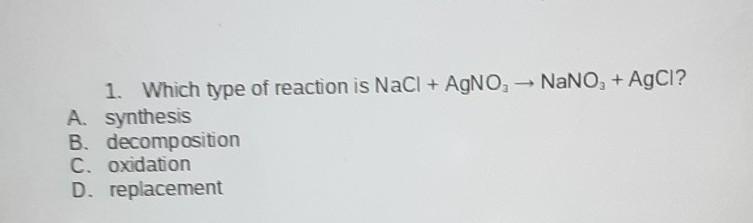
I dont get it, what am i supposed to do?​

Chemistry
1 answer:
anygoal [31]1 year ago
4 0

Answer:

It appears to be

<h2><u>replacement</u></h2>

Explanation:

I did that question.

You might be interested in
A sample of an unknown compound was decomposed and found to be composed of 1.36 mol oxygen, 4.10 mol hydrogen, and 2.05 mol carb
Flura [38]

Answer:

C3H6O2

Explanation:

To find the empirical formula of the compound, we divide the amount in moles of each of the elements by the amount in mole of the element with the smallest number of mole. In this question, the element with the smallest number of moles is oxygen with 1.36 mole. Hence, we divide the number of moles of each element by this.

H = 4.10/1.36 = 3

O = 1.36/1.36 = 1

C = 2.05/1.36 = 1.5

We then multiply through by 2 to yield the compound with the empirical formula C3H6O2

7 0
2 years ago
What mass of solid NaOH (97.0 % by mass) is required to prepare 1.00 L of a 10.0% solution of NaOH by mass? The density of the 1
Lelechka [254]

<u>Answer:</u> The mass of 97 % of NaOH solution required is 114.33 g

<u>Explanation:</u>

To calculate mass of a substance, we use the equation:

\text{Density of substance}=\frac{\text{Mass of substance}}{\text{Volume of substance}}

We are given:

Density of 10 % solution = 1.109 g/mL

Volume of 10% solution = 1 L = 1000 mL     (Conversion factor:  1 L = 1000 mL)

Putting values in above equation, we get:

1.109g/mL=\frac{\text{Mass of }10\%\text{ solution}}{1000mL}\\\\\text{Mass of }10\%\text{ solution}=1109g

The mass of 10 % solution is 1109 g.

To calculate the mass of concentrated solution, we use the equation:

c_1m_1=c_2m_2

where,

c_1\text{ and }m_1 are the concentration and mass of concentrated solution.

c_2\text{ and }m_2 are the concentration and mass of diluted solution.

We are given:

c_1=97\%\\m_1=?g\\c_2=10\%\\m_2=1109g

Putting values in above equation, we get:

97\times m_1=10\times 1109\\\\m_1=114.33g

Hence, the mass of 97 % of NaOH solution required is 114.33 g

3 0
2 years ago
What is the total number of sp2-hybridized carbon atoms present in the fluorophore used in the experiments
Mandarinka [93]

Answer:

9

Explanation:

The structure of fluorophore used in the experiments has been drawn in the attachment. And from the drawing counting we can say that there are 9 sp2-hybridized carbon atoms present. Fiuorophores are a fluorescent chemical compound that can re-emit light upon light excitation. Normally used to produce absorbance and emission spectra.

3 0
2 years ago
If the mass percentage composition of a compound is 72.1% Mn and 27.9% O, its empirical formula is
mojhsa [17]

Answer:

MnO- Manganese Oxide

Explanation:

Empirical formula: This is the formula that shows the ratio of elements

present in a  

compound.


How to determine Empirical formula

1. First arrange the symbols of the elements present in the compound

alphabetically to  determine the real empirical formula. Although, there

are exceptions to this rule, E.g H2So4

2. Divide the percentage composition by the mass number.

3. Then divide through by the smallest number.

4. The resulting answer is the ratio attached to the elements present in

a compound.


                                                                              Mn                         O    


% composition                                                      72.1                      27.9    


Divide by mass number                                       54.94                     16  


                                                                               1.31                      1.74    


Divide by the smallest number                         1.31                      1.31                          

                                                                               1                    1.3


The resulting ratio is 1:1


Hence the Empirical formula is MnO, Manganese oxide

8 0
2 years ago
What is most likely the ph of a solution containing many hydroxide ions (oh-) and few hydrogen ions (h )?
SIZIF [17.4K]
PH of solution will be greater than seven (pH>7), that means that solution is basic (<span>pH above </span>7<span> is a base, the higher the number, the stronger is the base).
</span>pH (potential of hydrogenis) is a measure of the hydrogen ion (H⁺) concentration of a solution. <span>Solutions with a pH less than 7 are acidic.</span>
5 0
2 years ago
Other questions:
  • Which material has a crystalline structure at room temperature ( 20 degrees Celsius )
    6·2 answers
  • Material A has a small latent heat of fusion. Material B has a large heat of fusion. Which of the following statements is true?
    7·2 answers
  • The electron dot structure for CI is
    7·2 answers
  • James was in an automobile accident in which he suffered a severely broken nose when his head hit the dashboard. Months later, h
    10·2 answers
  • Determine the volume of hexane that contains 5.33 × 10²² molecules of hexane. The density of hexane is 0.6548 g/ml and its molar
    10·1 answer
  • One of the substances that give wet goats and dirty gym socks their characteristic odors is hexanoic acid, CH3CH2CH2CH2CH2CO2H,
    13·1 answer
  • When 70. milliliter of 3.0-molar Na2CO3 is added to 30. milliliters of 1.0-molar NaHCO3 the result­ing concentration of Na+ is 2
    9·1 answer
  • For this question, the "entropy term" refers to "-TΔS". Addition reactions are generally favorable at low temperatures because _
    6·1 answer
  • Write an equation that shows the formation of a strontium ion from a neutral strontium atom
    10·1 answer
  • To calculate the relative age of rocks, geologists use the rate of radioactive decay of isotopes present in their samples. What
    6·1 answer
Add answer
Login
Not registered? Fast signup
Signup
Login Signup
Ask question!
