answer.
Ask question
Login Signup
Ask question
All categories
  • English
  • Mathematics
  • Social Studies
  • Business
  • History
  • Health
  • Geography
  • Biology
  • Physics
  • Chemistry
  • Computers and Technology
  • Arts
  • World Languages
  • Spanish
  • French
  • German
  • Advanced Placement (AP)
  • SAT
  • Medicine
  • Law
  • Engineering
NeTakaya
1 year ago
3

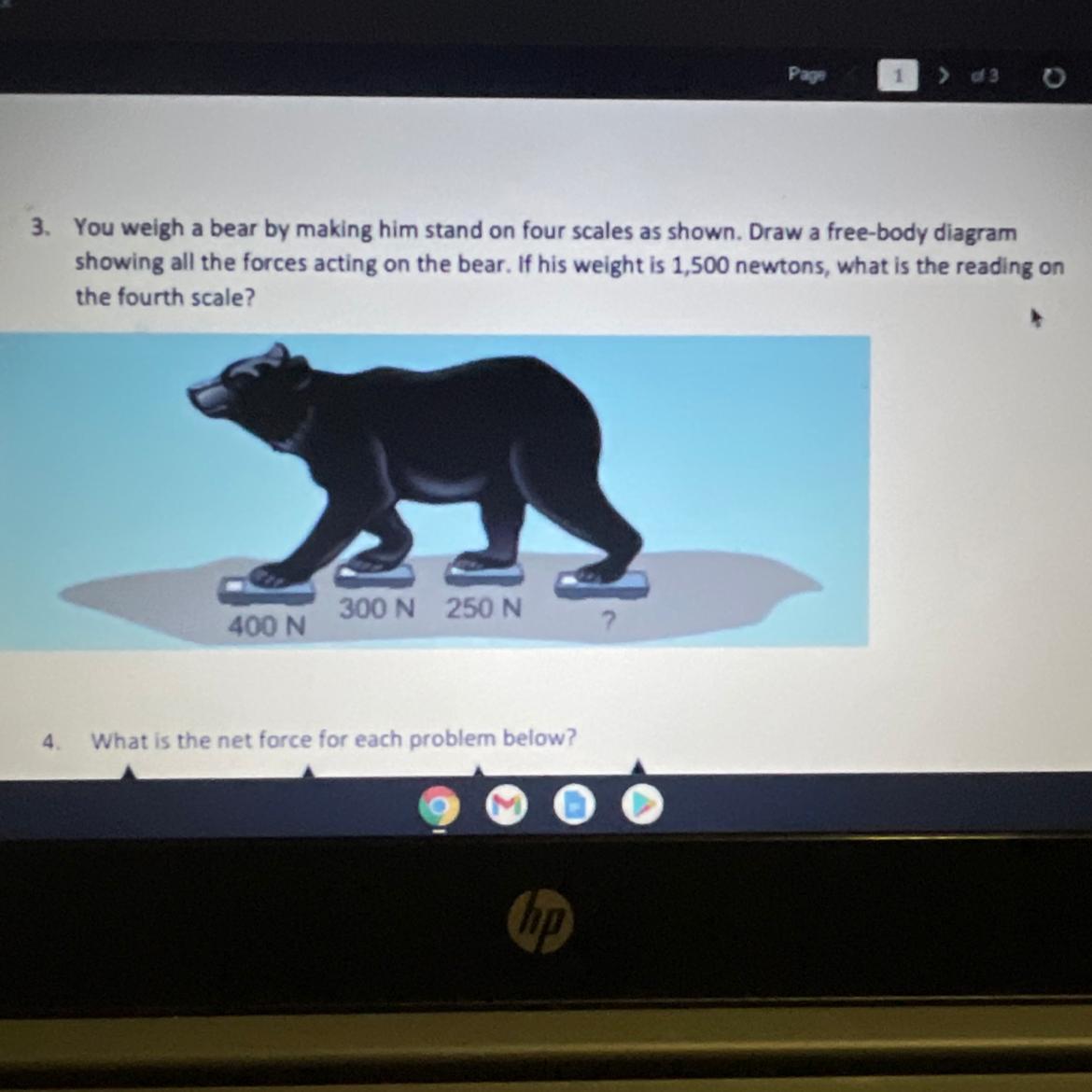
You weigh a bear by making him stand on four scales as shown. Draw a free-body diagram showing all the forces acting on the bear

. If his weight is 1,500 newtons, what is the reading on
the fourth scale?

Physics
1 answer:
denpristay [2]1 year ago
7 0

Answer:

what a fat bear I love physics

You might be interested in
A 6.0-cm-diameter, 11-cm-long cylinder contains 100 mg of oxygen (O2) at a pressure less than 1 atm. The cap on one end of the c
butalik [34]

Answer:

The temperature of the gas is 1197.02 K

Explanation:

From ideal gas law;

PV = nRT

Where;

P is the pressure of the gas

V is the volume of the gas

R is ideal gas constant = 8.314 L.kPa/mol.K

T is the temperature of the gas

n is the number of moles of gas

Volume of the gas in the cylindrical container = πr²h

Given;

r = 6/2 = 3 cm = 0.03 m

h = 11 cm = 0.11 m

V = π × (0.03)² × 0.11 = 3.11 × 10⁻⁴ m³ = 0.311 L

number of moles of oxygen gas = Reacting mass / molar mass

=\frac{0.1}{32} = 0.003125, moles

T = \frac{PV}{nR} = \frac{100X0.311}{0.003125X8.314} =1197.02K

Therefore, the temperature of the gas is 1197.02 K

6 0
2 years ago
Newton's law of cooling states that the temperature of an object changes at a rate proportional to the difference between its te
QveST [7]

Answer:

Please see attachment

Explanation:

Please see attachment

8 0
2 years ago
When jumping, a flea reaches a takeoff speed of 1.0 m/s over a distance of 0.47 mm .What is the flea's acceleration during the j
garri49 [273]
We can use kinematics here if we assume a constant acceleration (not realistic, but they want a single value answer, so it's implied). We know final velocity, vf, is 1.0 m/s, and we cover a distance, d, of 0.47mm or 0.00047 m (1m = 1000mm for conversion). We also can assume that the flea's initial velocity, vi, is 0 at the beginning of its jump. Using the equation vf^2 = vi^2 + 2ad, we can solve for our acceleration, a. Like so: a = (vf^2 - vi^2)/2d = (1.0^2 - 0^2)/(2*0.00047) = 1,064 m/s^2, not bad for a flea!
8 0
2 years ago
Read 2 more answers
Consider a boat heading due east at 15 miles/hour. The water's current is moving at 7.1 miles/hour at 45º south of east. Drag ve
givi [52]

If a boat is going East at 15mph and there is a water current going southeast at 45° then the boat is being drifted southward.  So since the current is going at an angle then it has a x and y component.  So Rx refers to the x-component force of the current and Ry refers to the y-component of the current, and |R| refers to the magnitude of these forces.

7 0
2 years ago
Read 2 more answers
(a) A 15.0 kg block is released from rest at point A in the figure below. The track is frictionless except for the portion betwe
castortr0y [4]

Answer:

(a) coefficient of friction = 0.451

This was calculated by the application of energy conservation principle (the total sum of energy in a closed system is conserved)

(b) No, it comes to a stop 5.35m short of point B. This is so because the spring on expanding only does a work of 43 J on the block which is not enough to meet up the workdone of 398 J against friction.

Explanation:

The detailed step by step solution to this problems can be found in the attachment below. The solution for part (a) was divided into two: the motion of the body from point A to point B and from point B to point C. The total energy in the system is gotten from the initial gravitational potential energy. This energy becomes transformed into the work done against friction and the work done in compression the spring. A work of 398J was done in overcoming friction over a distance of 6.00m. The energy used in doing so is lost as friction is not a conservative force. This leaves only 43J of energy which compresses the spring. On expansion the spring does a work of 43J back on the block is only enough to push it over a distance of 0.65m stopping short of 5.35m from point B.

Thank you for reading and I hope this is helpful to you.
4 0
2 years ago
Other questions:
  • A boy is exerting a force of 70 N at a 50-degree angle on a lawn mower. He is accelerating at 1.8 m/s2. Round the answers to the
    6·2 answers
  • What is the sources of error and suggestion on how to overcome it in the hooke's law experiment?
    15·1 answer
  • A geologist is studying the shore along a river. She finds a pile of rocks at the base of a riverbank. These broken rock pieces
    14·2 answers
  • Urban cities like Atlanta have to contend with a serious problem like pollution. Drivers in California are testing out a car tha
    7·1 answer
  • When two resistors are wired in series with a 12 V battery, the current through the battery is 0.33 A. When they are wired in pa
    5·1 answer
  • A ladder placed up against a wall is sliding down. The distance between the top of the ladder and the foot of the wall is decrea
    6·1 answer
  • A machine is currently set to a feed rate of 5.921 inches per minute (IPM). Te machinist changes this setting to 6.088 IPM. By h
    9·2 answers
  • An airplane flying parallel to the ground undergoes two consecutive dis- placements. The first is 75 km 30.0° west of north, and
    9·1 answer
  • When Brett and Will ride the​ carousel, Brett always selects a horse on the outside​ row, whereas Will prefers the row closest t
    7·1 answer
  • What is the direction of the magnetic field b⃗ net at point a? Recall that the currents in the two wires have equal magnitudes.
    5·1 answer
Add answer
Login
Not registered? Fast signup
Signup
Login Signup
Ask question!
