answer.
Ask question
Login Signup
Ask question
All categories
  • English
  • Mathematics
  • Social Studies
  • Business
  • History
  • Health
  • Geography
  • Biology
  • Physics
  • Chemistry
  • Computers and Technology
  • Arts
  • World Languages
  • Spanish
  • French
  • German
  • Advanced Placement (AP)
  • SAT
  • Medicine
  • Law
  • Engineering
arlik [135]
2 years ago
6

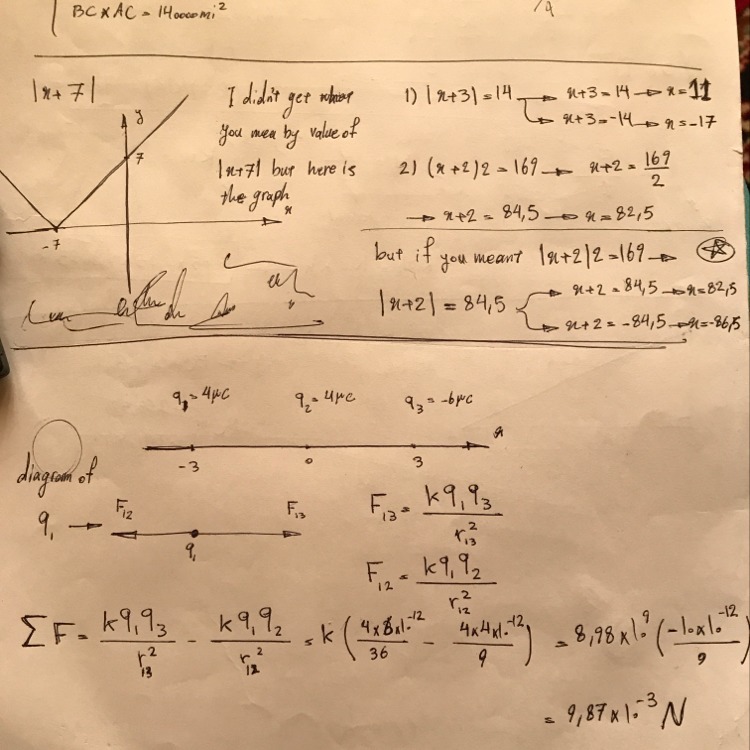
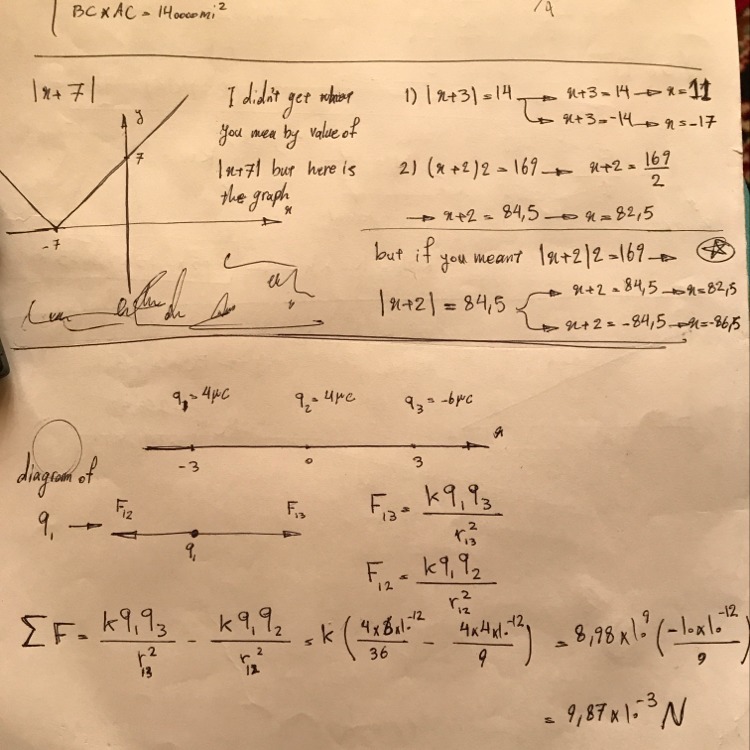
Three point charges are on the x-axis; q1 = 4.0 μc is at x = -3.0 m, q2 = 4.0 μc is at the origin, and q3 = -6.0 μc is at x = 3.

0 m. find the force on q1.

Physics
1 answer:
IrinaK [193]2 years ago
3 0
The last part is your answer

You might be interested in
An ocean liner is cruising at 10 meters/second and is about to approach a stationary ferryboat. A parcel is released from the oc
Afina-wow [57]
The parcel will undergo projectile motion, which means that it will have motion in both the horizontal and vertical direction.

First, we determine how long the parcel will fall using:

s = ut + 1/2 at²

where s will be the height, u is the initial vertical velocity of the parcel (0), t is the time of fall and a is the acceleration due to gravity. 

5.5 = (0)(t) + 1/2 (9.81)(t)²
t = 1.06 seconds

Now, we may use this time to determine the horizontal distance covered by the parcel by using:
distance = velocity * time

The horizontal velocity of the parcel will be equal to the horizontal velocity of the cruise liner.

Distance = 10 * 1.06
Distance = 10.6 meters

The boat should be 10.6 meters away horizontally from the point of release.
4 0
2 years ago
A small crack occurs at the base of a 15.0-m-high dam. The effective area through which water leaves is 2.30 × 10⁻³ m2. (a) Igno
vova2212 [387]

Answer

given,                                              

height of the dam = 15 m            

effective area of water = 2.3 x 10⁻³ m²

Using energy conservation              

    m g h = \dfrac{1}{2}mv^2

    v= \sqrt{2gh}                  

    v= \sqrt{2\times 9.8 \times 15}

    v= \sqrt{294}              

           v = 17.15 m/s            

 discharge of water

      Q = A V                            

      Q = 2.3 x 10⁻³ x 17.15    

      Q = 0.039 m³/s

3 0
2 years ago
Small blocks, each with mass m, are clamped at the ends and at the center of a rod of length L and negligible mass. Compute the
fenix001 [56]

Answer:

Answered

Explanation:

a) Two balls are at a distance of L/2 from the axis of rotation and one block at the center. ( center of rod).

therefore,

I=2\times m\frac{L}{2}^2

I= \frac{1}{2}mL^2

b) two balls at a distance L/4 at the from the axis and 1 ball at a distance 3L/4 from the from the axis.

I= 2\times m\times(L/4)^2 + m(\frac{3L}{4})^2

= \frac{1}{16} mL^2(2+9)= \frac{11}{16}mL^2

5 0
2 years ago
answers Collision derivation problem. If the car has a mass of 0.2 kg, the ratio of height to width of the ramp is 12/75, the in
Natasha2012 [34]

Answer:

4.8967m

Explanation:

Given the following data;

M = 0.2kg

∆p = 0.58kgm/s

S(i) = 2.25m

Ratio h/w = 12/75

Firstly, we use conservation of momentum to find the velocity

Therefore, ∆p = MV

0.58kgm/s = 0.2V

V = 0.58/2

V = 2.9m/s

Then, we can use the conservation of energy to solve for maximum height the car can go

E(i) = E(f)

1/2mV² = mgh

Mass cancels out

1/2V² = gh

h = 1/2V²/g = V²/2g

h = (2.9)²/2(9.8)

h = 8.41/19.6 = 0.429m

Since we have gotten the heigh, the next thing is to solve for actual slant of the ramp and initial displacement using similar triangles.

h/w = 0.429/x

X = 0.429×75/12

X = 2.6815

Therefore, by Pythagoreans rule

S(ramp) = √2.68125²+0.429²

S(ramp) = 2.64671

Finally, S(t) = S(ramp) + S(i)

= 2.64671+2.25

= 4.8967m

3 0
2 years ago
on the surface of planet x a body with a mass of 10 kilograms weighs 40 newtons. The magnitude of the acceleration due to gravit
tamaranim1 [39]
Based on the Newton's second law of motion, the value of the net force acting on the object is equal to the product of the mass and the acceleration due to gravity. If we let a be the acceleration due to gravity, the equation that would allow us to calculate it's value is,
      W = m x a
where W is weight, m is mass, and a is acceleration. Substituting the known values,
    40 kg m/s² = (10 kg) x a
Calculating for the value of a from the equation will give us an answer equal to 4. 
ANSWER: 4 m/s². 
6 0
2 years ago
Read 2 more answers
Other questions:
  • What is the standard metric unit of power
    11·1 answer
  • Scientists in a test lab are testing the hardness of a surface before constructing a building. Calculations indicate that the en
    9·1 answer
  • Complete combustion of 1.0 metric ton of coal (assuming pure carbon) to gaseous carbon dioxide releases 3.3 x 10¹⁰ j of heat. co
    10·1 answer
  • Tom has built a large slingshot, but it is not working quite right. He thinks he can model the slingshot like an ideal spring wi
    15·1 answer
  • A slender rod is 80.0 cm long and has mass 0.370 kg . A small 0.0200-kg sphere is welded to one end of the rod, and a small 0.05
    5·1 answer
  • You wad up a piece of paper and throw it into the wastebasket. How far will
    13·2 answers
  • Enrico says that positive charge is created when you rub a glass rod with silk, and that negative charge is simply the absence o
    5·1 answer
  • Using energy considerations and assuming negligible air resistance, show that a rock thrown from a bridge 20.0 m above water wit
    8·1 answer
  • An overhead projector lens is 32.0 cm from a slide (the object) and has a focal length of 30.1 cm. What is the magnification of
    5·1 answer
  • A woman is applying 300N/m2 of pressure on to door with her hand. Her hand has area of 0.02m2. Work out the force being applied​
    12·1 answer
Add answer
Login
Not registered? Fast signup
Signup
Login Signup
Ask question!