answer.
Ask question
Login Signup
Ask question
All categories
  • English
  • Mathematics
  • Social Studies
  • Business
  • History
  • Health
  • Geography
  • Biology
  • Physics
  • Chemistry
  • Computers and Technology
  • Arts
  • World Languages
  • Spanish
  • French
  • German
  • Advanced Placement (AP)
  • SAT
  • Medicine
  • Law
  • Engineering
Kruka [31]
2 years ago
11

A sample of a compound contains 60.0 g C and 5.05 g H. Its molar mass is 78.12 g/mol. What is the compound’s molecular formula?

CH C2H2 C6H6 C6H
Chemistry
2 answers:
Inessa [10]2 years ago
5 0

A sample of a compound contains 60.0 g C and 5.05 g H.

divide by molar mass of C(12) and H(1) to get molar ratio

C: 60/12=5 and H: 5/1=5

so C:H=5:5=1:1

total molar mass=78

divide by 1C+1H to find the formula: 78/(12+1)=78/13=6

compound is C6H6


BartSMP [9]2 years ago
3 0
Step 1: Calculate Moles for each Element:

Mole of C  =  60.0 / 12  =  5

Mole of H  =  5.05 / 1.008  =  5.009

Step 2: Calculate Mole Ratio:
                                             Divide each mole value with least mole value.

                                 H     :      C

                     5.009/5       :     5/5

                                  1    :     1
So,
           Empirical Formula  =  C₁H₁ or CnHn      ------ (1)

Step 3: Calculate Molecular Formula:
By using formula,
                               n  =  Molecular Mass / Empirical Formula Mass

Molecular Mass  =  78.12 g/mol

Empirical Formula Mass  =  12 + 1  = 13          ∴ C = 12 & H = 1
So,
                               n  =  78.12 / 13 

                               n  =  6

Putting value of n in eq. 1,
  
                                                  C₆H₆
Result:
            
The correct answer is C₆H₆.
You might be interested in
You see a structural formula in which the symbols for elements are connected by a long dash. You can assume that the chemical bo
Shkiper50 [21]
<span>You see a structural formula in which the symbols for elements are connected by a long dash. I can assume that the chemical bonds in the compound are covalent.</span>
4 0
2 years ago
Read 2 more answers
45.0 g of Ca(NO3)2 are used to create a 1.3 M solution. What is the volume of the solution
Stells [14]
As we know that Molarity is given as,

                                       M = moles / V 
Solving for V,
                                        V = moles / M ------------------(1)
Also, moles is equal to,
                                       moles = mass / M. mass -------------(2)
puting value of moles from eq. 2 into eq. 1,
                                       V = (mass / M.mass) / M
Putting values,
                                       V = (45 g / 164 g/mol) / 1.3 mol/dm³

                                       V = 0.21 dm³ 
6 0
2 years ago
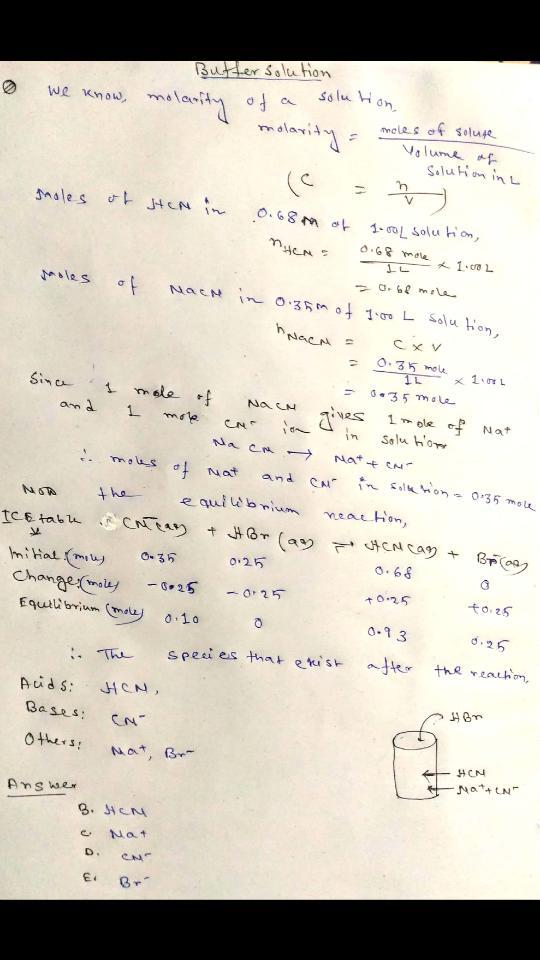
g A 0.25 mol sample of HBr is added to a 1.00 L buffer solution consisting of 0.68 M HCN and 0.35 M NaCN. Identify all species t
salantis [7]

Answer:

See explaination for details and diagram

Explanation:

We can say that Chemical reaction is a process in which one or more substances, the reactants, are converted to one or more different substances, the products. Substances are either chemical elements or compounds.

A chemical reaction rearranges the constituent atoms of the reactants to create different substances as products.

See attachment for the buffer of the chemical reaction.

7 0
2 years ago
The pKs of succinic acid are 4.21 and 5.64. How many grams of monosodium succinate (FW = 140 g/mol) and disodium succinate (FW =
Varvara68 [4.7K]

Answer:

9.744g of monosodium succinate.

4.925g of disodium succinate.

Explanation:

To find pH of the buffer produced by the mixture of monosodium succinate-Disodium succinate is obtained from H-H equation:

pH = pKa + log ([Na₂Suc] / [NaHSuc])

As you want a pH of 5.28 and pKa is 5.64:

5.28 = 5.64 + log ([Na₂Suc] / [NaHSuc])

-0.36 = log ([Na₂Suc] / [NaHSuc])

0.4365 = ([Na₂Suc] / [NaHSuc]) <em>(1)</em>

<em />

As total concentration of the buffer is 100mM = 0.100M:

0.100M = [Na₂Suc] + [NaHSuc] <em>(2)</em>

Replacing (2) in (1):

0.4365 = (0.100M - [NaHSuc] / [NaHSuc])

0.4365 = (0.100M - [NaHSuc] / [NaHSuc])

0.4365 [NaHSuc] = 0.100M - [NaHSuc]

1.4365 [NaHSuc] = 0.100M

[NaHSuc] = 0.0696M

And:

[Na₂Suc] = 0.0304M

As volume of the buffer is 1L:

[NaHSuc] = 0.0696 moles

[Na₂Suc] = 0.0304 moles

Using molar mass of both substances:

Mass of monosodium succinate:

0.0696moles * (140g / 1mol) =<em> 9.744g of monosodium succinate.</em>

Mass of disodium succinate:

0.0304moles * (162g / 1mol) =<em> 4.925g of disodium succinate.</em>

<em></em>

5 0
2 years ago
How many moles of KCl will be<br> produced from 15.0 g of KClO3?
slega [8]

Answer:

0.12 mol KCl

Explanation:

2 KClO3 (s)   2 KCl (s) + 3 O2 (g)

15 g                x mol

x g KCl = 15 g KClO3 x[ (1 mol KClO3)/ (122.5 g KClO3) ] x [(2 mol KCl)/ (2 mol KClO3)]

x g KCl = 0.12 mol KCl

7 0
2 years ago
Read 2 more answers
Other questions:
  • Which isolated gaseous atom has a total of five electrons occupying spherically shaped orbitals?
    7·1 answer
  • A steam turbine is a device in which high-pressure steam enters the turbine and causes blades to spin. The spinning blades have
    15·2 answers
  • Butane (c4h10) undergoes combustion in excess oxygen to generate gaseous carbon dioxide and water. given δh°f[c4h10(g)] = –124.7
    11·1 answer
  • What is the empirical formula of a compound containing 90 grams carbon, 11 grams hydrogen, and 35 grams nitrogen? A. C3H4N B. C2
    6·1 answer
  • What type of bond holds amino acids together?
    14·2 answers
  • During chemistry lab, Mrs. Black’s students placed an antacid tablet in a zip lock bag. They recorded the mass of the tablet in
    13·1 answer
  • A mixture of ethyl alcohol (molecular mass = 46.1 u) and water (molecular mass = 18.0 u) contains one mole of molecules. The mix
    11·1 answer
  • The equilibrium reaction below has the Kc = 4.00 at 25°C. If the temperature of the system at equilibrium is increased to 100°C,
    11·1 answer
  • What it the oxidation number for bromine in the molecule H2Br2O6?
    5·1 answer
  • The table shows the densities of four samples, each of the same volume.
    15·2 answers
Add answer
Login
Not registered? Fast signup
Signup
Login Signup
Ask question!